“Die Stadt” is No. 11 from Franz Schubert’s posthumously published song cycle Schwanengesang D 957 (1828/29), after Heinrich Heine. Mist, water, distant towers: seen from the boat, the place of loss appears — and at the end the sun points out “that spot” where the beloved was lost. Schubert shapes this into a muted, through-composed nocturne in C minor, 3/4, rather slow: wave-like accompaniment figures, pallid harmony, and an in-one rowing stroke.
The Poem (Heinrich Heine – Buch der Lieder, 1827)
On the distant horizon
There appears, like an image in mist,
The town with its towers,
Wrapped in evening twilight.
A damp breath of wind ripples
The grey track of water;
With mournful rhythm the boatman rows
In my skiff.
The sun rises once again
Gleaming from the ground,
And shows me that spot
Where I lost my beloved.
Work Data & Overview
- Composer: Franz Schubert (1797–1828)
- Cycle: Schwanengesang D 957, No. 11 (Die Stadt)
- Text source: Heinrich Heine (1797–1856)
- Composition: 1828; First publication (posthumous): 1829
- Key / Meter / Tempo: C minor, 3/4, rather slow
- Duration: approx. 2:30–3:30 minutes
- Scoring: Voice and piano (transpositions common)
- Form: through-composed; three inner scenes (apparition – journey – pointer of light)
Poem Data
- Author: Heinrich Heine (1797–1856)
- Stanza form: 3 quatrains; regular, calm flow of verse
- Devices: mist metaphor, water imagery, deixis (“that spot”), final point (the place of loss)
Genesis & Cycle Context
Within the Heine group (Nos. 8–13), Die Stadt continues the line from Ihr Bild (inward gaze) and Das Fischermädchen (bright mask) into a nocturnal topography: distance becomes the scene of memory. It foreshadows the final darkening in Am Meer and Der Doppelgänger.
More on the song cycle: Schwanengesang – Overview.
Performance Practice & Reception
Pulse & diction: an in-one feeling (3/4) in a rather slow tempo; text delivered straight ahead, consonants soft, vowels covered. No broad wave: suspension before weight.
Piano texture: continuous, wavelike figures as water/mist coloring; transparent pedal, “matte” tone. The pointer of light (“The sun rises…”) is briefly colored, then withdrawn into the basic coolness.
Reference Recordings (Selection)
- Dietrich Fischer-Dieskau – Gerald Moore
- Matthias Goerne – Alfred Brendel
- Ian Bostridge – Julius Drake
- Christoph Prégardien – Andreas Staier (fortepiano)
- Thomas Quasthoff – James Levine
Analysis – Music
Image of Mist & Oar Stroke
The prelude draws a field of mist, from which the voice emerges like a distant silhouette. Even “rowing” impulses (3/4) carry the text; the sound avoids hard contours — seeing through haze.
Harmony, Form & Pointer of Light
Within the field of C minor, Schubert begins with floating tension (diminished seventh chords) and avoids a clear dominant for a long time — the town remains a vision. The through-composed design culminates in the brief illumination (“The sun rises…”), which immediately sinks back into dusk.
Visual Representation
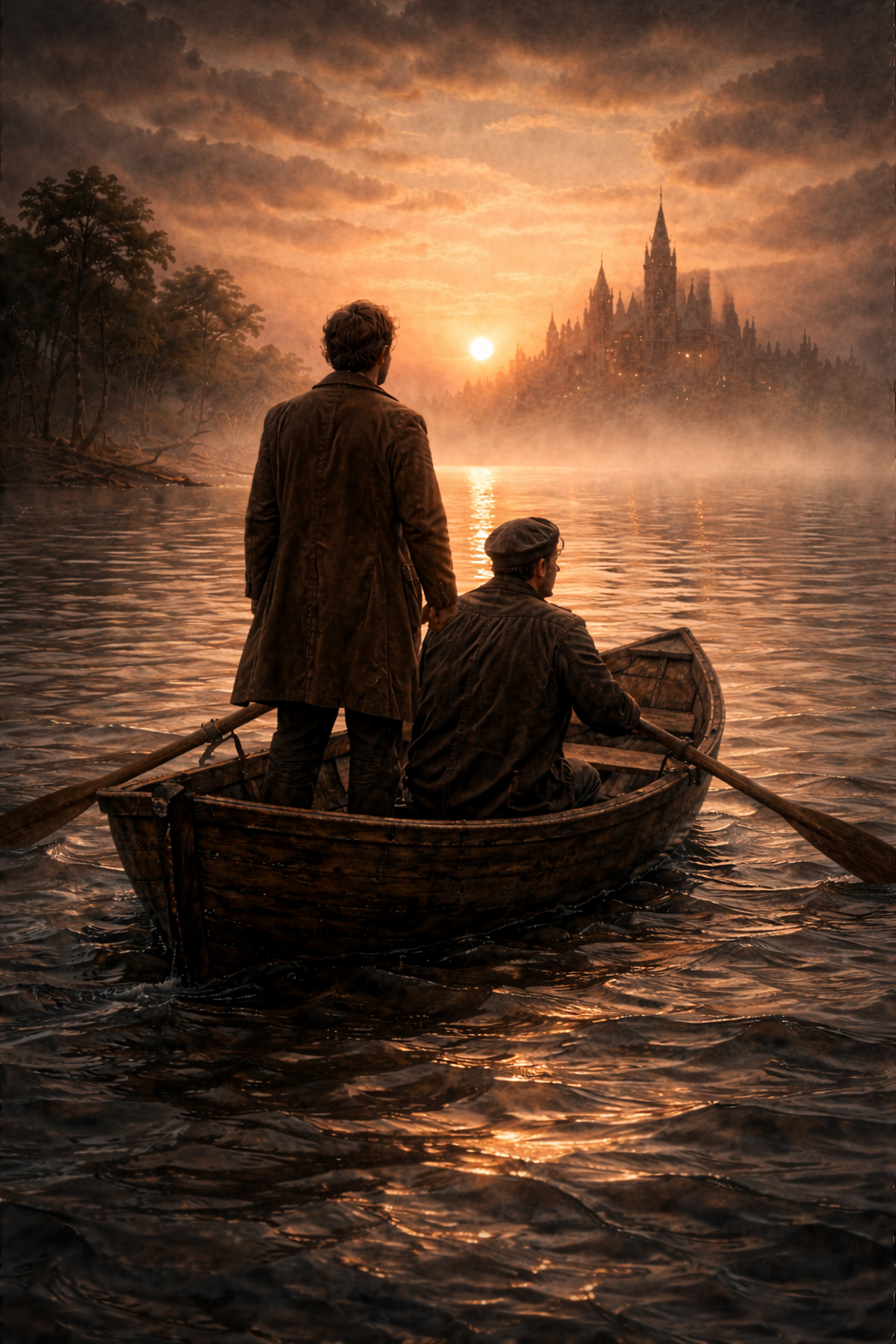
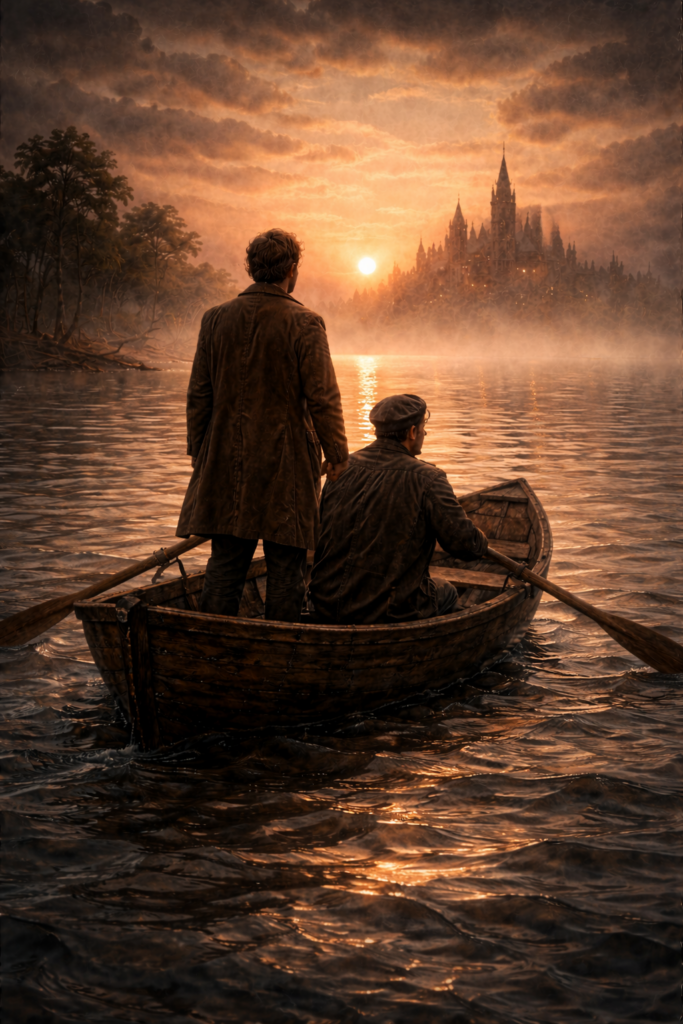
Artistic visualization by Evgenia Fölsche:
A still river reflects
the light of the setting
sun. In a narrow skiff
sits a man,
while a boatman rows him
quietly across the water.
The air is warm,
the light soft and golden.
Before them, on the distant shore,
the silhouette
of a town appears.
Roofs and towers glow
in the evening light, as though
secrets,
memories, and longing
were waiting there.
The movement of the water
is scarcely more than a whisper,
yet it carries the man
inexorably nearer
to the town.
The boatman remains calm,
as though the journey itself
were a state of suspension.
The image takes up
the wistful mood of the song:
like the wave-like
piano figures,
which constantly oscillate
between pressing onward
and remaining still,
the scene here hovers
between destination and memory.
The town in the light
of the evening sun becomes
the symbol of a place
that seems at once near
and unreachable —
an emblem of longing,
remembrance, and quiet
expectation.
Analysis – Poetry
Heinrich Heine’s poem “Die Stadt” belongs to the Heine group of Schwanengesang. It depicts a nocturnal boat journey across the water while, on the horizon, a town appears in the haze. The outer landscape becomes a mirror of an inner memory of lost love.
The first stanza opens with the image of the distant town:
On the distant horizon there appears, like an image in mist, the town with its towers, wrapped in evening twilight.
The town lies far away and appears only in outline. The comparison with an “image in mist” creates an atmosphere of vagueness and unreality. Already here it is suggested that this is not about a real arrival, but about a landscape of memory.
The second stanza introduces movement on the water:
A damp breath of wind ripples the grey track of water; with mournful rhythm the boatman rows in my skiff.
Wind, water, and darkness determine the scene. The boatman rows “with mournful rhythm” — the movement of the oars becomes an audible expression of melancholy. Outer world and feeling coincide.
The third stanza brings the inner reason for the journey to light:
The sun rises once again gleaming from the ground and shows me that spot where I lost my beloved.
The sun rises once more — a final illumination — and lights up a specific place: the site of loss. The outer moment of light becomes an inner flash of memory. The journey across the water thus becomes a journey into one’s own past.
Formally, the poem is simple and concentrated in imagery. Short, clear lines and reduced language create a quiet yet tense atmosphere. Movement and stillness, nearness and distance, light and darkness structure the speaker’s emotional condition.
Meaning & Effect within the Cycle
“Die Stadt” presents memory as an unavoidable return to the place of loss. The speaker travels across the water toward a town that is not a destination, but the trigger of a painful past.
Typical of the Heine songs, outer landscape merges with inner condition. Nature no longer offers consolation, but becomes the projection surface of spiritual isolation.
Within Schwanengesang, this song belongs among the darkest moments. After images of dream, vision, and wooing, memory now appears as the final, inescapable power.
Schubert intensifies the dark atmosphere musically through rigid accompaniment figures, weighty harmony, and an almost motionless vocal line — a soundscape of paralysis and inner coldness.
Evgenia Fölsche – Performances & Audio
Pianist Evgenia Fölsche keeps the surface glassy: calm in-one pulse, lean middle register, speech-close line — brief radiance, long twilight.
Audio example: Die Stadt with Dietrich Fischer-Dieskau and Gerald Moore
Concert Inquiry
Schwanengesang by Franz Schubert is part of Evgenia Fölsche’s Lied repertoire and is regularly performed in collaboration with renowned singers. Concert programs can be designed flexibly and adapted to different ensembles.
Evgenia Fölsche has collaborated, among others, with singers such as Benjamin Russell and Johann Kristinsson who include Schwanengesang in their repertoire.
Send concert inquiryFrequently Asked Questions about Schubert: “Die Stadt” (Schwanengesang No. 11)
Click on a question to reveal the answer.
Is “Die Stadt” strophic?
No: through-composed; the three quatrains are set as a continuous scene (apparition – journey – pointer of light).
What are the key, meter & tempo?
C minor, 3/4, rather slow with an in-one feeling (oar stroke).
How is the “image in mist” created musically?
Through soft, uniform waves in the accompaniment, the sparsest possible pedal, gentle consonants, and the avoidance of clear dominant cadences until the brief moment of light.