“Der Atlas” is No. 8 from Franz Schubert’s posthumously published song cycle Schwanengesang D 957 (1828/29), based on a poem by Heinrich Heine. The speaker casts himself as a titan bearing the “world of sorrows” — self-accusation, hubris, and collapse in eight lines. Schubert shapes this into a compressed, through-composed monodrama in G minor, 3/4, rather slow: hammering chords, abrupt register leaps, and an almost declamatory vocal line.
The Poem (Heinrich Heine – Buch der Lieder, 1827)
I, unhappy Atlas! A world,
the whole world of sorrows, I must bear.
I bear the unbearable, and my heart
is on the verge of breaking within my breast.
You proud heart! Yes, you wanted it.
You wanted to be happy, infinitely happy,
or infinitely miserable, proud heart.
And now you are miserable.
Work Data & Overview
- Composer: Franz Schubert (1797–1828)
- Cycle: Schwanengesang D 957, No. 8 (Der Atlas)
- Text source: Heinrich Heine (1797–1856)
- Composition: 1828; First publication (posthumous): 1829
- Key / Meter / Tempo: G minor, 3/4, rather slow
- Duration: approx. 2:00–2:45 minutes
- Scoring: Voice and piano (transpositions common)
- Form: through-composed; two contrasting stanzas (self-accusation → self-condemnation)
Poem Data
- Author: Heinrich Heine (1797–1856)
- Stanza form: 2 quatrains; masculine cadences, parallelisms
- Devices: mythological self-image (Atlas), hyperbole, antithesis of happiness/misery, apostrophe to the “proud heart”
Genesis & Cycle Context
With Der Atlas, the Heine group (Nos. 8–13) begins — the cycle suddenly tips into darkness: self-mythologization instead of natural idyll, harsh verticalities instead of flowing texture. This number serves as a portal into the Heine dramaturgy (Ihr Bild, Die Stadt, Am Meer, Der Doppelgänger): love as doom, not as consolation.
More on the cycle: Schwanengesang – Overview.
Performance Practice & Reception
Pulse & diction: a heavy 3/4 beat, felt as one pulse to the bar; consonants sharp, vowels firm and full-bodied. No “operatic” widescreen — the force arises from compactness.
Piano texture: compressive block chords (martellato) and tension-filled inner sonorities; pedal used sparingly. Warmth, if at all, only as a pain color on “heart” / “miserable,” never as relaxation.
Reference Recordings (Selection)
- Dietrich Fischer-Dieskau – Gerald Moore
- Ian Bostridge – Julius Drake / Antonio Pappano
- Matthias Goerne – Alfred Brendel
- Christoph Prégardien – Michael Gees / Andreas Staier (fortepiano)
- Jonas Kaufmann – Helmut Deutsch
Analysis – Music
Titanic Gesture & “Weight” Chords
From the very first bar: impact blocks in the piano that make the act of “bearing” physical. The voice hurls out brief cries (“Atlas!”, “world”), then falls back into declamatory depth; the pulse remains pressed down — weight instead of flow.
Harmony, Form & Falling Figure
Within the field of G minor, Schubert stretches harsh tension degrees (among other things via the augmented third / III+) against the tonic — the vertical element cuts into time. The second stanza shifts the energy inward (apostrophe “proud heart”), and the cadence breaks without redemption: Atlas remains under the burden.
Visual Representation
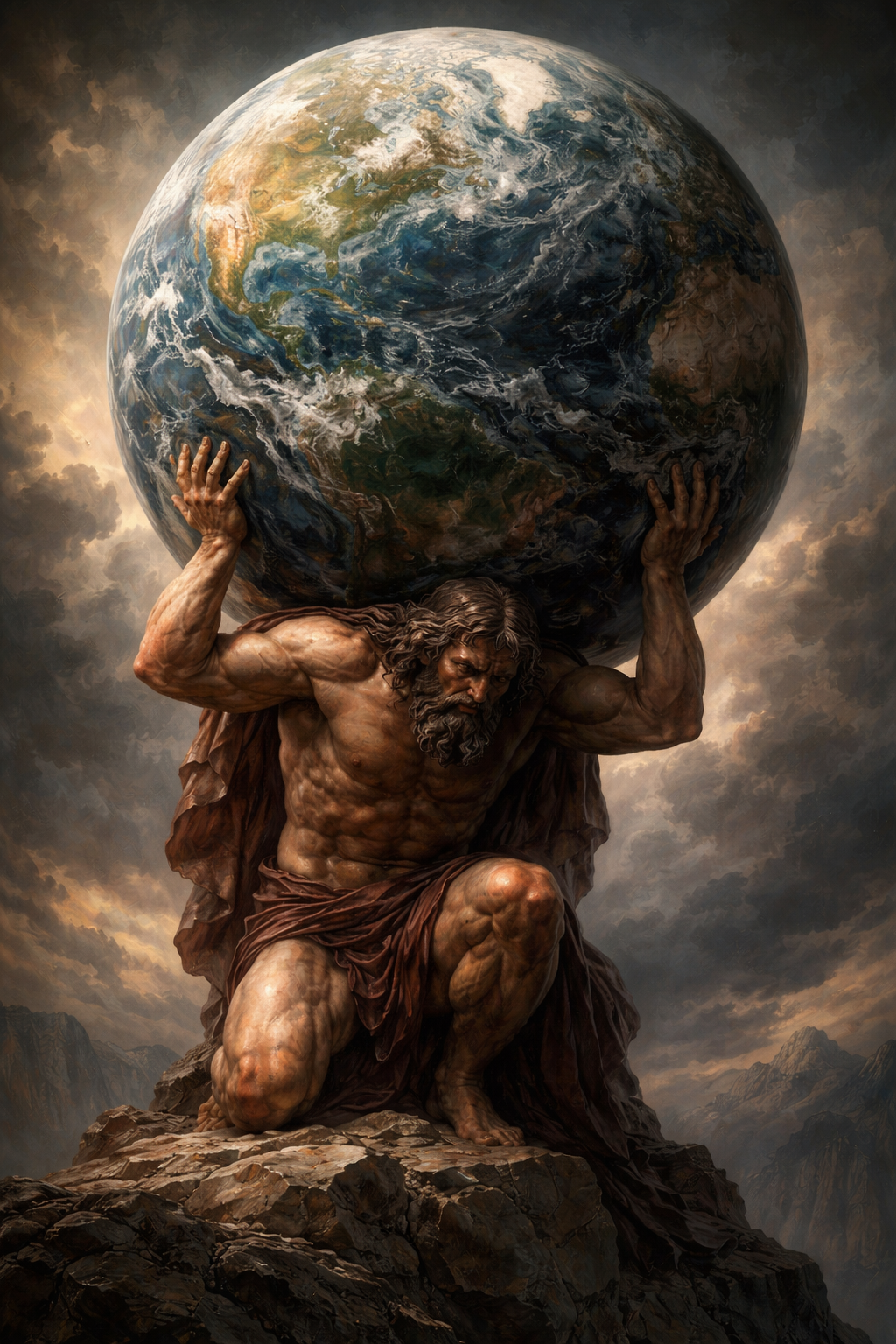
Artistic visualization by Evgenia Fölsche:
The figure of Atlas stands
at the center of the image.
Heavily burdened, he carries
the Earth upon his shoulders.
His body is tense,
the muscles stand out
under the weight.
The sphere above him appears
overwhelming — not only
physically, but also
symbolically.
It stands for the sum
of all experiences,
all disappointments,
all unbearable
memories.
The background remains
reduced, almost empty.
The focus lies entirely
on the figure and
its existential burden.
No way out is visible,
no support except
one’s own resistance.
In the song, Schubert
transforms this inner burden
into eruptive sound gestures.
The piano strikes
with massive chords,
as though it too carried
the weight of the world.
The vocal line rises
dramatically,
almost accusatory,
shot through with
inner tension.
The mythological figure
thus becomes an image
of the suffering self.
Personal experience
is heightened into the
superhuman —
pain becomes
cosmic.
The image condenses this
elevation:
the human being bears not only
his own fate,
but the world.
What becomes audible in the music
as dramatic intensification
appears here visibly —
as a moment of utmost
tension,
in which burden and
self-assertion
are inseparably joined.
Analysis – Poetry
Heinrich Heine’s poem “Der Atlas” belongs to the late Heine songs of Schwanengesang. It takes up the myth of the titan Atlas, condemned to bear the world on his shoulders. This mythic figure becomes the image of the suffering self, carrying the burden of an unbearable emotional world.
The first stanza begins with self-comparison:
I, unhappy Atlas! A world, the whole world of sorrows, I must bear.
The speaker identifies himself immediately with Atlas. But instead of the real world he bears a “world of sorrows” — the burden is emotional, not physical. The exaggeration rises into the cosmic: individual suffering is given universal dimension.
The following lines describe the effect of this burden:
I bear the unbearable, and my heart is on the verge of breaking within my breast.
The language is drastic and direct. The heart threatens to break — an image of total inner overload. Unlike Romantic nature lyric, no consoling outer world appears here. The poem unfolds exclusively in the realm of inner pain.
The second stanza turns unexpectedly against the heart itself:
You proud heart! Yes, you wanted it.
The heart is personified and accused. The speaker assigns it responsibility for his own condition. It wanted to be “infinitely happy” or “infinitely miserable” — the boundlessness of feeling is exposed as the cause of suffering.
The closing line draws the bitter consequence:
And now you are miserable.
The tone is hard, sober, and resigned. No hope, no comfort, no escape. The poem ends in radical self-accusation and existential isolation.
Formally, the poem is brief, tightly constructed, and rhetorically powerful. Apostrophes (“You proud heart!”), intensifications, and absolute terms (“infinitely happy,” “infinitely miserable”) create a dramatic, almost theatrical intensity.
Meaning & Effect within the Cycle
“Der Atlas” marks in Schwanengesang the transition into the dark world of the Heine songs. Whereas the Rellstab songs are still shaped by Romantic nature and farewell scenes, a modern, psychologically sharpened inner world appears here.
The poem no longer presents love and longing as hope, but as destructive overload. The human being carries his feelings like a cosmic burden — without divine order, without any conferring of meaning.
Thus “Der Atlas” becomes a key piece of the cycle: it opens the perspective onto the following songs, dominated by abandonment, estrangement, and existential cold.
Schubert intensifies this poem musically through heavy chords, declamatory singing, and extreme expressive tension — a shattering image of the suffering human being at the end of the Romantic era.
Evgenia Fölsche – Performances & Audio
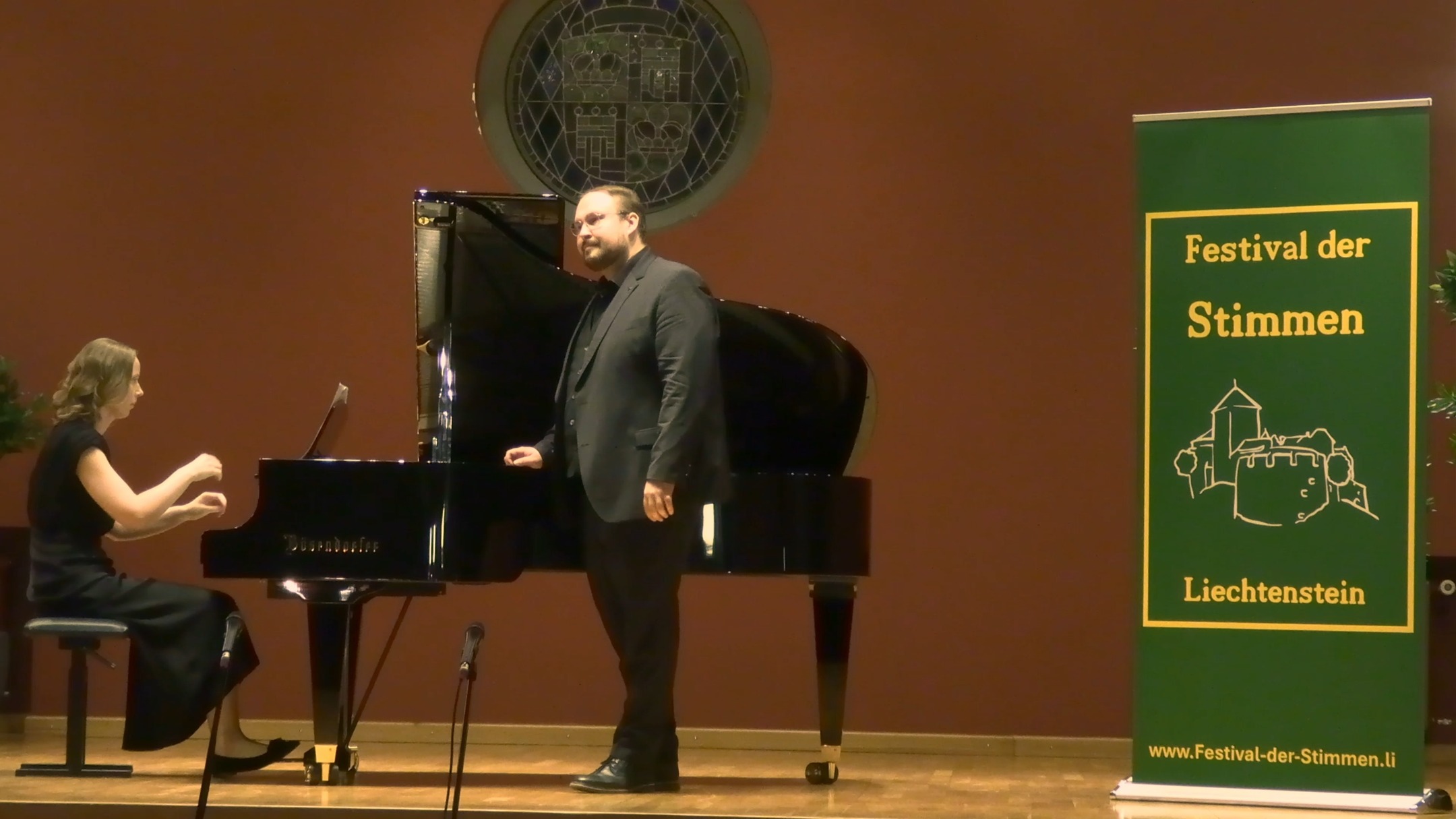
Pianist Evgenia Fölsche opts for compact verticalities, sparing use of pedal, and a speech-like sharpness: strength through concentration, not through volume.
Audio example: Der Atlas with Dietrich Fischer-Dieskau and Gerald Moore
Concert Inquiry
Schwanengesang by Franz Schubert is part of Evgenia Fölsche’s Lied repertoire and is regularly performed in collaboration with renowned singers. Concert programs can be designed flexibly and adapted to different ensembles.
Evgenia Fölsche has collaborated, among others, with singers such as Benjamin Russell and Johann Kristinsson who include Schwanengesang in their repertoire.
Send concert inquiryFrequently Asked Questions about Schubert: “Der Atlas” (Schwanengesang No. 8)
Click on a question to reveal the answer.
Is “Der Atlas” strophic?
No: through-composed; the two Heine stanzas receive independent musical profiles.
What are the key and meter?
G minor, 3/4, rather slow; a heavy one-beat-per-bar character with block chords.
What does the Atlas myth mean in the song?
It is a self-image: the speaker declares his suffering to be a cosmic burden — and Heine’s twist turns it into self-inflicted guilt (“proud heart”).