“Abschied” is No. 7 from Franz Schubert’s posthumously published song cycle Schwanengesang D 957 (1828/29), based on a poem by Ludwig Rellstab. A cheerful tone covers the separation: “Farewell, you lively, cheerful town” – the little horse paws the ground, the singer keeps his composure. Schubert shapes this as a strophic travel song in E-flat major, 2/4, moving, lightly springing: buoyant chordal strokes and light phrases – a carefree face over a wounded core.
The Poem (Ludwig Rellstab: Gedichte - Erstes Bändchen, Berlin 1827)
Farewell, you lively, cheerful town, farewell!
Already my little horse paws with merry hoof;
Now take my last, my parting greeting.
You have surely never seen me sad,
And so it cannot happen now at parting.
Farewell, you lively, cheerful town, farewell!
Farewell, you trees, you gardens so green, farewell!
Now I ride along the silver stream,
Far resounding rings my song of farewell;
You have never heard a song of lament,
And so none shall be bestowed on you at parting.
Farewell, you trees, you gardens so green, farewell!
Farewell, you friendly maidens there, farewell!
Why do you look out from the flower-scented house
With roguish, enticing glances?
As before, so I greet and look around,
Yet never again do I turn my little horse back.
Farewell, you friendly maidens there, farewell!
Farewell, dear sun, now you go to rest, farewell!
Now the gold of the sparkling stars begins to shimmer.
How dear to me you little stars in the sky are;
Though we may roam the world far and wide,
You give us faithful company everywhere.
Farewell, dear sun, now you go to rest, farewell!
Farewell, you bright little shining window, farewell!
You gleam so cozily in the dim light,
And invite us so kindly into the little cottage.
Ah, I rode past so many a time,
And might it then be today for the last time?
Farewell, you bright little shining window, farewell!
Farewell, you stars, veil yourselves in gray! – Farewell!
The little window’s dim, shimmering light
Cannot be replaced for me by you countless stars;
If I may not linger here, must pass on by,
What use is it to me, however faithfully you follow!
Farewell, you stars – veil yourselves in gray! – Farewell!
Work Data & Overview
- Composer: Franz Schubert (1797–1828)
- Cycle: Schwanengesang D 957, No. 7 (Abschied)
- Text source: Ludwig Rellstab (1799–1860)
- Composition: 1828; First publication (posthumous): 1829
- Key / Meter / Tempo: E-flat major, 2/4, moving, lightly springing
- Duration: approx. 3:30–4:30 minutes
- Scoring: Voice and piano (transpositions common)
- Form: strophic (several stanzas with recurring “Ade” framing line)
Poem Data
- Author: Ludwig Rellstab (1799–1860)
- Stanza form: 6 six-line stanzas; refrain-like return of the opening line
- Devices: anaphoras (“Ade” / “Farewell”), dialogue with nature and place, cheerful mask over separation, riding imagery
Genesis & Cycle Context
Within the Rellstab group (Nos. 1–7), Abschied stands as a bright clearing-piece after the darkening of In der Ferne and the immobile Aufenthalt. Dramaturgically, it functions as the “scherzo of the travel theme”: outward swing, inward renunciation – before the Heine group unfolds the shadow side.
More on the song cycle in the overview: Schwanengesang – Overview.
Performance Practice & Reception
Pulse & diction: springing 2/4 with clear, short consonants; a smile in the voice, no hardening. The tone remains light – the irony is taken care of by the text.
Piano texture: sturdy chordal strokes and bouncing bass notes as a “riding” gesture; use pedal sparingly, articulation dry. Tiny brightenings on greeting and window words; never make the refrain “broad.”
Reference Recordings (Selection)
- Dietrich Fischer-Dieskau – Gerald Moore
- Mark Padmore – Mitsuko Uchida
- Christoph Prégardien – Andreas Staier (fortepiano)
- Peter Schreier – András Schiff
- Thomas Quasthoff – Justus Zeyen
Analysis – Music
“Riding” Gesture & Chordal Strokes
Even, short-articulated chords provide the “trot”: the voice phrases syllabically and forward, with small leaps on greeting words. The smile is set in place – each stanza begins as though riding off anew.
Harmony, Form & Bright Mask
Within the field of E-flat major, dominant and mediant excursions provide brilliance without clouding the basic brightness. The strophic design stabilizes the appearance: a cheerful frame in which individual words (“last greeting,” “little window”) let the wound glimmer through.
Visual Representation
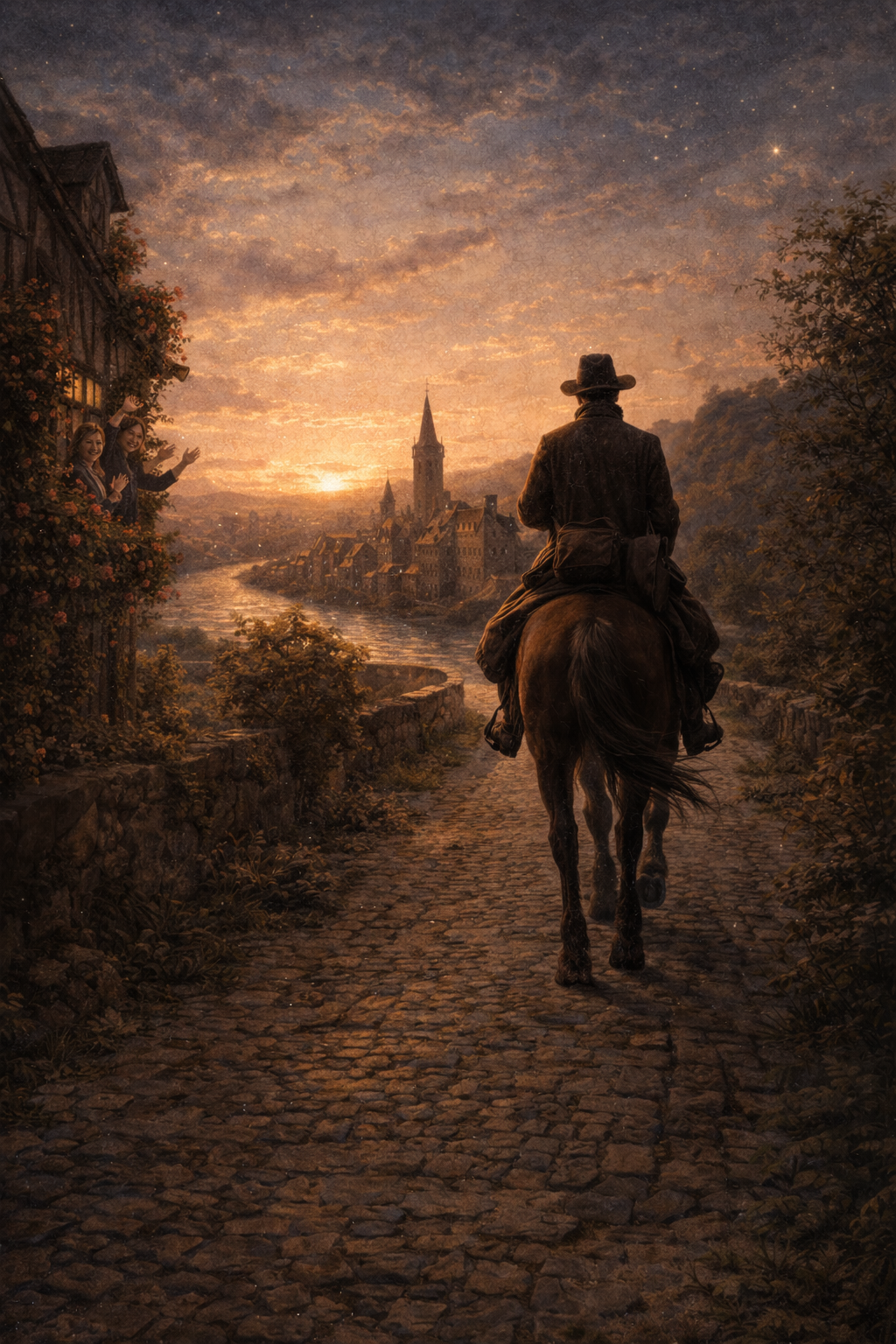
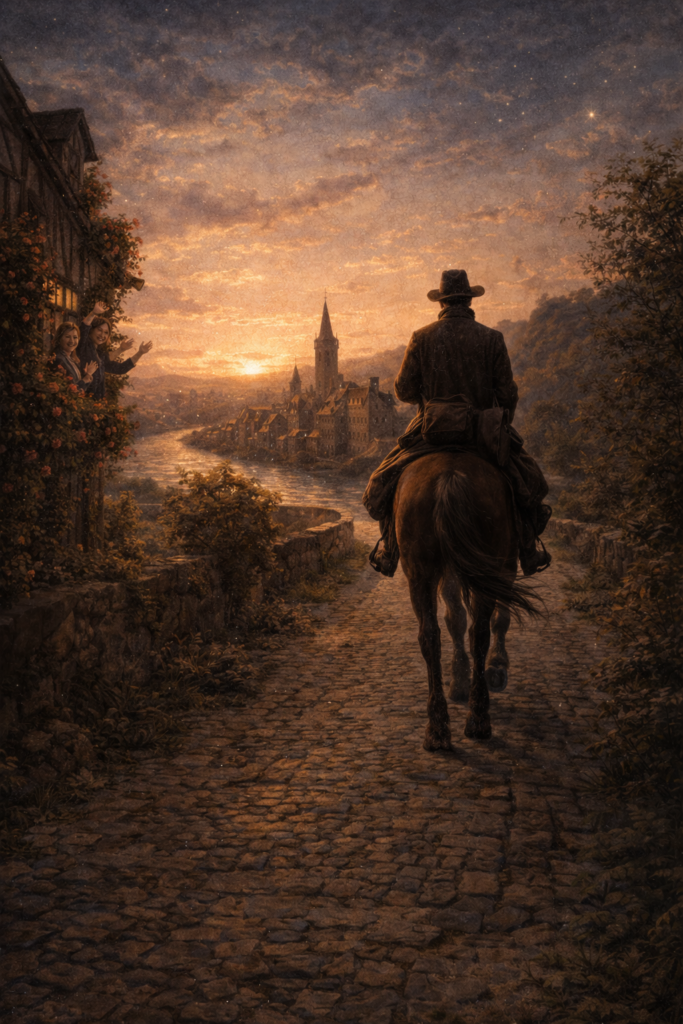
Artistic visualization by Evgenia Fölsche:
In the twilight there emerges
the silhouette of a
solitary rider.
The road lies quiet
before him, while the
evening light bathes the sky
in warm, fleeting colors.
The moment does not feel
dramatic, but rather
resolute. The rider
does not turn around.
His path leads forward,
even if the direction
remains uncertain.
The evening twilight
marks a threshold:
between day and night,
lingering and departure,
nearness and distance.
The light is still there,
but it is fading.
In the song itself,
farewell appears not as
lamenting resignation,
but as a moving,
almost cheerful act
of continuing onward.
The piano unfolds
rhythmic energy
that recalls the horse’s
steady step.
Above this movement
the voice rises
with lightness and
inner tension.
Farewell here is
not standstill,
but motion.
It carries sadness,
but also self-assertion
within it.
The image condenses
this ambivalence:
loneliness and resolve,
melancholy and departure
stand side by side.
The rider does not vanish
into the darkness –
he rides into it.
Thus the road becomes
a symbol of moving on.
What becomes audible
in Schubert’s music
as springing rhythm
and luminous energy
appears here visibly –
as a quiet resolve
to direct one’s gaze forward,
even in the half-light.
Analysis – Poetry
Ludwig Rellstab’s poem “Abschied” belongs to the Rellstab songs of Schwanengesang. It portrays a rider leaving a familiar environment and taking leave, in quick succession, of town, nature, people, and heavenly bodies. The progressive farewell creates a movement from outward cheerfulness toward inner uncertainty.
The first stanza opens with the farewell to the town:
Farewell, you lively, cheerful town, farewell!
Already my little horse paws with merry hoof;
Now take my last, my parting greeting.
You have surely never seen me sad,
And so it cannot happen now at parting.
Farewell, you lively, cheerful town, farewell!
The town is addressed as a living counterpart. The speaker emphasizes his cheerful appearance and avoids visible sorrow. Yet the pawing horse signals urgency – the farewell is not calm, but shaped by an inner pressure to depart.
The second stanza turns to nature:
Farewell, you trees, you gardens so green, farewell!
Now I ride along the silver stream,
Far resounding rings my song of farewell;
You have never heard a song of lament,
And so none shall be bestowed on you at parting.
Farewell, you trees, you gardens so green, farewell!
Trees and gardens appear as familiar companions. The farewell song resounds far and wide – yet the speaker insists that he is not singing a lament. This demonstrative cheerfulness functions like self-protection against rising melancholy.
The third stanza addresses people:
Farewell, you friendly maidens there, farewell!
Why do you look out from the flower-scented house
With roguish, enticing glances?
As before, so I greet and look around,
Yet never again do I turn my little horse back.
Farewell, you friendly maidens there, farewell!
The exchange of glances with the maidens recalls human nearness and temptation. Yet the rider no longer turns his horse around. Here the finality of the farewell is stated explicitly for the first time.
In the fourth stanza, sun and stars appear:
Farewell, dear sun, now you go to rest, farewell!
Now the gold of the sparkling stars begins to shimmer.
How dear to me you little stars in the sky are;
Though we may roam the world far and wide,
You give us faithful company everywhere.
Farewell, dear sun, now you go to rest, farewell!
The day’s transition from sun to stars accompanies the journey into night. The stars appear as faithful companions to the wanderer – a Romantic image of cosmic connectedness.
The fifth stanza introduces a single window:
Farewell, you bright little shining window, farewell!
You gleam so cozily in the dim light,
And invite us so kindly into the little cottage.
Ah, I rode past so many a time,
And might it then be today for the last time?
Farewell, you bright little shining window, farewell!
The window symbolizes human warmth and shelter. The rider has so often passed by it – perhaps today for the last time. The motif of unattainable domesticity emerges.
The sixth stanza closes with a surprising turn:
Farewell, you stars, veil yourselves in gray! – Farewell!
The little window’s dim, shimmering light
Cannot be replaced for me by you countless stars;
If I may not linger here, must pass on by,
What use is it to me, however faithfully you follow!
Farewell, you stars – veil yourselves in gray! – Farewell!
The stars, just now faithful companions, are now told to veil themselves. The light of the little window is extinguished, and orientation is lost. The previously asserted cheerfulness collapses – what remains is loneliness and uncertainty.
Formally, the poem is strictly strophic, with refrain-like repetition of “Ade.” This circular form intensifies the sense of ritualized farewell – yet with each stanza the emotional tension grows denser.
Meaning & Effect within the Cycle
“Abschied” shows the moment of departure as a mixture of demonstrative cheerfulness and hidden despair. The speaker takes leave of world and people without naming his destination. That is precisely what gives the scene its existential openness.
Characteristically for Romantic poetry, nature becomes a mirror of inner states: town, gardens, sun, stars, and window appear as stations of a psychological journey from the outer world into the inner one.
Within Schwanengesang, the song stands at the threshold between the songlike scenes of the Rellstab group and the later Heine songs. It prepares the darker, more existential world of the songs that follow.
Thus “Abschied” becomes a musical-poetic representation of restless being-on-the-way – a farewell without arrival, typical of late Schubert.
Evgenia Fölsche – Performances & Audio
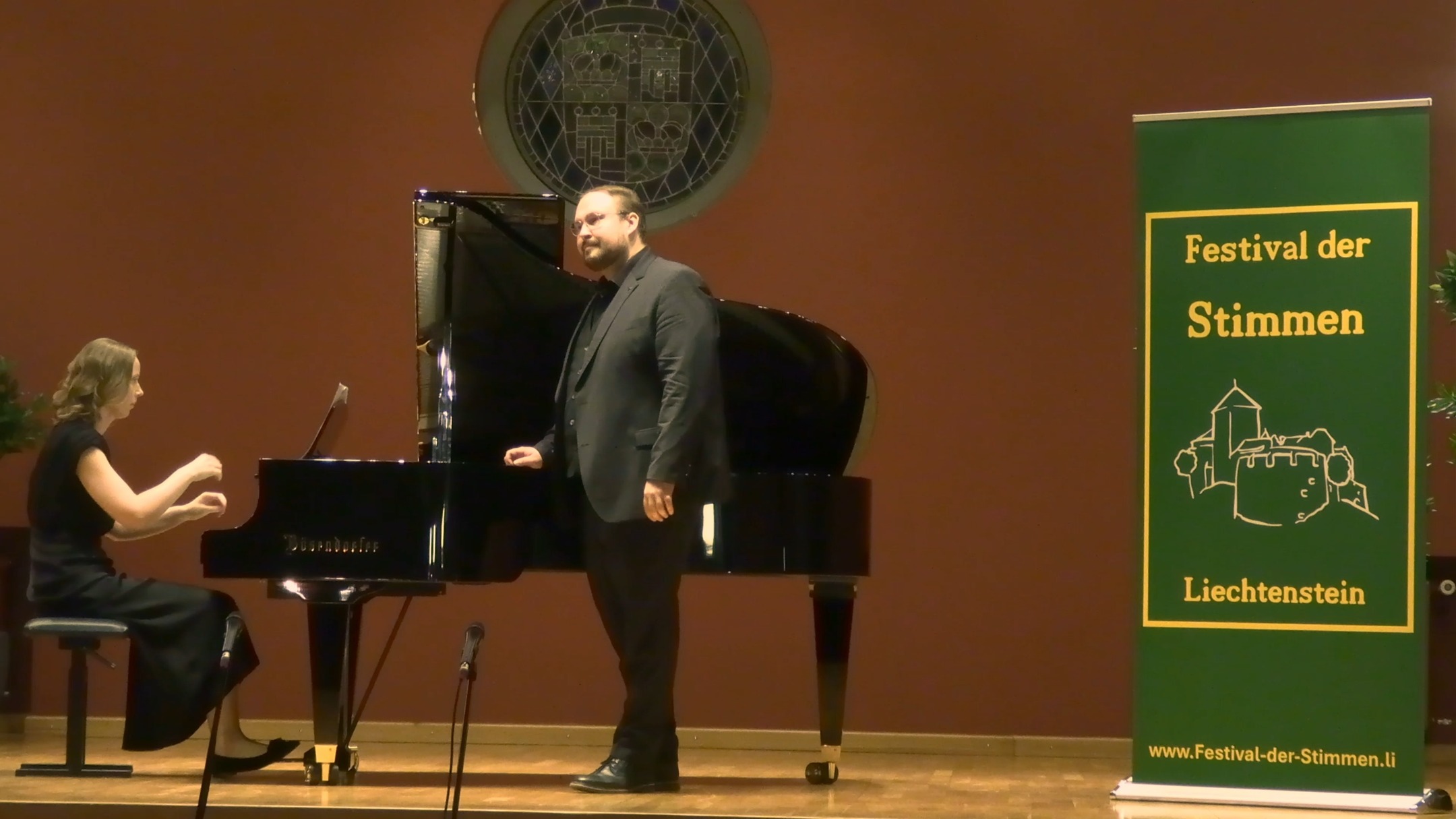
Pianist Evgenia Fölsche keeps the tone lightly springing and dry: crisp chords, lean middle register, speech-close line – elegance instead of urgency.
Audio example: Abschied with Dietrich Fischer-Dieskau and Gerald Moore
Concert Inquiry
Schwanengesang by Franz Schubert is part of Evgenia Fölsche’s Lied repertoire and is performed regularly in collaboration with renowned singers. Concert programs can be designed flexibly and adapted to different ensembles.
Evgenia Fölsche has collaborated, among others, with singers such as Benjamin Russell and Johann Kristinsson who include Schwanengesang in their repertoire.
Send concert inquiryFrequently Asked Questions about Schubert: “Abschied” (Schwanengesang No. 7)
Click on a question to reveal the answer.
Is “Abschied” strophic?
Yes: strophic with a recurring “Ade” framing line; each stanza varies the scene (town, nature, maidens, sun/stars, window).
What are the key and character?
E-flat major, 2/4, moving; springing chordal strokes and syllabic vocal writing – a cheerful appearance over the pain of farewell.
How much tempo and rubato?
Prefer light and elastic rather than fast: an even pulse, only small breathing expansions at caesuras (“Ade,” “little window”); no broad ritardandi in the refrain.