“Frühlingssehnsucht” is No. 3 from Franz Schubert’s posthumously published song cycle Schwanengesang D 957 (1828/29), based on a poem by Ludwig Rellstab. Between awakening nature and inner unrest, the speaker asks ever more urgently, “Where to? … Downward? … Why? … And you?” – until the final intensification: “Only you!” Schubert shapes this into a restless, through-composed panorama of nature and the heart in B-flat major, 3/4, lively, with a springing step: undulating accompanimental figures, bright glints of light – yet beneath the surface longing presses forward.
The Poem (Ludwig Rellstab: Gedichte - Erstes Bändchen, Berlin 1827)
Whispering breezes,
blowing so gently,
filled with the breath
of flowery scents!
How blissfully you breathe your greeting upon me!
What have you done to my throbbing heart?
It longs to follow you on airy paths!
Where to?
Little brook, so lively,
murmuring all the more,
surging downward
silver into the valley.
The hovering wave, there it hastens away!
Meadows and sky are deeply mirrored in it.
Why do you draw me, longing, desirous spirit,
Downward?
Playful gold
of the greeting sun,
graciously you bring
hopeful delight.
How your blessedly greeting image refreshes me!
It smiles so gently in the deep blue sky,
and has filled my eyes with tears! –
Why?
Greening, it wreathes
forests and heights,
shimmering, it glistens,
snow of blossoms!
Thus everything presses toward bridal light;
the seeds swell, the bud bursts;
they have found what they were lacking:
And you?
Restless longing!
yearning heart,
always only tears,
lament and pain?
I too am conscious of swelling impulses!
Who will at last still this urgent desire in me?
Only you can free the springtime in my breast,
Only you!
Work Data & Overview
- Composer: Franz Schubert (1797–1828)
- Cycle: Schwanengesang D 957, No. 3 (Frühlingssehnsucht)
- Text source: Ludwig Rellstab (1799–1860)
- Composition: 1828; First publication (posthumous): 1829
- Key / Meter / Tempo: B-flat major, 3/4, lively, pressing forward
- Duration: approx. 3:20–4:30 minutes
- Scoring: Voice and piano (transpositions common)
- Form: through-composed; succession of stanzas with recurring question-cadences
Poem Data
- Author: Ludwig Rellstab (1799–1860)
- Stanza form: 5 six-line stanzas with refrain-like interjections (“Where to? / Downward? / Why? / And you? / Only you!”)
- Devices: personifications of nature (air, brook, sun), anaphoras, climax of interrogative particles culminating in the resolving formula “Only you!”
Genesis & Cycle Context
Within the Rellstab group (Nos. 1–7), Frühlingssehnsucht forms the motoric contrast to the tender Liebesbotschaft and to the nocturnal Kriegers Ahnung. The song layers external images (wind – water – sun – blossom) into a psychological intensification that culminates in the personal cry “Only you!” – foreshadowing the later sharpening of the cycle in the Heine group.
More on the song cycle: Schwanengesang – Overview.
Performance Practice & Reception
Pulse & diction: an elastic 3/4 step with a clear forward pull; consonants springing, no over-broad phrasing – the question particles (Where to / Downward / Why / And you) as precise points of articulation.
Piano texture: undulating sixteenth-note motion and sparkling upper voices; transparent pedal, finger legato. Slight brightening of color on “gold,” “snow of blossoms,” and denser coloring on “tears,” “urgent desire.”
Reference Recordings (Selection)
- Dietrich Fischer-Dieskau – Gerald Moore
- Ian Bostridge – Julius Drake / Graham Johnson
- Christoph Prégardien – Michael Gees / Andreas Staier (fortepiano)
- Gerald Finley – Julius Drake
- Jonas Kaufmann – Helmut Deutsch
Analysis – Music
Flow, Brilliance & Interrogative Particles
The left hand establishes a walking / wave pulse, while the right sparkles in arpeggiated shimmer (wind / sun / water). At the end of each stanza, short question-cadences gather the energy into flaring interjections – musical question marks that immediately propel the motion onward.
Harmony, Form & Logic of Intensification
Within the field of B-flat major, dominant and mediant side-glances open luminous windows; the through-composed design arranges five natural scenes into a climax that concludes with the personal solution “Only you!” The final line condenses rhythm and register – answer as cry.
Visual Representation
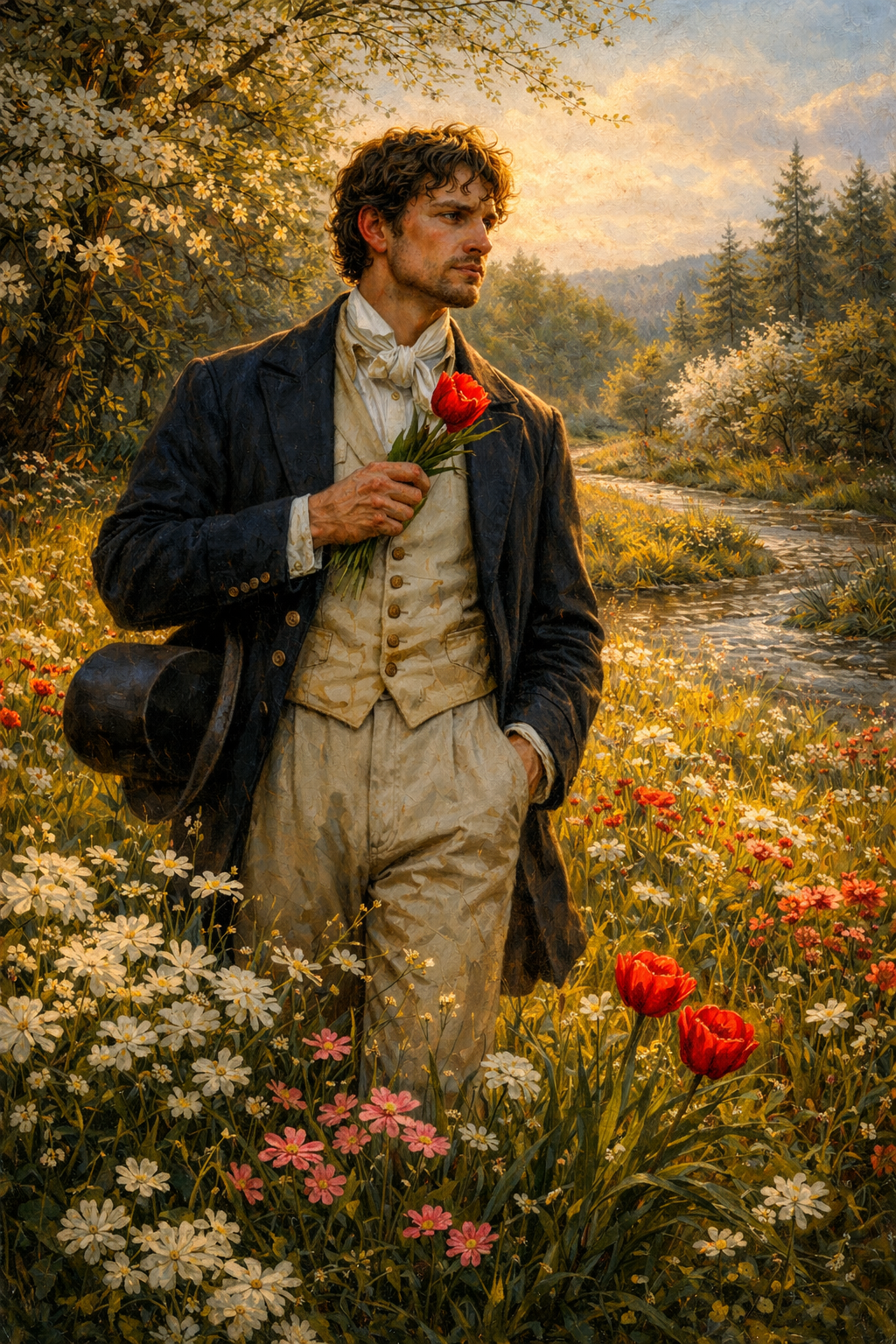
Artistic visualization by Evgenia Fölsche:
A man stands amid
a wide field
filled with countless flowers
in glowing colors.
The landscape seems
permeated by the light
of spring –
clear, mobile, and alive.
In his hand he holds
a red tulip.
Its strong hue
stands out clearly
from the surrounding blossoms.
It appears like a
concentrated sign
of his inner feeling –
passion,
hope, and
longing expectation.
His gaze turns into the distance.
He does not linger in the moment,
but seems moved by
an inward urge.
The nature around him
stands in full bloom,
and yet in his posture
there is unrest,
a striving beyond
the visible.
The image takes up
the impetuous movement of the song.
Like the forward-driving
piano figures,
which hardly ever come to rest,
everything here too
seems suspended in expectation.
Spring is not merely
a season,
but an inner state –
a new beginning,
borne by longing
for closeness,
fulfillment,
and living love.
Analysis – Poetry
Ludwig Rellstab’s poem “Frühlingssehnsucht” belongs to the most passionate songs of Schwanengesang. It unfolds a sequence of natural images, all directed toward motion, emergence, and renewal. Yet in the end, the gaze turns inward again: behind awakening nature stands the human being’s unfulfilled longing for love.
The first stanza opens with the image of the spring breezes:
Whispering breezes, blowing so gently,
filled with the breath of flowery scents!
How blissfully you breathe your greeting upon me!
What have you done to my throbbing heart?
It longs to follow you on airy paths!
Where to?
Scent, air, and breath are described as sensual forces that set the heart in motion. The question “Where to?” marks the first open cry for direction and destination. Nature here acts as the immediate trigger of inner unrest.
The second stanza continues the motif of movement with the brook:
Little brook, so lively, murmuring all the more,
surging downward silver into the valley.
The hovering wave, there it hastens away!
Meadows and sky are deeply mirrored in it.
Why do you draw me, longing, desirous spirit,
Downward?
The brook becomes a mirror of the speaker’s own longing. Its downward movement draws him along with it. Landscape and soul merge: outer world and inner world form a field of resonance for the same unrest.
In the third stanza, the sun appears:
Playful gold of the greeting sun,
graciously you bring hopeful delight.
How your blessedly greeting image refreshes me!
It smiles so gently in the deep blue sky,
and has filled my eyes with tears! –
Why?
Light becomes the promise of happiness. Yet the overwhelming experience of nature leads not to fulfillment but to tears. The question “Why?” opens the existential dimension: nature knows fulfillment, while the human being remains behind asking.
The fourth stanza intensifies the spring image:
Greening, it wreathes forests and heights,
shimmering, snow of blossoms glistens!
Thus everything presses toward bridal light;
the seeds swell, the bud bursts;
they have found what they were lacking:
And you?
The whole of nature presses toward fulfillment: seeds burst, blossoms open, everything finds “what was lacking to it.” The final question “And you?” turns sharply toward the self – only the human being remains unfinished.
The fifth stanza finally names the inner core:
Restless longing! yearning heart,
always only tears, lament and pain?
I too am conscious of swelling impulses!
Who will at last still this urgent desire in me?
Only you can free the springtime in my breast,
Only you!
The speaker recognizes his own longing as the poem’s true center. Nature has already accomplished spring – but within the heart, only the beloved can release it. The final line gathers all previous images of motion into a single cry for love.
Formally, the poem is structured by questions closing each stanza. In this way, a progressing inner monologue arises, leading from external natural images toward inward recognition.
Meaning & Effect within the Cycle
“Frühlingssehnsucht” traces a great movement from awakening nature to the awakening heart. The world stands under the sign of spring, emergence, and renewal – and yet the human being remains trapped in unfulfilled longing.
Within Schwanengesang, the song forms the passionate counterpole to the quiet intimacy of Liebesbotschaft and to the dark foreboding of death in Kriegers Ahnung. Here love is shown as a burning need still awaiting fulfillment.
Nature appears as the completed counter-image: seeds burst, blossoms open, light fills the world. The human being, however, experiences himself as unfinished as long as love remains unattained. The poem thus acquires an existential tension between cosmic harmony and personal lack.
In this way, “Frühlingssehnsucht” becomes a great Romantic allegory of desire: everything in nature strives toward completion – and the heart seeks its springtime in love.
Evgenia Fölsche – Performances & Audio
Pianist Evgenia Fölsche reads “Frühlingssehnsucht” as a forward gliding: lean middle register, speech-close articulation, clear accents on the questions – brilliance without sugar-coating.
Audio example: Frühlingssehnsucht with Dietrich Fischer-Dieskau and Gerald Moore
Concert Inquiry
Schwanengesang by Franz Schubert is part of Evgenia Fölsche’s Lied repertoire and is performed regularly in collaboration with renowned singers. Concert programs can be designed flexibly and adapted to different ensembles.
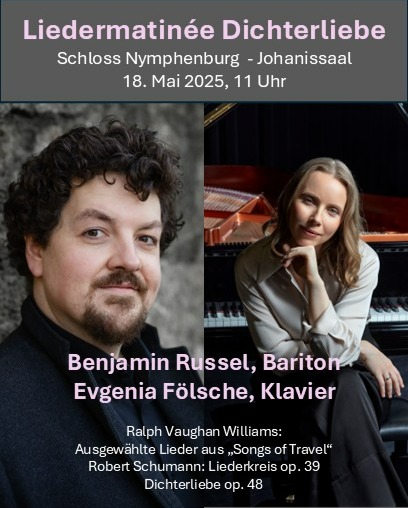
Evgenia Fölsche has collaborated, among others, with singers such as Benjamin Russell and Johann Kristinsson who include Schwanengesang in their repertoire.
Send concert inquiryFrequently Asked Questions about Schubert: “Frühlingssehnsucht” (Schwanengesang No. 3)
Click on a question to reveal the answer.
Is “Frühlingssehnsucht” strophic?
Not strictly: through-composed with a recurring question-gesture at the end of each stanza (“Where to? …”).
What are the key and meter?
B-flat major, 3/4, lively; undulating sixteenth notes in the piano create gestures of flow and wind.
How should the question words be shaped musically?
With clear caesuras, a slight dynamic peak, and an immediate return to the basic pulse – the question as impulse, not as operatic exclamation.