“Der Doppelgänger” is No. 13 from Franz Schubert’s posthumously published song cycle Schwanengesang D 957 (1828/29), based on a poem by Heinrich Heine. Deep night, an empty square before the beloved’s former house – in the moonlight, the speaker recognizes the figure staring upward as himself. Schubert condenses this into a time-suspended, through-composed chamber scene of terror in B minor, 4/4, very slow, as if petrified: a static carpet of chords above which the voice spirals upward toward its cutting realization.
The Poem (Heinrich Heine – Buch der Lieder, 1827)
Still is the night, the streets are at rest;
In this house my beloved once lived;
She has long since left the town,
Yet the house still stands in the selfsame place.
There too stands a man, staring upward,
Wrings his hands in the violence of pain;
I shudder when I see his face –
The moon shows me my very own form.
You double! you pale companion!
Why do you mimic my sorrow in love,
That tormented me on this very spot
Through many a night in times long past?
Work Data & Overview
- Composer: Franz Schubert (1797–1828)
- Cycle: Schwanengesang D 957, No. 13 (Der Doppelgänger)
- Text source: Heinrich Heine (1797–1856)
- Composition: 1828; First publication (posthumous): 1829
- Key / Meter / Tempo: B minor, 4/4, very slow
- Duration: approx. 2:30–3:30 minutes
- Scoring: Voice and piano (transpositions common)
- Form: through-composed; three scenes (place → apparition → address/recognition)
Poem Data
- Author: Heinrich Heine (1797–1856)
- Stanza form: 3 quatrains; even, calm cadence
- Devices: motifs of night and emptiness, the double motif, deixis (“this very spot”), and the twist of self-recognition
Genesis & Cycle Context
Der Doppelgänger concludes the Heine group (Nos. 8–13) by carrying its line of darkening to the extreme: after Die Stadt and Am Meer, there is now no outside world left – only the self as stranger. The song is the final image of the Heine complex: rigidity, recognition, and silence.
More on the cycle in the overview: Schwanengesang – Overview.
Performance Practice & Reception
Pulse & diction: an absolutely steady 4/4 foundation; consonants quietly sharp, vowels covered. No crescendo pathos: pressure through stillness.
Piano texture: static chordal fields (almost like an organ-point surface) with minimal internal shifts; pedal used sparingly, tone kept “dim.” The culmination lies on the address “Du Doppelgänger!” – followed by an immediate withdrawal.
Reference Recordings (Selection)
- Dietrich Fischer-Dieskau – Gerald Moore
- Matthias Goerne – Alfred Brendel
- Ian Bostridge – Julius Drake
- Christoph Prégardien – Andreas Staier (fortepiano)
- Gerald Finley – Julius Drake
Analysis – Music
Rigid Surface & the “Standstill” of Pain
Hardly any movement: the accompaniment holds chordal terraces, and time seems suspended. The voice rises out of this standstill – recitative-like, breaking out only at certain points (“Schmerzensgewalt,” “Doppelgänger!”) – and sinks back into rigidity.
Harmony, Form & the Shock of Recognition
Within the field of B minor, harsh tension-chords (including Neapolitan proximity and chromatic side-steps) create an unresolved gloom. The through-composed design leads from description of place to self-address; the ending refuses consolation – recognition without redemption.
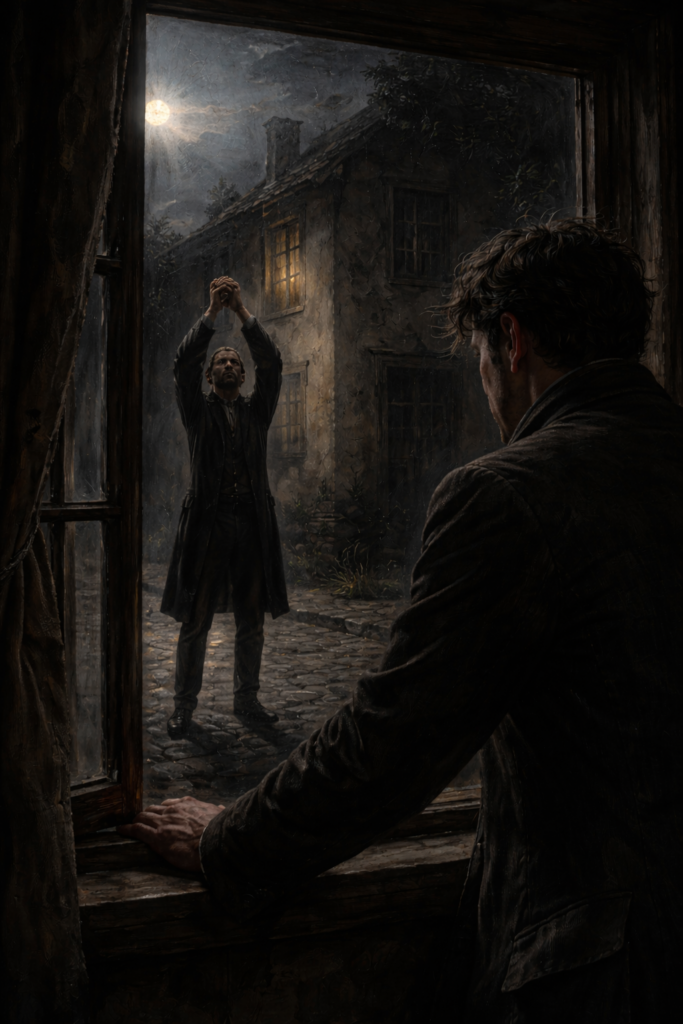
Visual Representation by Evgenia Fölsche

Artistic visualization:
A man stands in the darkness
of a room by the window.
His gaze is directed outward –
toward the night street,
which appears cold and empty.
The room behind him remains
in shadow, heavy and still.
Outside, however, he recognizes
himself.
Like a ghostly mirror image,
his double stands
in the street and raises
his arms upward
in silent lament.
The posture reveals
profound sorrow in love,
frozen within
a moment of pain.
Between inside and outside
an uncanny tension arises.
The window becomes a boundary
between present and memory,
between reality
and the inner abyss.
The man is at once
observer and
sufferer.
The image captures
the oppressive rigidity of the song.
Like the slow,
heavy chords in the piano,
which remain almost motionless,
time here too
seems to stand still.
No consolation, no movement –
only the relentless
confrontation
with one’s own pain.
The double becomes
a symbol
of inescapable memory
and existential loneliness.
Analysis – Poetry
Heinrich Heine’s poem “Der Doppelgänger” belongs to the Heine group of Schwanengesang and forms its dramatic conclusion. It presents a nocturnal vision in which the speaker encounters his own double. Past, present, and memory merge into a scene of existential self-alienation.
The first stanza opens a nocturnal landscape of remembrance:
Still is the night, the streets are at rest;
In this house my beloved once lived;
She has long since left the town,
Yet the house still stands in the selfsame place.
The town lies silent, deserted, and frozen. The house of the former beloved remains unchanged – a motionless relic of the past. The contrast between abandoned love and enduring place evokes memory with painful sharpness.
The second stanza introduces the uncanny apparition:
There too stands a man, staring upward,
Wrings his hands in the violence of pain;
I shudder when I see his face –
The moon shows me my very own form.
The speaker sees a man before the house, staring despairingly toward the sky. Only gradually does he recognize in the moonlight: it is his own face. The double appears as the embodiment of a former self that once endured the same suffering in this place. The horror arises from encountering one’s own past self.
The third stanza becomes a direct address:
You double! you pale companion!
Why do you mimic my sorrow in love,
That tormented me on this very spot
Through many a night in times long past?
The speaker addresses his mirror image. The double becomes the ghost of his own pain, reenacting the suffering of past love. The past is not overcome – it stands bodily before the self. The poem ends without resolution, only with the recognition of inescapable psychic repetition.
Formally, the poem is strictly built, with clear stanzas and simple language. It is precisely this sobriety that heightens the uncanny effect. Place, time, and identity begin to dissolve – a modern psychological nightmare.
Meaning & Effect within the Cycle
“Der Doppelgänger” portrays a human being confronted with his own past suffering. Love, memory, and identity merge into an existential encounter with the self.
The beloved has long since gone – but the pain remains. The speaker realizes that he cannot escape his former self. The past lives on within him.
Within Schwanengesang, this song is the radical endpoint of the Heine group: no consolation, no hope, only self-alienation in the nocturnal mirror.
Schubert intensifies this vision musically into an extreme expressive tension: static chords, almost toneless declamation, and an eruptive outburst at the center of the song. In this way, one of the most shattering final images in the art song repertoire comes into being.
Evgenia Fölsche – Performances & Audio
Pianist Evgenia Fölsche shapes maximum calm with maximum tension: static sonorities, a lean middle register, and speech-like textual clarity – coldness as form.
Audio example: Der Doppelgänger with Dietrich Fischer-Dieskau and Gerald Moore
Concert Inquiry
Schwanengesang by Franz Schubert is part of Evgenia Fölsche’s song repertoire and is performed regularly in collaboration with renowned singers. Concert programs can be designed flexibly and adapted to various vocal combinations.
Among others, Evgenia Fölsche has worked with singers such as Benjamin Russell and Johann Kristinsson, both of whom include Schwanengesang in their repertoire.
Send concert inquiryFrequently Asked Questions about Schubert: “Der Doppelgänger” (Schwanengesang No. 13)
Click on a question to reveal the answer.
Is “Der Doppelgänger” strophic?
No: it is through-composed; the three quatrains form a dramatic arc (place → apparition → address/recognition).
What are the key and character?
B minor, 4/4, very slow; static chordal surfaces, no motoric motion – tension generated through stasis.
How much dynamic contrast is appropriate?
Very sparingly: one clear peak at the address “Du Doppelgänger!”, otherwise a narrow p–mp range; postlude morendo.