“Ich habe im Traum geweinet” is Song No. 13 from Robert Schumann’s cycle Dichterliebe op. 48 after Heinrich Heine. Three dream scenes – death, abandonment, and an illusory reconciliation – all lead to the same gesture upon waking: tears. Schumann shapes this into an extremely restrained meditation of lament, with plain declamation, an almost motionless pulse, and a fading postlude.
The Poem (Heinrich Heine)
From: Lyrisches Intermezzo (Buch der Lieder)
I wept in my dream,
I dreamed that you lay in the grave;
I woke, and the tear
Flowed down from my cheek.
I wept in my dream,
I dreamed that you had left me;
I woke, and I wept
Long and bitterly.
I wept in my dream,
I dreamed that you were still kind to me;
I woke, and even now
My flood of tears keeps flowing.
Work Data & Overview
- Composer: Robert Schumann (1810–1856)
- Cycle: Dichterliebe op. 48, No. 13
- Text source: Heinrich Heine, Lyrisches Intermezzo (part of the Buch der Lieder)
- Composition: May/June 1840 (Year of Song); first edition 1844
- Tonal space / notation: dark minor sphere; calm, even pulse; chordal, legato piano writing
- Tempo indications: Very slow, restrained; quasi parlando
- Duration: approx. 1–2 minutes; concentrated miniature of lament
- Scoring: voice (various ranges in published editions) and piano
- Form: three stanzas, strophic with variation; short postlude that dries away
Data on the Poem
- Poet: Heinrich Heine (1797–1856)
- Origin (text): 1822/23; published in 1827 in the Buch der Lieder (Lyrisches Intermezzo)
- Stanza form: 3 stanzas of 4 lines each
- Rhyme scheme: alternating rhyme (ABAB)
- Stylistic devices: anaphoras (“Ich hab’ im Traum geweinet”), contrast between dream and awakening, intensifying irony (deceptive reconciliation)
Genesis & Contexts
In the Year of Song, 1840, Schumann assembled Heine poems into an inner dramatic arc. After the tender garden scene of No. 12, No. 13 deepens the inward gaze: no external image, only dream and awakening – pure affective dramaturgy.
Heine’s poem lives through repetition and variation: each stanza repeats the formula, but changes the dream-content – and yet the awakening remains the same: tears. Schumann translates this into ascetic means and delicate inner shifts.
Performance Practice & Reception
Sustained textual clarity, a calm pulse, and a narrow dynamic spectrum (pp–p) are central. The three waking lines each need their own nuance: matter-of-fact – despairing – stunned and still.
Reference Recordings (Selection)
- Dietrich Fischer-Dieskau – Gerald Moore
- Fritz Wunderlich – Hubert Giesen
- Ian Bostridge – Julius Drake
- Peter Schreier – András Schiff
- Matthias Goerne – Christoph Eschenbach
Analysis – Music
Parlando & Pulse
The voice declaims almost as speech; beneath it the piano lays calm, sustained chordal fields. The absence of broad waves of tension makes the tear-motifs of the closing lines all the more penetrating.
Three-Part Dream Form & Postlude
Strophic return with minimal colour changes: the second dream deepens the harmony, while the third, supposedly comforting dream briefly brightens – more bitterly. The postlude withdraws the sound: no resolution, only ebbing away.
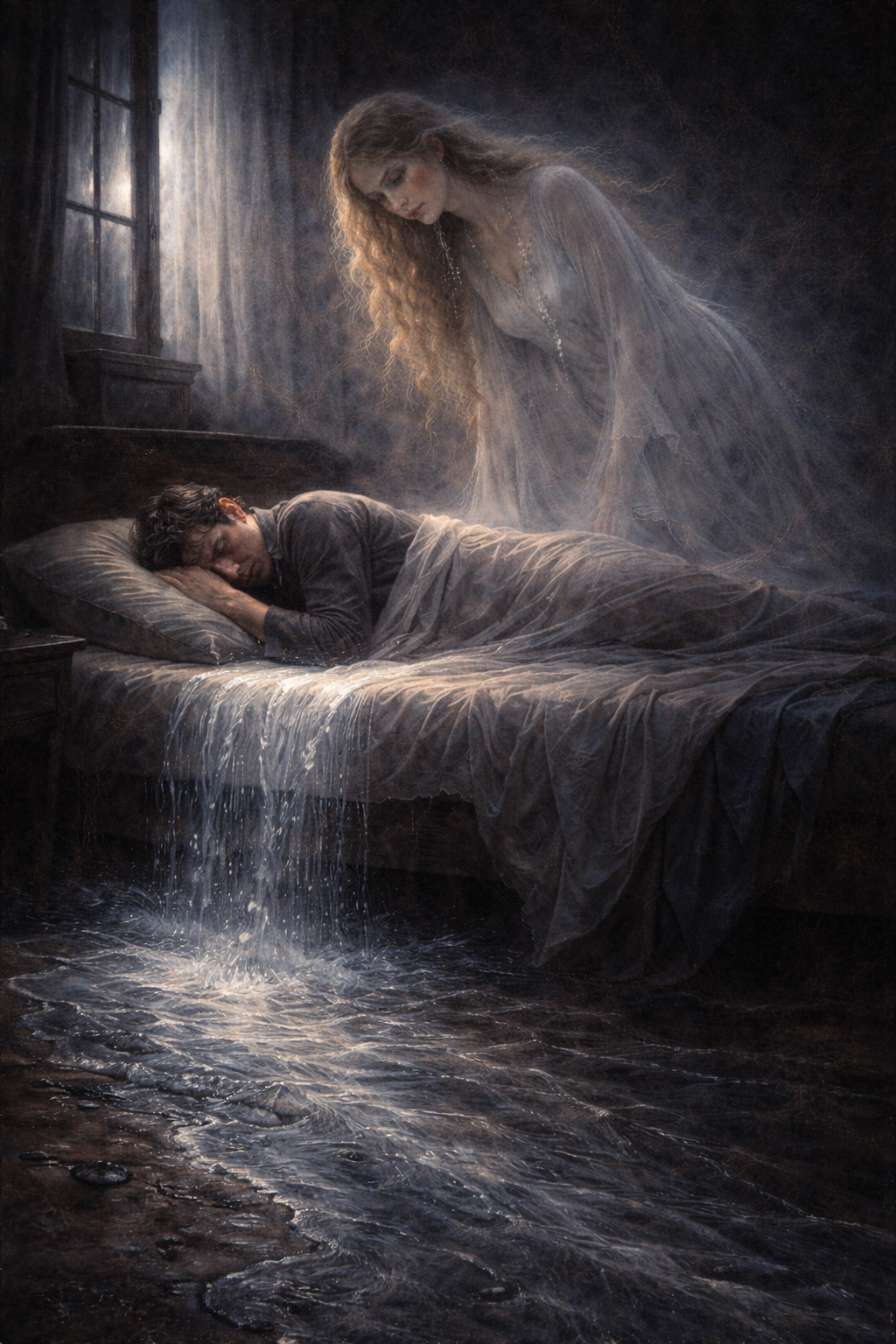
Visual Representation
Artistic visualization:
A man lies sleeping in a dark room.
His face is turned toward the pillow,
his body still – and yet from the bed
an unreal stream of water pours forth.
What in the poem is at first only a single
tear is here visibly intensified:
from a drop it becomes a flood.
The water does not flow as a natural
element, but as a symbol. It is
the material expression of the “flood of tears”
named only at the end of the text.
In this way, the poem’s inner movement –
from the single tear to overflowing –
is anticipated visually.
Beside the bed stands, like a shadow,
the spirit of a young woman. She bends
over the sleeper without touching him.
Her appearance is half-transparent,
more memory than body.
She belongs not to the reality
of the room, but to the dream.
Precisely in this overlap of
dream and reality lies the tension
of the song. The man weeps in sleep –
yet on waking, the weeping continues.
The image captures the moment between
sleep and consciousness:
the beloved is there – and at the same time
unreachable.
Schumann’s music intensifies this
effect through its restraint.
The accompaniment is sparse, almost
monotonously repetitive. There is no
dramatic outburst, but rather
a quiet, unstoppable
onward flow – like the water
streaming from the bed.
In this way, the image unites
the poem’s repeated structure
with the musical persistence
of Schumann’s setting.
Analysis – Poetry
I wept in my dream,
I dreamed that you lay in the grave;
I woke, and the tear
Flowed down from my cheek.
The poem begins with a simple, almost sober statement: “I wept in my dream.” The dream is here not a place of longing, but of loss.
The first vision shows the beloved in the grave. The pain is radical — death appears as the most final form of separation. Yet on waking, the tear is real. Dream and reality interlock.
I wept in my dream,
I dreamed that you had left me;
I woke, and I wept
Long and bitterly.
The second stanza repeats the beginning almost word for word. This repetition creates a monotonous, circling structure — like a train of thought that never ends.
Now it is not death that appears, but abandonment. The loss becomes more concrete, more personal. Waking brings no release — the weeping continues.
I wept in my dream,
I dreamed that you were still kind to me;
I woke, and even now
My flood of tears keeps flowing.
The third stanza intensifies the pain paradoxically through a positive dream-image: the beloved is “still kind” to me. Not her death or her withdrawal, but her affection proves to be the most unbearable illusion.
Waking destroys this hope. The “flood of tears” at the end is stronger than the single tear of the first stanza. From the solitary drop there grows an unstoppable stream.
Formally, the poem is simple, almost song-like in design. Yet precisely repetition and reduction intensify its existential desolation.
Meaning & Effect within the Cycle
Within Dichterliebe, this song marks an inward turning point. Pain is no longer projected or imagined, but experienced.
Dream and reality are no longer clearly separated. Waking brings no liberation, but confirms the suffering.
Particularly significant is the escalation: death, abandonment, and dreamed kindness — all three variants lead to the same result. The pain remains.
Schumann’s setting underscores this sobriety. The music is restrained, almost sparse. No dramatic outburst, but a resigned circling around the same emotion.
Thus the song becomes a quiet centre of the cycle: the poet recognizes that even dream offers no refuge any longer. The tear belongs no longer to sleep — it belongs to reality.
Evgenia Fölsche – Performances & Audio
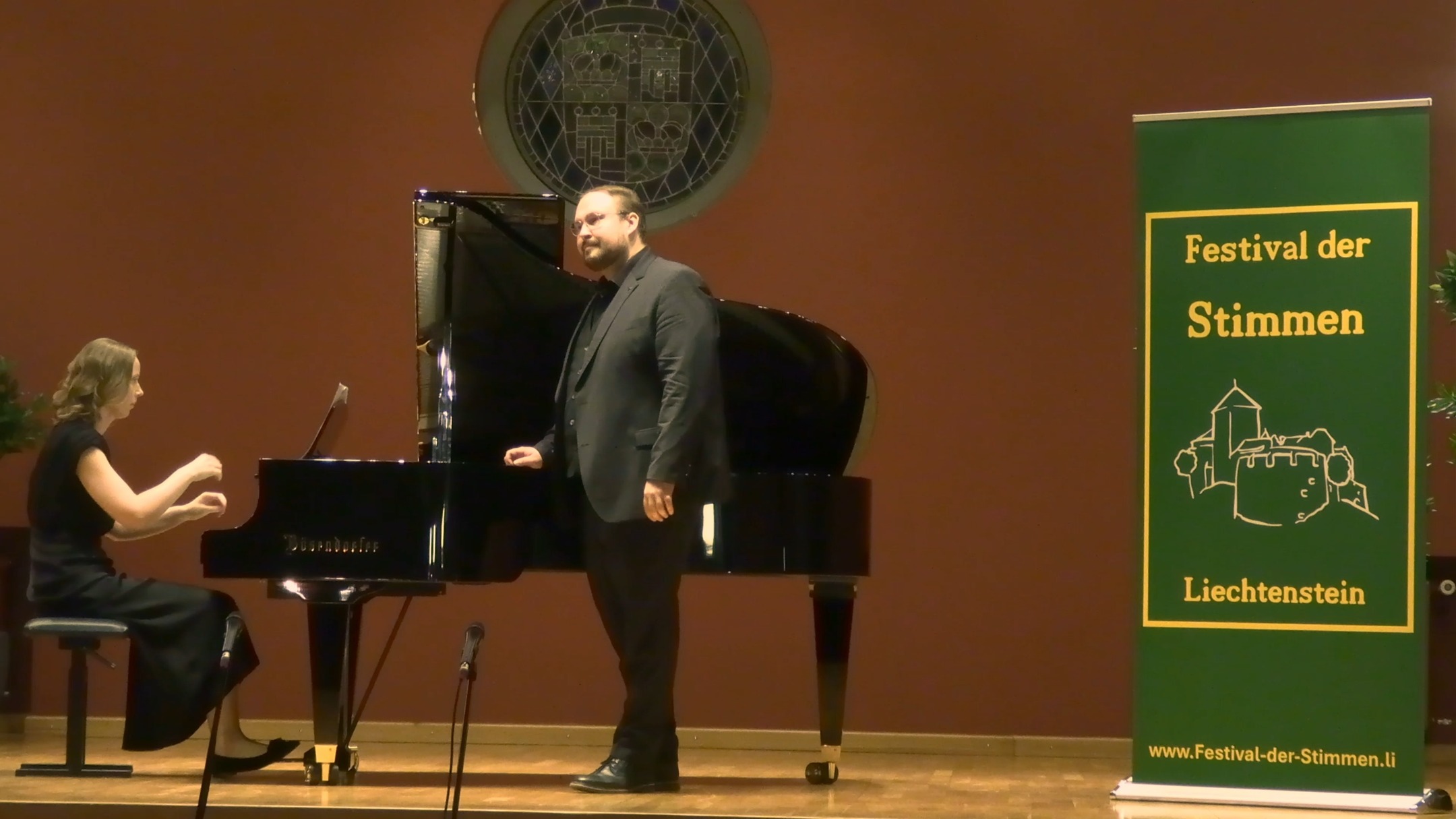
Pianist Evgenia Fölsche shapes “Ich habe im Traum geweinet” with maximum restraint: breathing piano writing, text-centred parlando, scarcely any vibrato – so that the three waking moments can speak for themselves.
Frequently Asked Questions about Schumann: “Ich habe im Traum geweinet” (Dichterliebe No. 13)
Click on a question to reveal the answer.
What is the song about?
Three dream variants end in the same awakening: tears. Even the “good” dream brings no consolation.
How does Schumann’s setting sound?
Very slow, parlando-like declamation over calm chordal planes; narrow dynamic spectrum, brief postlude.
Is the song strophic?
Yes, three stanzas with small variations in harmony and melodic goal points; the postlude ebbs away.
Which voice types are common?
Transpositions for high and low ranges are available; often soprano/mezzo-soprano as well as tenor/baritone.
Interpretive tip?
Keep the tempo steady, consonants clear, vibrato narrow; differentiate each waking line (matter-of-fact – bitter – empty).