“Aus alten Märchen winkt es” (short: “Aus alten Märchen”) is Song No. 15 from Robert Schumann’s cycle Dichterliebe op. 48 after Heinrich Heine. The poem unfolds a visionary tableau of an enchanted land – radiant, fragrant, resonant – which finally dissolves in the morning sun. Schumann shapes this into a swaying dream-motion: bright colour, flowing 6/8 gesture, a rise into luminous intensity – and a delicate fading before the final song.
The Poem (Heinrich Heine)
From: Lyrisches Intermezzo (Buch der Lieder)
From ancient fairy tales there beckons
Forth a white hand,
There it sings and there it sounds
Of an enchanted land;
Where many-coloured flowers bloom
In the golden evening light,
And glow with lovely fragrance,
With a bridal face bright;
And green trees are singing
Primeval melodies,
The breezes ring in secret,
And birds sing out with ease;
And misty figures rise
Up from the earth below,
And dance airy round dances
In wondrous choral flow;
And blue sparks are burning
On every leaf and spray,
And red lights are racing
In wild, bewildered array;
And loud fountains are breaking
Out of savage marble stone;
And strangely through the brooklets
The reflection flashes on.
Ah! if only I could get there,
And there delight my heart,
Released from all affliction,
And free and blessed depart!
Ah! that land of rapture,
I often see it in dreams;
But when the morning sun arrives,
It melts like empty foam, it seems.
Work Data & Overview
- Composer: Robert Schumann (1810–1856)
- Cycle: Dichterliebe op. 48, No. 15
- Text source: Heinrich Heine, Lyrisches Intermezzo (part of the Buch der Lieder)
- Composition: May/June 1840 (year of song); first printed edition 1844
- Tonal space / notation: bright major realm; swaying 6/8 pulse; arpeggiated, figurative piano writing
- Tempo indications: Lively, buoyant; cantabile in the middle register
- Duration: approx. 2–3 minutes; radiant vision before the finale
- Scoring: voice (various ranges in published editions) and piano
- Form: strophic with variation; a climactic arc with a fading postlude
Poem Data
- Poet: Heinrich Heine (1797–1856)
- Origin (text): 1822/23; printed in 1827 in the Buch der Lieder (Lyrisches Intermezzo)
- Stanza form: 8 stanzas of 4 lines each
- Rhyme scheme: alternating rhyme (ABAB)
- Devices: synaesthesia, personification, round-dance and light imagery, contrast between dream and morning sun
Genesis & Contexts
In his year of song, 1840, Schumann shaped Heine’s poems into a dramatic inner arc. After the dream songs Nos. 13–14, No. 15 opens the perspective onto a radiant counter-world – a final promise before No. 16 concludes with the burial of the “old songs.”
Heine’s poem gathers romantic topoi of the “enchanted land”: light, fragrance, sound, and dance. Schumann mirrors this sensual abundance in an elastic 6/8 motion that lifts the vision upward – and gently lets it slip away at the end.
Performance Practice & Reception
Essential are a buoyant 6/8 pulse, clear diction, and a glowing mf without harshness. The closing stanzas require brilliance without pressure, so that the fading away before No. 16 sounds fully convincing.
Reference Recordings (Selection)
- Dietrich Fischer-Dieskau – Gerald Moore
- Fritz Wunderlich – Hubert Giesen
- Ian Bostridge – Julius Drake
- Peter Schreier – András Schiff
- Matthias Goerne – Christoph Eschenbach
Analysis – Music
Swaying 6/8 Gesture & Tone Colours
Arpeggiated piano figures and a bound vocal line create a light state of suspension. Accented keywords (Zauberland, Reigen, Wonne) set points of brilliance; short ornamental impulses make the “sparks” flash up.
Strophic Design, Climax & Dissolving Close
Within an essentially strophic design, Schumann intensifies harmony and dynamics in the wish-stanzas (“Ach! könnt’ ich dorthin kommen”). The postlude withdraws the motion again – the vision dissolves, just as in the text the morning light dissolves the dream.
Visual Representation
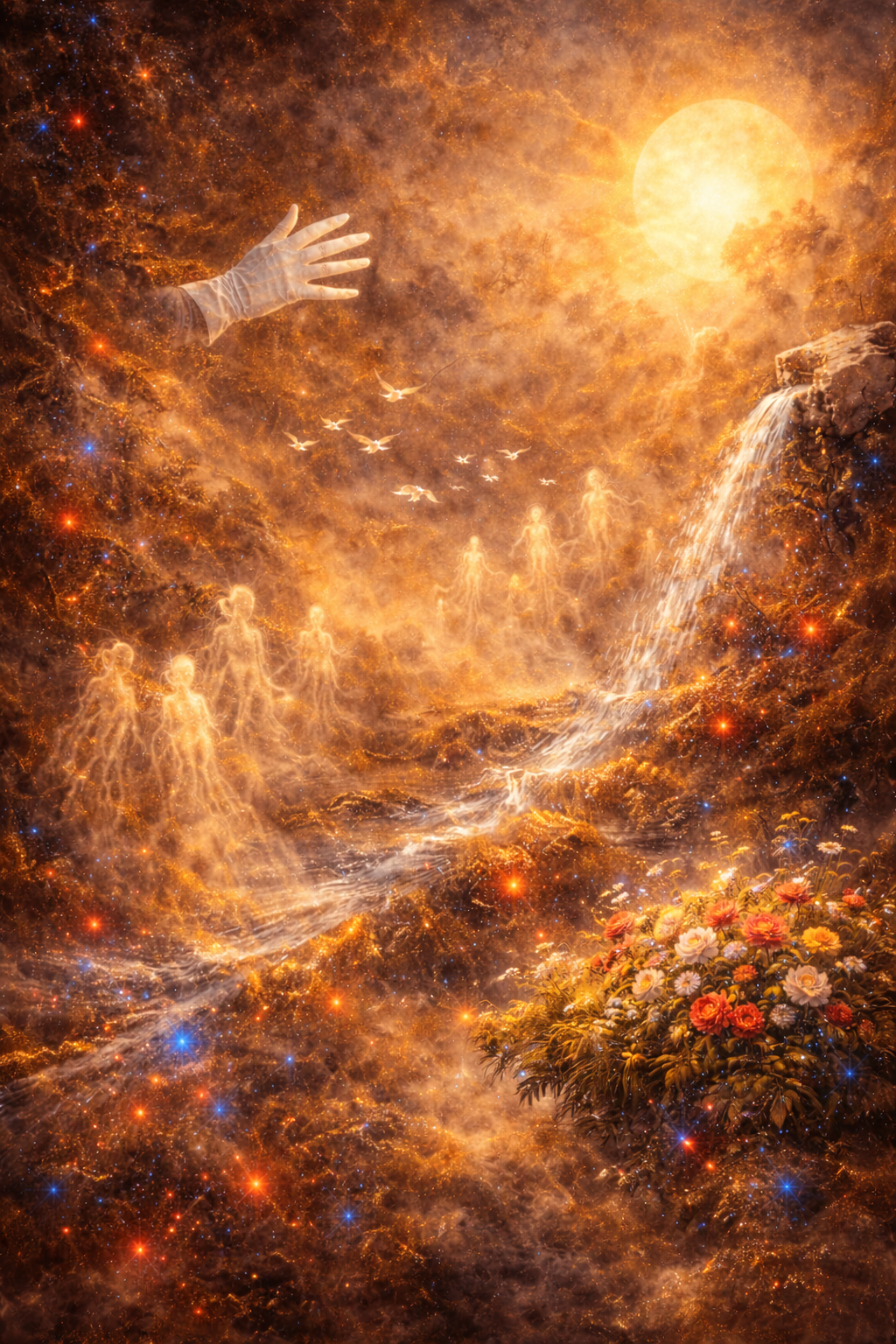
Artistic visualisation:
No firm ground, no horizon, no clearly defined space.
The image unfolds within a golden atmosphere
in which fragments of a dream-world float freely.
In the upper part of the image appears a single white,
gloved hand – without a visible arm, without a body.
It waves, remote and bodiless, like an invitation
from another reality.
Bright flowers shine not as a meadow in any natural sense,
but as a floating fragment. Mist-like
human figures rise out of undefined light,
their contours dissolving at the edges.
Red lights pass through the space like flickering
impulses; blue sparks hover in unstable motion.
A fountain springs from a white fragment of marble,
yet the water does not flow logically downward –
it draws itself as a shining line diagonally
through the image.
An oversized golden sun outshines the whole scene.
Where its light falls, individual elements
begin to melt away. Forms lose their solidity.
The dream-world feels opulent and yet
unstable – as though on the verge of vanishing.
In this way the image visualises the central tension of the song:
an alluring fairy-tale vision full of sound
and colour – and at the same time its beginning
dissolution in the light of reality.
Analysis – Poetry
From ancient fairy tales there beckons
Forth a white hand,
There it sings and there it sounds
Of an enchanted land;
The poem opens with a fairy-tale vision. “Ancient fairy tales” point to a past, idealised world. The “white hand” feels like an invitation – delicate, promising, almost unearthly.
Sound and song are present from the start. The desired land is not only visible, but audible as well. Music becomes the expression of another reality.
Where many-coloured flowers bloom
In the golden evening light,
And glow with lovely fragrance,
With a bridal face bright;
The imagery is filled with colour and light. “Golden evening light” and “bridal face” connect nature and love symbolism. The enchanted land takes on features of an idealised realm of love.
And green trees are singing
Primeval melodies,
The breezes ring in secret,
And birds sing out with ease;
Nature becomes wholly musicalised. Trees sing, breezes ring, birds resound. The world appears as a harmonious whole.
And misty figures rise
Up from the earth below,
And dance airy round dances
In wondrous choral flow;
With the “misty figures,” an initial blurring enters. The vision remains elusive. The fairy-tale world is not tangible, but moves in the in-between realm of dream and reality.
And blue sparks are burning
On every leaf and spray,
And red lights are racing
In wild, bewildered array;
The colours intensify. Yet “wild” and “bewildered” already suggest instability. The paradise begins to flicker.
And loud fountains are breaking
Out of savage marble stone;
And strangely through the brooklets
The reflection flashes on.
The image of fountains from “savage marble” combines vitality with hardness. Reflections and afterglow intensify the motif of unreality.
Ah! if only I could get there,
And there delight my heart,
Released from all affliction,
And free and blessed depart!
Here the wish is explicitly voiced. The enchanted land is the counter-image to present affliction.
Ah! that land of rapture,
I often see it in dreams;
But when the morning sun arrives,
It melts like empty foam, it seems.
The final stanza destroys the vision. With the “morning sun” the dream dissolves. The image of foam emphasises the transience of happiness.
The enchanted land exists only in dreams – not in reality.
Meaning & Effect within the Cycle
Within Dichterliebe, this song represents a moment of escapist longing. After disappointment and pain, the lyrical self seeks refuge in an imagined world.
The enchanted land unites harmony of nature, love symbolism, and musical abundance. It stands as a counter-design to inner fragmentation.
Yet this world is not stable. It exists only in dreams. With morning light, the illusion falls apart.
Schumann’s setting mirrors this ambivalence. At first the music unfolds a floating, almost transfigured sound world, but as it proceeds, a subtle unrest enters. The ending does not sound triumphant, but resigned.
Thus the song becomes a key piece of the cycle: the longing for a harmonious fairy-tale realm remains unfulfilled. Dream and reality fall apart.
Evgenia Fölsche – Performances & Audio
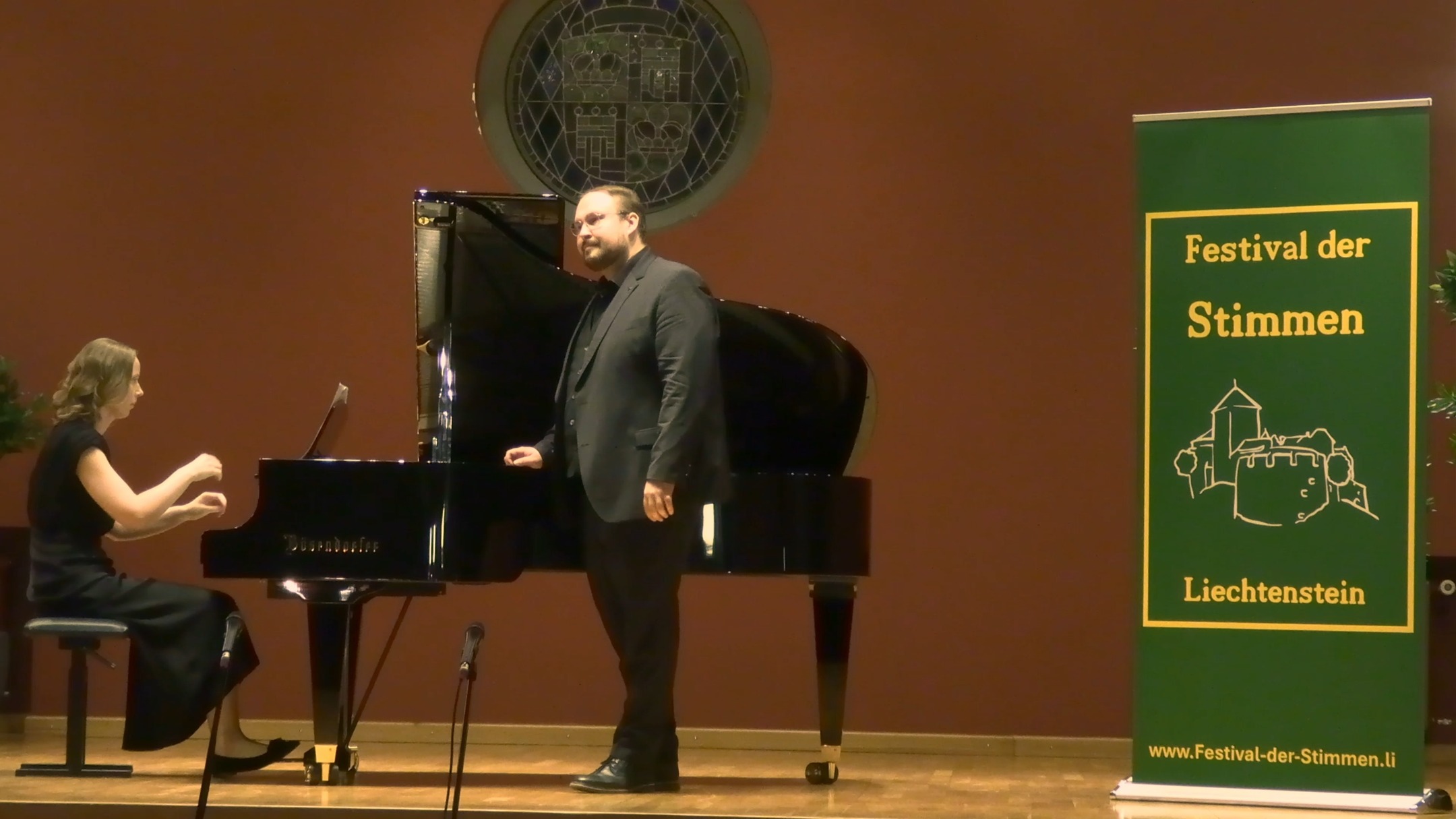
Pianist Evgenia Fölsche interprets “Aus alten Märchen” as a radiant curtain before No. 16: a buoyant 6/8 pulse, speech-close line, and a clearly withdrawn ending.
Frequently Asked Questions about Schumann: “Aus alten Märchen” (Dichterliebe No. 15)
Click on a question to reveal the answer.
What is the song about?
A synaesthetic vision of an “enchanted land” unfolds in sensory richness; in the end, the morning sun destroys the illusion.
What musical motion shapes the song?
A buoyant 6/8 gesture with arpeggiated piano figures and a cantabile, syllabic declamation.
How does the song fit into the cycle?
As the last radiant vision before the finale No. 16, it prepares the emotional and motivic fading-away of the close.
Is the song strophic?
Yes, strophic with variation, building toward the wish-stanzas and ending with a soft postlude.
Interpretive tip?
Let the pulse sway rather than rush, keep consonants clear, maintain brilliance without harshness, and genuinely let the ending fade for the transition into No. 16.