“Aus meinen Tränen sprießen” is Song No. 2 from Robert Schumann’s cycle Dichterliebe op. 48 after Heinrich Heine. In simple, radiant tones, the music unfolds a tender scene of confession: tears become flowers, sighs become a choir of nightingales. Schumann’s strophic design and the Nicht schnell (“Not fast”) of the first edition sustain an atmosphere poised between calm, hope, and restrained happiness.
The Poem (Heinrich Heine) – Full Text
From: Lyrisches Intermezzo (Buch der Lieder)
From my tears there spring forth
many blooming flowers,
and my sighs become
a choir of nightingales.
And if you love me, little one,
I shall give you all the flowers,
and before your window there shall sound
the song of the nightingale.
Work & Poem Data
Data on the Composition
- Composer: Robert Schumann (1810–1856)
- Cycle: Dichterliebe op. 48, No. 2
- Composition: 1840 (year of song); First edition: 1844, C. F. Peters (Leipzig)
- Tempo (first edition): Nicht schnell (“Not fast”) (heading)
- Tonal framework / notation: 3 sharps (A major / F-sharp minor sphere); clear centring on A major
- Form: strophic (2 stanzas on the same musical model)
- Scoring & duration: voice and piano; approx. 1½–2 minutes
Data on the Poem
- Poet: Heinrich Heine (1797–1856)
- Origin (text): 1822/23; Publication: 1827 in Buch der Lieder (Lyrisches Intermezzo)
- Stanza form: 2 × 4 lines
- Rhyme scheme: abcb / abcb (end rhyme respectively in lines 2 & 4; “hervor” ~ “Nachtigallenchor”, “all” ~ “Nachtigall”)
- Meter: regular iambic tendency (four-stress lines with slight variants)
- Images & figures: metaphor (tear → flower; sigh → birdsong), parallelism, alliteration (“blühende Blumen”)
Genesis & Contexts
In May and June 1840, Schumann gathered the Heine settings into a large body of songs; in 1844 the 16-song version of Dichterliebe was published by C. F. Peters. Dramaturgically, the piece stands as the immediate continuation of No. 1 (“Im wunderschönen Monat Mai”) and preserves its tenderness, though now with clearer tonal direction.
Heine’s poems from the Lyrisches Intermezzo (1822/23; published 1827) trace an arc from blossoming to disillusionment. “Aus meinen Tränen sprießen” represents the early, hopeful phase: the transformation of inner pain into beauty and sound.
Performance Practice & Reception
As an integral part of Dichterliebe, the song belongs to the standard repertoire of Lied recitals. It is often interpreted with flowing cantabile, a light touch, and finely graded dynamics from piano to pianissimo. The simplicity of its tone meets with immediate resonance from audiences, especially in contrast to the more dramatic numbers of the cycle.
Analysis – Music
Declamation & Texture
The syllabic vocal line unfolds a calm cantilena above a simple chordal piano texture with small impulses of motion. Dynamically, p/pp predominates; the voice-leading remains transparent, serving the clarity of the text.
Harmony & Tonal Relations
- Tonic centre: A major (three sharps); song-like cadential points at the end of each stanza
- Progression: coherent, “bright” harmony as a counterpart to the suspension of No. 1; only a few gentle digressions
- Rhetoric: the poem’s images (flowers / nightingale) are mirrored in blossoming lines and small “call” gestures
Visual Representation
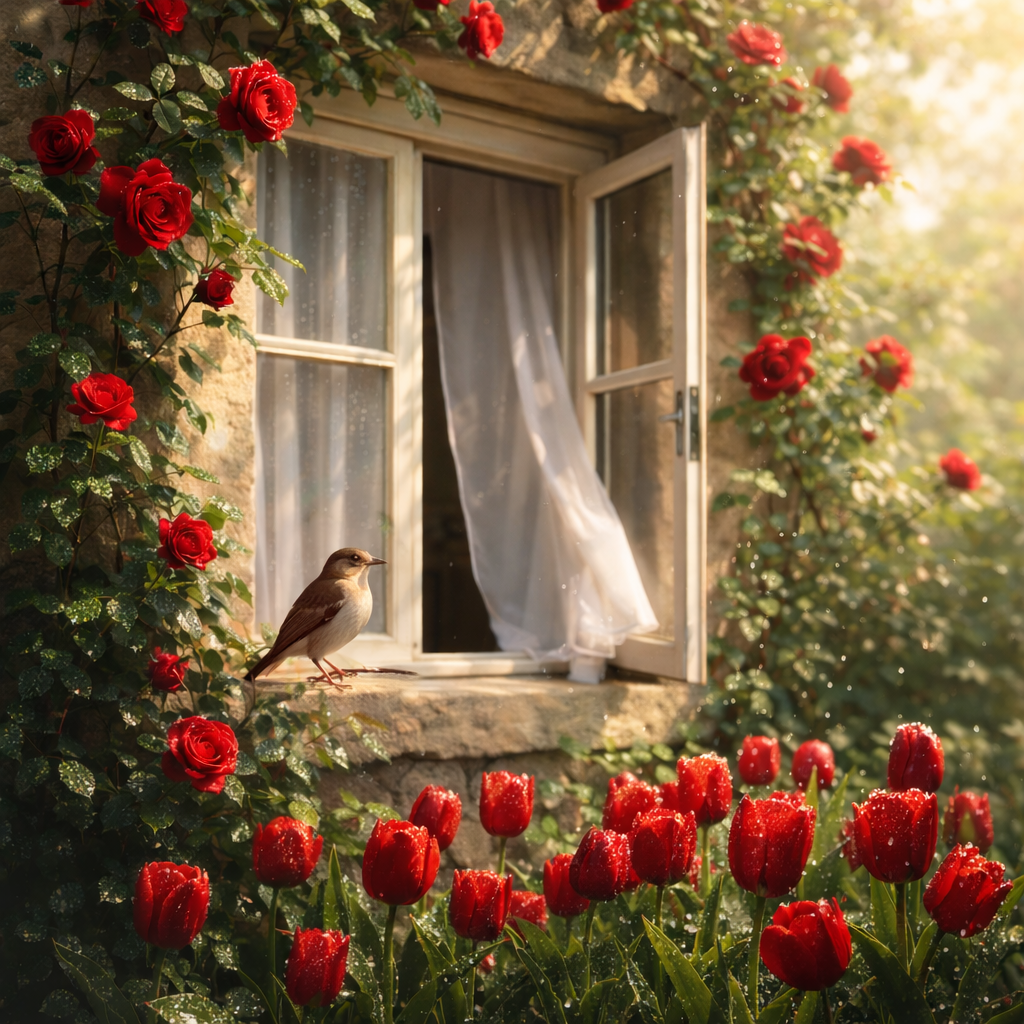
Artistic visualization by Evgenia Fölsche:
An old window stands slightly open.
A light curtain moves gently
in the warm sunlight and veils
the view into the interior. The room
remains hidden – like the heart,
which does not entirely reveal itself.
Red roses climb upward along
the wall. Their blossoms glow intensely,
still covered with raindrops.
Beneath the window, red tulips bloom,
their leaves glittering with water
in the sunlight. It seems
as though the rain has only just
passed by.
A nightingale sits upon the windowsill.
Its small body
appears inconspicuous – and yet
it carries the song within itself.
It does not look into the room,
but outward, as though
its singing were mediating
between inside and outside.
The image unites rain and sunlight,
tear and blossom, longing and sound.
Out of wetness comes flowering,
out of silence, a song.
Nature becomes a symbol
of transformation: pain
turns into beauty,
sighs become song.
Analysis – Poetry
The poem “Aus meinen Tränen sprießen” belongs to the most delicate songs of Dichterliebe. After the tentative confession of the first song, a poetic transformation takes place here: suffering is not lamented, but transfigured into beauty.
Tears as the Source of Life
From my tears there spring forth
many blooming flowers,
and my sighs become
a choir of nightingales.
The first stanza unfolds a metaphor of transformation. Tears – signs of pain – become the source of blossoms. Sighs, expressions of longing, are transformed into song. The inner world is projected outward and appears there in ennobled form.
The nightingale stands in the Romantic tradition for love song and nocturnal poetry. What in the heart is painful appears in nature as harmonious sound.
The Gift of Devotion
And if you love me, little one,
I shall give you all the flowers,
and before your window there shall sound
the song of the nightingale.
In the second stanza, the inner transformation becomes a gift. The speaker offers not only flowers, but the sublimated form of his suffering. Love is formulated here as conditional devotion: “If you love me …”
The window is a decisive imagistic motif. It marks the boundary between the inner and outer world. Before this window the song is to sound – not within. Love remains on the threshold.
Meaning & Effect within the Cycle
Within Dichterliebe, this song shows an idealised phase of feeling. Pain is not repressed, but aesthetically transformed. Nature once again serves as a mirror of the inner world – though not destructively, but transfiguringly.
The crucial idea is poetic sublimation: the lover can express his suffering only in artistic form. Flowers and nightingale are not real nature, but the expression of inward longing.
Thus the song still stands in the early part of the cycle under the sign of Romantic hope. Yet the condition “if you love me” already contains a quiet reservation – and with it the seed of later disappointment.
Evgenia Fölsche – Performances
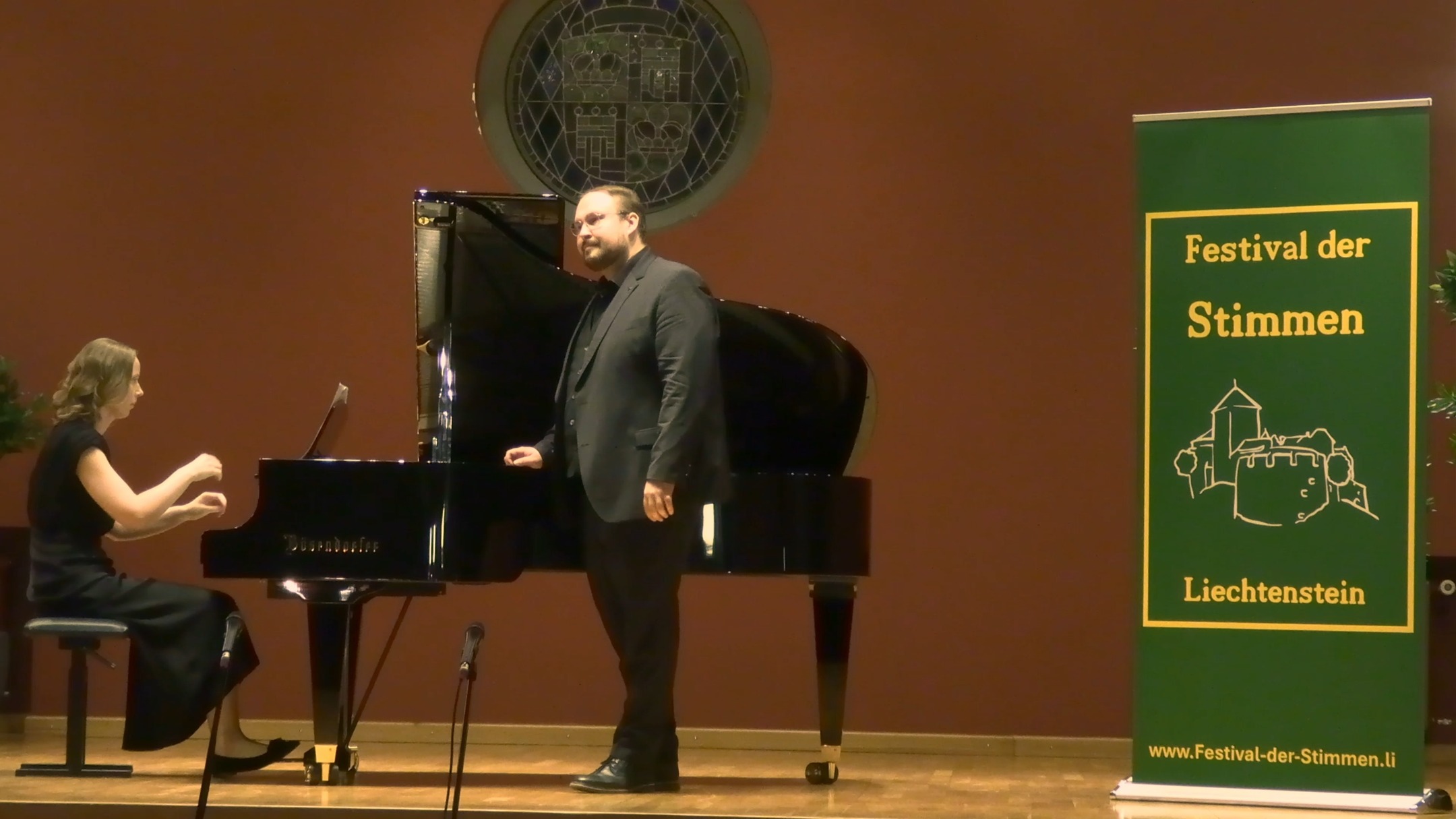
Pianist Evgenia Fölsche has presented “Aus meinen Tränen sprießen” several times within complete Dichterliebe programmes with various singers (including projects with Benjamin Russell).