“Das ist ein Flöten und Geigen” is Song No. 9 from Robert Schumann’s cycle Dichterliebe op. 48 after Heinrich Heine. Between sounding wedding music and bitter insight, the poem contrasts festive noise with inner pain. Schumann transforms this into a sharply drawn dance scene: sparkling, pointed — and in the end permeated by ironic bitterness.
The Poem (Heinrich Heine)
From: Lyrisches Intermezzo (Buch der Lieder)
There is a fluting and fiddling,
Trumpets blare in between;
There my dearest darling surely dances
In the wedding roundelay.
There is ringing and roaring,
Drums and shawms;
In between, sobbing and moaning
Are heard from the lovely little angels.
Work Data & Overview
- Composer: Robert Schumann (1810–1856)
- Cycle: Dichterliebe op. 48, No. 9
- Text source: Heinrich Heine, Lyrisches Intermezzo (part of the Buch der Lieder)
- Composition: May/June 1840 (year of song); first edition 1844
- Tonal space / notation: bright major-key sphere with dance character (often A major in editions); 3/4 pulse with sharp accentuation
- Tempo indications: lively, not too fast; buoyant
- Duration: approx. 1–2 minutes; sparkling character miniature
- Scoring: voice (various ranges in published editions) and piano
- Form: two stanzas; a brief postlude commenting with irony
Data on the Poem
- Poet: Heinrich Heine (1797–1856)
- Origin (text): 1822/23; published in 1827 in the Buch der Lieder (Lyrisches Intermezzo)
- Stanza form: 2 stanzas of 4 lines each
- Rhyme scheme: alternating rhyme (ABAB)
- Stylistic devices: tone painting (list of instruments), irony, contrast between celebration and pain
Genesis & Contexts
In the compositional year of song, 1840, Schumann gathered Heine settings into a cycle with an inner dramatic progression. No. 9 marks the shift from the contemplative tone of the previous songs to the glaring outer world — a scenic “cut” straight into the festive noise of another person’s wedding.
Heine’s poem works with exaggerated sound-images — flutes, violins, trumpets, drums, shawms; the lyrical self remains a marginal figure and suffers what it describes: the wedding of the beloved to another man.
Performance Practice & Reception
What matters are a buoyant 3/4 pulse, precise articulation, and a clear distinction between outer brilliance and inner sharpness. The forte may shine, but must not shout; the punchline arises from controlled irony, not from sheer volume.
Reference Recordings (Selection)
- Dietrich Fischer-Dieskau – Gerald Moore
- Fritz Wunderlich – Hubert Giesen
- Ian Bostridge – Julius Drake
- Peter Schreier – András Schiff
- Matthias Goerne – Christoph Eschenbach
Analysis – Music
Dance Gesture & Tone Painting
Schumann paints the celebration with percussively accented chords, offbeat playing figures, and a syllabic, sharply cut vocal line. The list of instruments gains motoric drive; brief grace notes and accents glitter like “blaring trumpets.”
Two Stanzas & Punchline
The second stanza intensifies the density: denser sonority, shorter breath, and more sharply set target words (Hochzeitsreigen, Engelein). The short postlude comments dryly — like a grim wink after the festive bustle.
Visual Representation
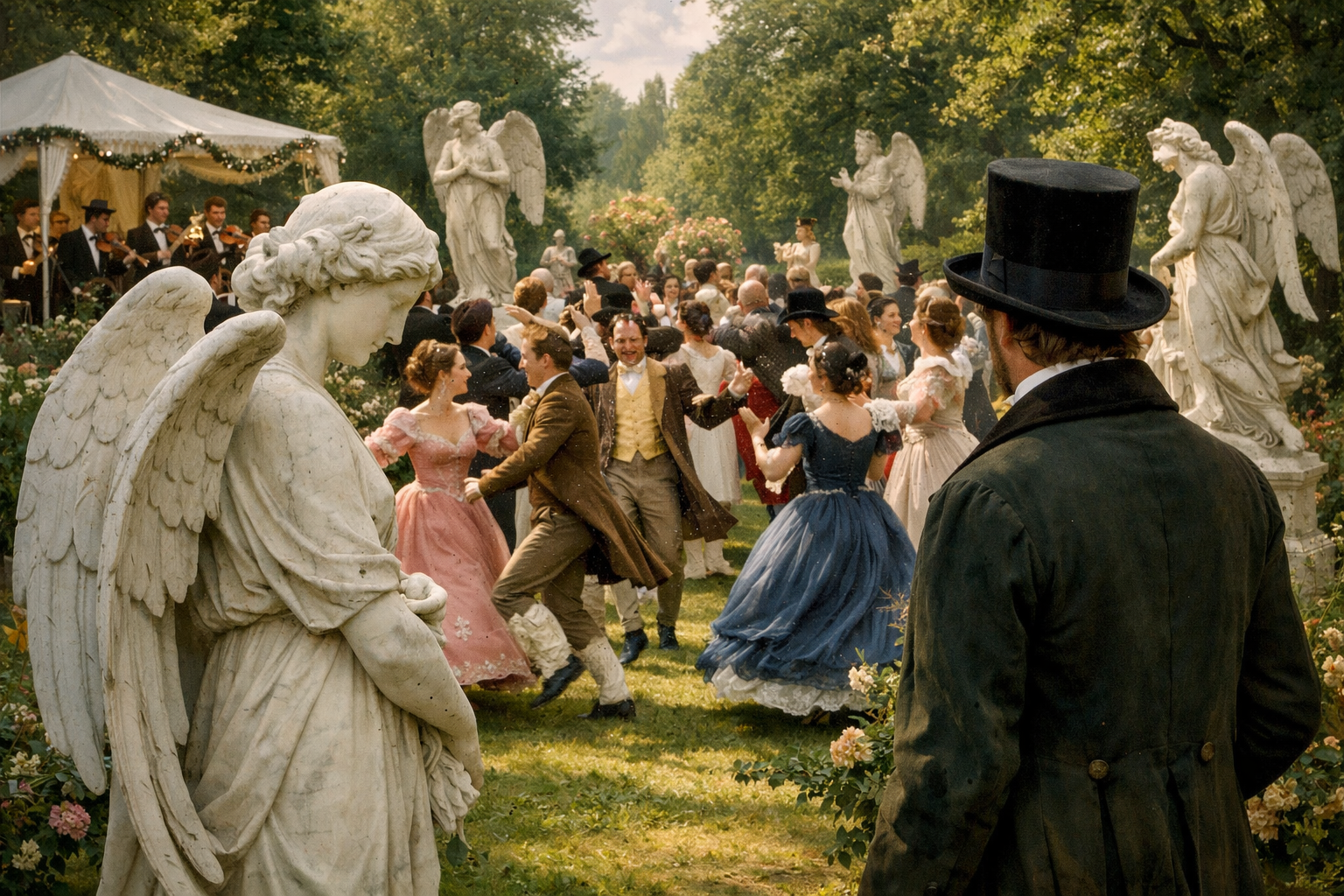
Artistic visualization by Evgenia Fölsche:
In a spacious garden of the early nineteenth century,
a small ensemble is playing. Violins, flutes,
and wind instruments merge into
a festive fabric of sound that sets
the wedding guests in motion.
Men in frock coats and top hats lead
ladies in wide dresses through the
lively round dance. Fabrics whirl,
colours glow in the warm light of day.
The bridal couple remains hidden in the crowd —
it is not the centre, but part
of the sounding whole.
Between flowerbeds and old trees
stand marble statues of angels.
Their pale, motionless figures
form a silent contrast
to the liveliness of the celebration.
Behind one of the statues stands a man.
Half concealed in shadow,
he looks at the exuberant festivity.
His posture appears calm, almost rigid —
as though he did not truly belong there.
Thus a double layer emerges:
in the foreground the “fluting and fiddling,”
the ringing and roaring of
a dazzling wedding dance —
yet in the background a moment
of distance, perhaps of longing.
The angels seem to be silent witnesses
to this contrast —
between outward festivity
and inward movement.
Analysis – Poetry
There is a fluting and fiddling,
Trumpets blare in between;
There my dearest darling surely dances
In the wedding roundelay.
The poem begins with an acoustic overwhelming. The enumeration of “flutes,” “violins,” and “trumpets” creates a panoramic soundscape. The music appears loud, festive, almost noisy.
The wedding scene appears like a public celebration — a contrast to the inner isolation of the lyrical self. The beloved is no longer the object of private longing, but part of a social festivity.
There is ringing and roaring,
Drums and shawms;
In between, sobbing and moaning
Are heard from the lovely little angels.
In the second stanza the noise-character intensifies: “ringing,” “roaring,” “drums.” The sound-painting condenses the atmosphere of sonic abundance and acoustic pressure.
But suddenly another element breaks in: amid the festive uproar the “lovely little angels” are “sobbing and moaning.” The heavenly responds with sorrow to the earthly celebration.
The irony is unmistakable: while the wedding appears as a happy climax, it is at the same time unmasked as a painful event. Even the angels cannot conceal the discrepancy between outward joy and inward suffering.
Meaning & Effect within the Cycle
Within Dichterliebe, this song constitutes a drastic turning point. The beloved is no longer merely distant or unattainable — she is marrying another.
The lyrical self stands outside the action. It perceives the wedding as a noisy, overwhelming sonic event that almost mocks its own pain.
The “little angels,” who sob amid the festive tumult, mirror the speaker’s inner feeling. The heavenly becomes a fellow-sufferer.
Schumann’s setting intensifies this ambivalence through an almost grotesque, march-like character. The music feels overstimulated, almost parodistic. Beneath the outward festivity lies a sharp bitterness.
Thus the song appears as a sarcastic wedding scene: a celebration that means joy for everyone else — but for the lyrical self the final extinction of hope.
Evgenia Fölsche – Performances & Audio
Pianist Evgenia Fölsche has performed “Das ist ein Flöten und Geigen” in complete Dichterliebe cycles as well as in thematic programmes on Romantic irony; the balance between brilliance and bite is central.
Frequently Asked Questions about Schumann: “Das ist ein Flöten und Geigen” (Dichterliebe No. 9)
Click on a question to reveal the answer.
What is the song about?
Festive wedding noise contrasts with the pain of the lyrical self: the “dearest darling” is getting married — but not to him.
How does Schumann’s setting sound?
A sparkling 3/4 dance with marked accents, syllabic declamation, and a brief ironic closing gesture.
Is the song strophic?
Yes, two stanzas with intensification in stanza 2; a brief postlude serves as commentary.
Which voice types are common?
Transpositions for various ranges are common; frequently soprano/mezzo-soprano as well as tenor/baritone.
Interpretive tip?
Brilliance without pressing: clear consonants, buoyant pulse, an ironic edge — do not cement it in forte.