“Ein Jüngling liebt ein Mädchen” is Song No. 11 from Robert Schumann’s cycle Dichterliebe op. 48 after Heinrich Heine. The poem tells a small tragicomic chain of love — laconic, ironic, and in the end heart-rending. Schumann translates this into a light, almost dance-like tone that sharply outlines the bitterness behind the smile.
The Poem (Heinrich Heine)
From: Lyrisches Intermezzo (Buch der Lieder)
A young man loves a maiden,
Who has chosen another;
The other loves yet another,
And has married her.
The maiden, out of anger,
Takes the very first man
Who happens to cross her path;
The young man is badly off.
It is an old story,
Yet it always remains new;
And whoever it happens to,
His heart breaks in two.
Work Data & Overview
- Composer: Robert Schumann (1810–1856)
- Cycle: Dichterliebe op. 48, No. 11
- Text source: Heinrich Heine, Lyrisches Intermezzo (part of the Buch der Lieder)
- Composition: May/June 1840 (Year of Song); first edition 1844
- Tonal space / notation: bright major-key sphere with dance-like motion (often A major in editions); 2/4 gesture with allusive “dance” feeling
- Tempo indications: Light and not too fast; buoyant, pointed
- Duration: approx. 1 minute; aphoristic character miniature
- Scoring: voice (various ranges in published editions) and piano
- Form: three stanzas, strophic with subtle internal variations; brief postlude
Data on the Poem
- Poet: Heinrich Heine (1797–1856)
- Origin (text): 1822/23; published in 1827 in the Buch der Lieder (Lyrisches Intermezzo)
- Stanza form: 3 stanzas of 4 lines each
- Rhyme scheme: alternating rhyme (ABAB)
- Stylistic devices: irony, proverbial punchline, laconic narrative stance
Genesis & Contexts
In the Year of Song, 1840, Schumann integrated Heine’s poems into a dramatic sequence. After the intimate miniature of lament that is No. 10, No. 11 sets a sharply drawn, worldly contrast: a “street song” with a double edge.
Heine’s original is a model of Romantic laconicism: in 12 lines a whole chain of love unfolds, together with a moral punchline. Schumann preserves the dry wit — and lets the final line strike like a cold cut.
Performance Practice & Reception
What matters is a buoyant pulse, crystal-clear articulation, and a smile “with teeth”: bright in sound, not heavy. The final punchline works best without pathos-laden stretching — it should be delivered dryly.
Reference Recordings (Selection)
- Dietrich Fischer-Dieskau – Gerald Moore
- Fritz Wunderlich – Hubert Giesen
- Ian Bostridge – Julius Drake
- Peter Schreier – András Schiff
- Matthias Goerne – Christoph Eschenbach
Analysis – Music
Laconic Dance & Punchline
Light dotted figures and quick harmonic changes sketch a dance-like street scene. The voice remains syllabic and direct; accents fall on key words (ärgert, übel dran, Herz entzwei), while the postlude snaps shut like a dry stage curtain.
Strophic Form & Text Declamation
Schumann preserves the three-stanza design, but colours it minimally: stanza 2 gains a little more bite, while stanza 3 slightly draws back the dynamics so that the punchline feels not “sung” but spoken.
Visual Representation
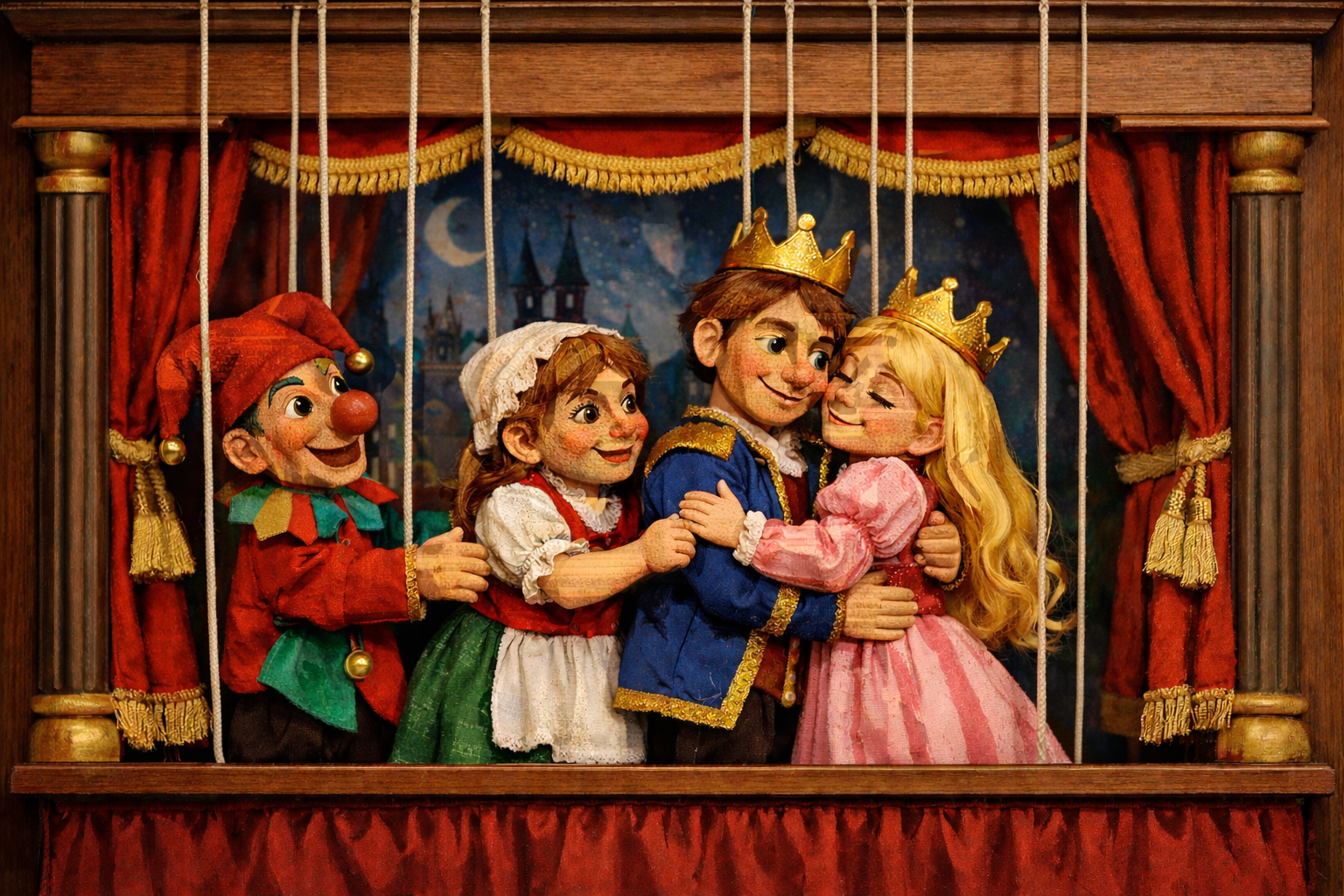
Artistic visualization:
On a small stage with a red curtain
the scene unfolds as though in
a traditional puppet theatre.
Four wooden marionettes stand
side by side, clearly visible
on their strings.
On the right, prince and
princess embrace — the seemingly happy pair.
But beside them Gretel
clutches at the prince’s jacket,
as if she wanted to hold him back.
Far to the left, Kasperl in turn
holds Gretel by the hem of her skirt.
A chain of
movements arises: each holds
the next, yet none gets
the one he or she truly desires.
The bodies remain stiff,
slightly mechanical — like figures
moved less by their own will
than by outside forces.
Especially eloquent are the
clearly visible strings.
They descend from above
and make visible what the
poem only suggests:
the lovers are not free.
They are part of a pattern,
of a story that repeats itself again and again.
Thus the stage becomes a metaphor
for fate. What at first looks like
a harmless children’s puppet play
reveals itself as
a bitterly ironic game:
an old story —
and yet new for everyone.
Analysis – Poetry
A young man loves a maiden,
Who has chosen another;
The other loves yet another,
And has married her.
The poem begins like a simple narrative. No lyrical self speaks, but rather an apparently objective voice. The constellation seems almost folksong-like: love misses its target, affection remains unreturned.
What is striking is the sober language. No images, no metaphors — only a clear sequence of relationships. Love appears here as a chain of misdirections.
The maiden, out of anger,
Takes the very first man
Who happens to cross her path;
The young man is badly off.
The second stanza brings an almost ironic sharpening. The maiden acts not out of love, but out of anger. The decision is impulsive, almost banal.
The young man is left behind — not heroically suffering, but simply “badly off.” This laconic phrase undercuts any pathetic idealization.
It is an old story,
Yet it always remains new;
And whoever it happens to,
His heart breaks in two.
In the last stanza the story is generalized. It is “old” — a pattern that keeps recurring.
At the same time it remains “always new,” because for the one affected it is unique and painful. The final line brings pathos back in: the heart breaks “in two.”
Thus a tension arises between ironic distance and genuine pain. The narrative stance feels cool — but the last line is existential.
Meaning & Effect within the Cycle
Within Dichterliebe, this song represents a shift of perspective. Pain is no longer cried out subjectively, but presented as a general pattern of life.
Precisely this apparent objectivity intensifies the tragedy. The unhappiness is not extraordinary, but everyday.
Schumann’s setting takes up this tone. The music feels almost dance-like, mobile, nearly light. Yet beneath the surface lies a cutting undertone.
The song shows that personal pain is part of a larger pattern. Everyone experiences it anew — and yet it is an “old story.”
Irony and tragedy stand side by side. Distance offers no protection against hurt. In the end, what remains is the broken heart.
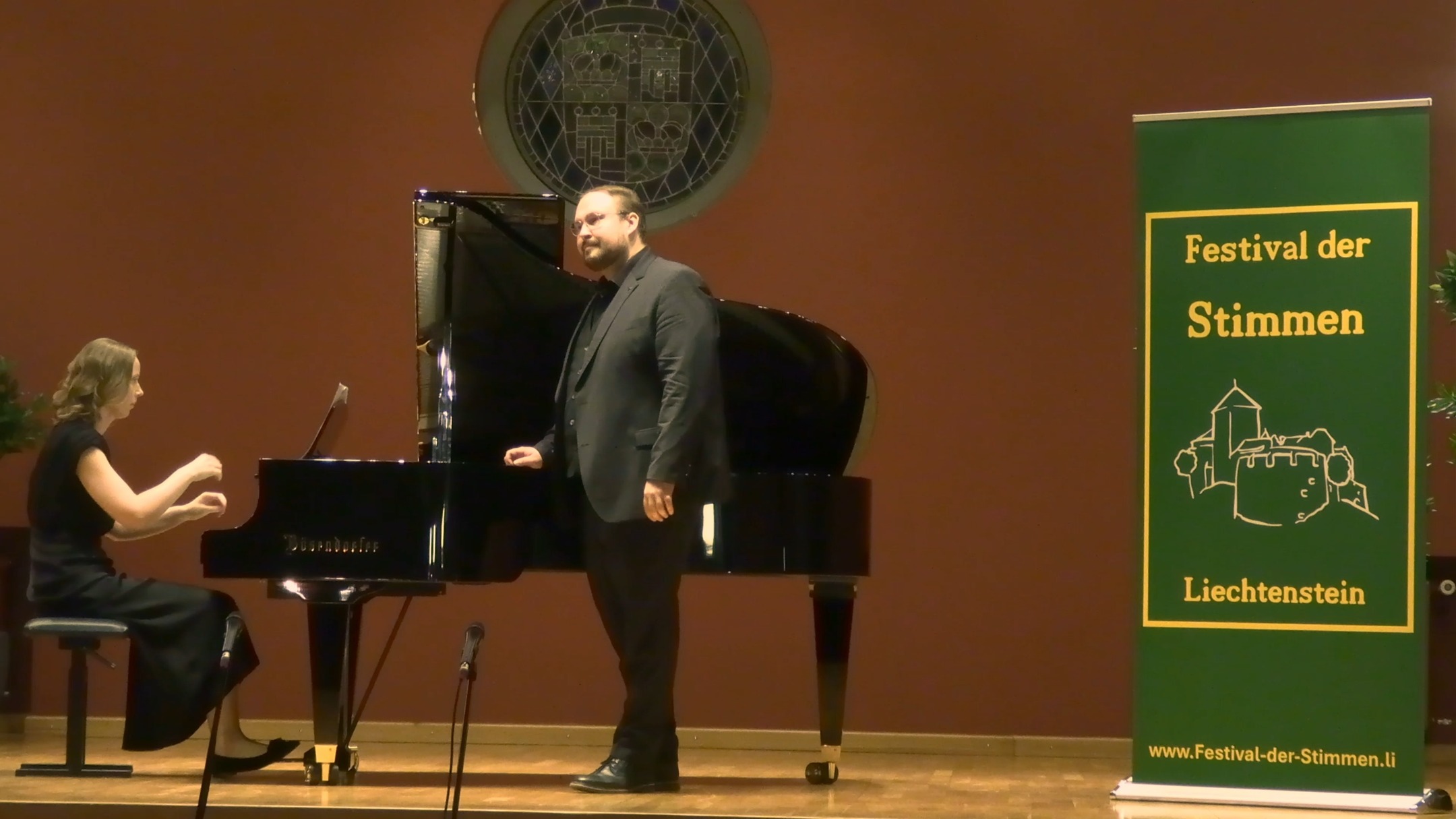
Evgenia Fölsche – Performances & Audio
Pianist Evgenia Fölsche has interpreted “Ein Jüngling liebt ein Mädchen” in complete Dichterliebe programmes as a deliberately simple, buoyant number — with a sharply placed final line.
Audio example: Add audio/video link here
Frequently Asked Questions about Schumann: “Ein Jüngling liebt ein Mädchen” (Dichterliebe No. 11)
Click on a question to reveal the answer.
What is the song about?
A chain of mismatched loves; in the end, what remains is the general punchline — and the concrete heartbreak.
How does Schumann’s setting sound?
Light, dance-like, syllabic — with a dry closing gesture; a “street song” with a sting.
Is the song strophic?
Yes, three stanzas; minimal variations in bite and dynamics, especially before the punchline.
Which voice types are common?
Transpositions for high and low ranges; often soprano/mezzo-soprano as well as tenor/baritone.
Interpretive tip?
Keep the pulse buoyant, consonants precise, the punchline dry — do not savour it sentimentally.