“Im wunderschönen Monat Mai” opens Robert Schumann’s Dichterliebe op. 48 – two stanzas that hover like a quiet meditation of confession. The vocal line ends without a “resolved” cadence: an open ending that leaves the promise of love suspended. It is precisely this mixture of delicate declamation, harmonic ambiguity, and silence that makes the song one of the most striking openings of any cycle.
The Poem (Heinrich Heine) – Full Text
From: Lyrisches Intermezzo (Book of Songs)
In the wondrous month of May,
When all the buds were bursting,
Then in my heart
Love arose.
In the wondrous month of May,
When all the birds were singing,
Then I confessed to her
My longing and desire.
Work & Poem Data
Data on the Composition
- Composer: Robert Schumann (1810–1856)
- Cycle: Dichterliebe op. 48, No. 1 (opening song)
- Composition: 1840 (year of song); First edition: 1844 (C. F. Peters, Leipzig)
- Tempo: Langsam, zart (“Slow, tender”) (first edition)
- Tonal framework: 3 sharps in the notation (A major / F-sharp minor sphere); ending without a full cadence (open ending)
- Form: strophic (2 stanzas on identical musical material)
- Scoring: voice and piano; approx. 1½–2½ minutes
Data on the Poem
- Poet: Heinrich Heine (1797–1856)
- Origin (text): 1822/23; Publication: 1827 in Das Buch der Lieder (Lyrisches Intermezzo)
- Structure: 2 stanzas of 4 lines each; rhyme scheme in each stanza: A–B–C–B; simple, image-rich diction
- Meter: regular iambic tendency (four stresses, varying with feminine endings)
- Semantics: the topos of confession (arising / avowal) in springtime; experience of nature as an emotional mirror
Genesis & Contexts
Schumann composed the songs of Dichterliebe in May and June 1840 – the famous year of song, in which, while awaiting marriage to Clara Wieck, he created major groups of songs in a short span of time (publication of the 16-song version: 1844, Peters).
Heine’s text comes from the Lyrisches Intermezzo (1822/23; published in 1827 in the Buch der Lieder), whose poetic arc extends from delicate blossoming to disillusionment – a dramaturgical pattern Schumann artistically condenses in his cycle.
Performance Practice & Reception
Dichterliebe today belongs to the core repertoire of the Lied recital; an early documented complete performance in London was given in 1895 by Harry Plunket Greene (baritone) and Leonard Borwick (piano). “Im wunderschönen Monat Mai” is often perceived as a “prelude without resolution” – the open cadence captivates the audience already in the very first song.
Analysis – Music
Declamation, Harmony & Ambiguity
The piano lays down a breathing carpet of shimmering arpeggios, above which the voice declaims syllabically in an almost speech-like manner. The notation with 3 sharps points toward A major / F-sharp minor, yet Schumann refuses a clear final cadence: the vocal line ends “open,” the harmony remains vague – a musical image of a confession only just begun.
Motivic Work & Sonic Gesture
- Motivic work: wave-like upward movements (blossoming) versus gentle withdrawals
- Color: “tender” piano, abundant legato; hardly any darkening – rather suspension
- Agogics: slight breathing expansions at caesuras; no dramatic rubato
Analysis – Poetry
The poem “Im wunderschönen Monat Mai” opens the cycle Dichterliebe as a delicate exposition of an inner event. Unlike a dramatic beginning, the text formulates no conflict, but rather a state of awakening. Nature and feeling do not appear separately, but in symbolic correspondence.
In the wondrous month of May,
When all the buds were bursting,
Then in my heart
Love arose.
The first stanza establishes May as a cipher of new beginnings. The image of the “bursting buds” evokes not only blossoming, but a sudden, almost involuntary breaking open. Decisive, however, is the parallelism: what happens in nature happens simultaneously within the lyric self. Love “arises” like a flower – it is not actively chosen, but grows organically out of an undefined interior.
The tense is remarkable: the poem is told in retrospect. May already belongs to the past. Love thus appears not as present fulfilment, but as a remembered beginning. A moment of distance is therefore present already in the first line.
In the wondrous month of May,
When all the birds were singing,
Then I confessed to her
My longing and desire.
The second stanza deliberately repeats the opening. This reprise creates a circling motion – as though memory were feeling its way toward a decisive moment. Whereas the awakening of love was previously described, the next step now follows: speech, confession.
“Longing and desire” are not fulfilled emotions, but expressions of lack. Love is not yet encounter, but yearning. The lyric self steps out of the silence of nature into the uncertainty of communication. Whether the confession is returned remains open. It is precisely this omission that forms the poem’s true tension.
The structure of natural image and inner event, of arising and speaking, marks a transition: from unconscious feeling to conscious revelation. Yet the poem lingers exactly in this moment. It ends before any answer is given. The beginning of love is at the same time its most fragile state.
Visual Representation
Artistic visualization by Evgenia Foelsche:
A delicate branch with apple blossoms reaches into the luminous spring sky.
Between opened blossoms and rosy buds, a moment of becoming appears:
nothing has yet fully unfolded, and yet everything already contains a quiet awakening.
The fresh green of the leaves, the clear air after the rain, and the almost imperceptible shimmer of a rainbow
lend the image an atmosphere of hope, expectation, and subtle uncertainty.
Just as Schumann’s music shapes the beginning of love not as fulfilment but as suspended possibility,
this image too lingers in the unspoken.
It shows no triumph of feeling, but its first unfolding:
light, vulnerable, and open – a springtime moment between longing and promise.
Meaning & Effect within the Cycle
As the opening of Dichterliebe, this song does not establish a triumphant beginning, but a suspended one. Love appears not as a secure state, but as a possibility. Its poetic force lies precisely in this delicacy.
Schumann intensifies this openness musically: the harmony avoids a clear resolution and leaves the song poised in expectation. In this way a space of tension arises that shapes the entire cycle. The confession has been spoken – but its echo does not come.
“Im wunderschönen Monat Mai” thus functions as a sensitive prologue. The cycle begins not with fulfilment or loss, but with hope. Only later will it become clear how fragile this springtime truly is. May stands at the beginning – yet it already carries within itself the premonition of its own transience.
Evgenia Fölsche – Performances
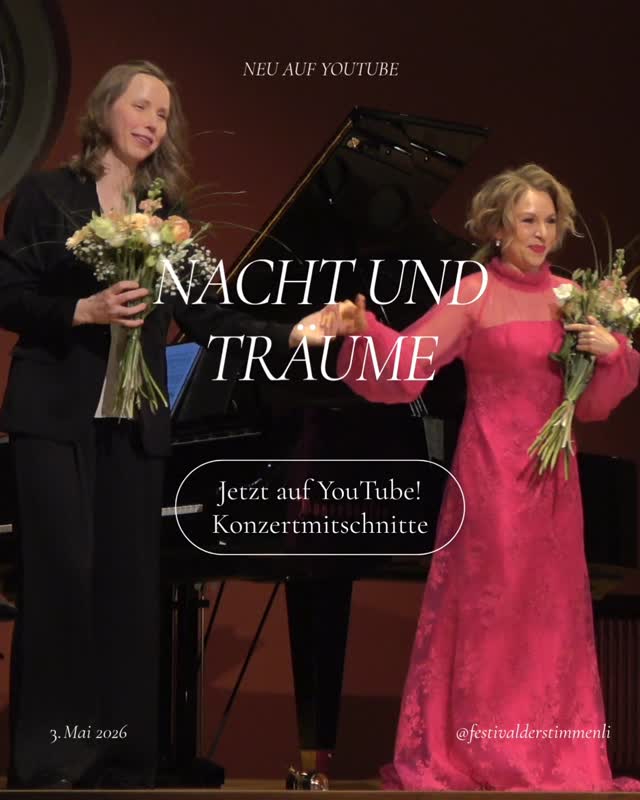
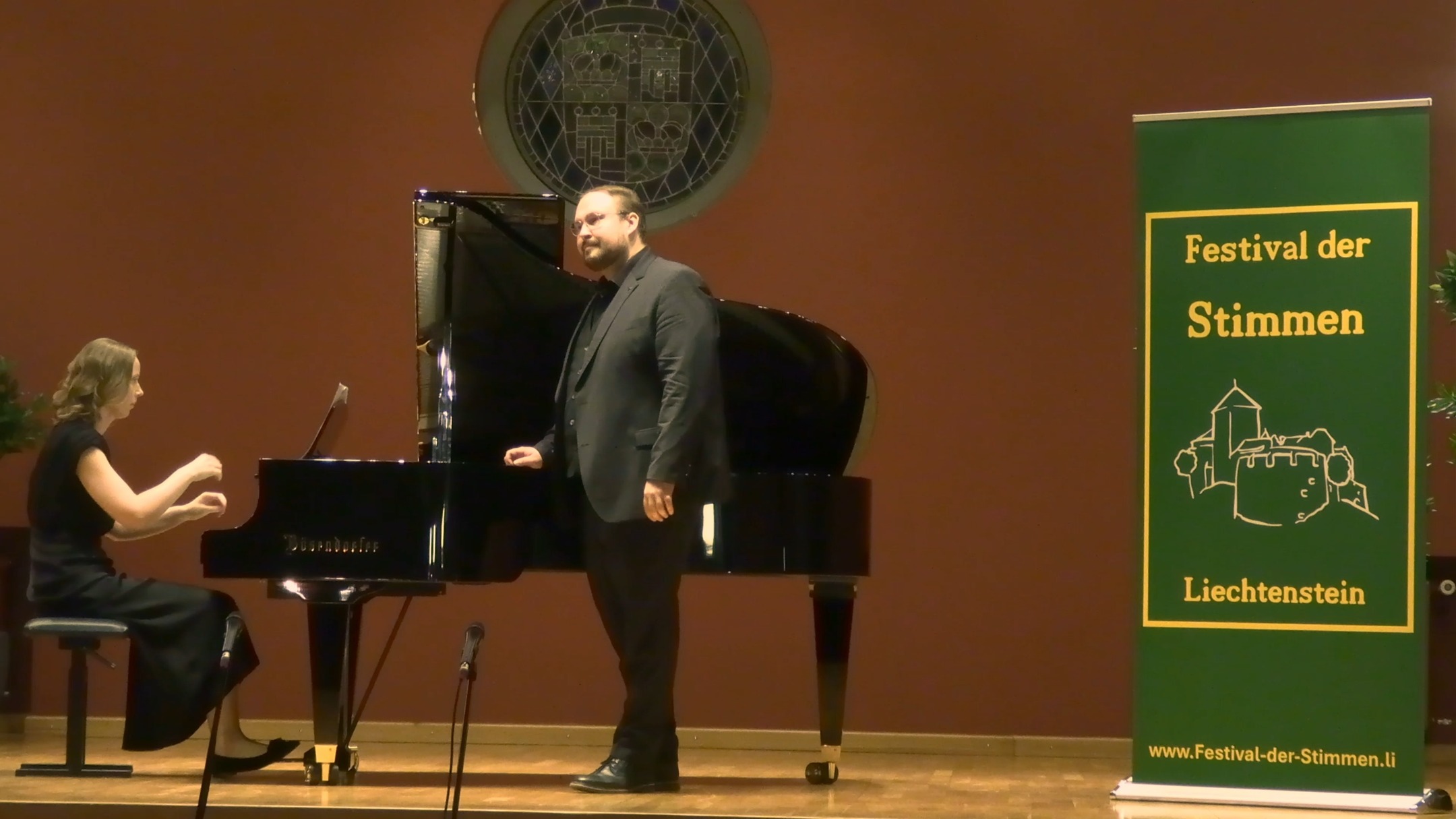
Pianist Evgenia Fölsche has performed “Im wunderschönen Monat Mai” several times within complete Dichterliebe programmes with various singers (including projects with Benjamin Russell).
FAQ – “Im wunderschönen Monat Mai” (Schumann, Dichterliebe No. 1)
Click on a question to reveal the answer.
Why does the song end “open” and without a clear closing cadence?
The open cadence reflects the unfinished quality of the early phase of love: confession rather than fulfilment. Schumann deliberately avoids a rounded close and thus keeps expectation and tension alive.
In which key is the song written?
It is notated with 3 sharps (A major / F-sharp minor sphere). Yet the harmony remains suspended; the ending avoids a clear tonic – one of the hallmarks of this song.
What tempo and expression marking does Schumann give?
Langsam, zart (“Slow, tender”) – accordingly, a light touch, legato cantilena, and breathing phrase-shaping are central.
Is the song strophic or through-composed?
Strophic: both stanzas are set to the same musical model, which places the text in the foreground.
How is the song used in concert contexts?
Often as a quiet opening to Dichterliebe programmes; in themed series also as a standalone piece before readings or Heine programmes because of its openness and brevity.
Sources (Selection)
- First edition (tempo marking “Langsam, zart”; notational layout): C. F. Peters (IMSLP). Path: imslp.org … Dichterliebe 1st edition (PDF)
- Work data (1840/1844), cycle overview, early London performance in 1895: Wikipedia – Dichterliebe
- Heine text & translation: Oxford Song – “Im wunderschönen Monat Mai”
- Genesis / letters (year of song 1840): Hampsong Foundation – Notes on the Genesis of Dichterliebe
- Analytical remarks on tonal ambiguity: Intégral (2023) – Intertextuality in “Im wunderschönen Monat Mai”