“Ich grolle nicht” is Song No. 7 from Robert Schumann’s cycle Dichterliebe op. 48 after Heinrich Heine. The poem claims outward composure while exposing the pain of lost love and the recognition of the beloved’s inner darkness. Schumann shapes this into a short, gripping scene of confession – energetic, clearly declaimed, and sustained by relentless chordal blows.
The Poem (Heinrich Heine)
From: Lyrisches Intermezzo (Buch der Lieder)
I bear no grudge, though my heart should break,
O love forever lost! I bear no grudge.
However you shine in diamond splendour,
Not one ray falls into the night of your heart.
I have long known that. For I saw you in a dream,
And saw the night within your heart’s domain,
And saw the serpent that gnaws at your heart,
I saw, my love, how deeply wretched you are.
Work Data & Overview
- Composer: Robert Schumann (1810–1856)
- Cycle: Dichterliebe op. 48, No. 7
- Text source: Heinrich Heine, Lyrisches Intermezzo (part of the Buch der Lieder)
- Composition: May/June 1840 (year of song); first edition 1844
- Tonal space / notation: bright major-key sphere with a dramatic thrust (often C major in editions); marked 4/4 pulse; chordal piano writing
- Tempo indications: Nicht zu schnell (“Not too fast”); energetic, without haste
- Duration: approx. 1–2 minutes; a pointed miniature of culmination
- Scoring: voice (various ranges in published editions) and piano
- Form: two stanzas; the second stanza with clear intensification and a short postlude
Data on the Poem
- Poet: Heinrich Heine (1797–1856)
- Origin (text): 1822/23; published in 1827 in the Buch der Lieder (Lyrisches Intermezzo)
- Stanza form: 2 stanzas of 4 lines each
- Rhyme scheme: alternating rhyme (ABAB)
- Stylistic devices: litotes (“I bear no grudge”), metaphors (night, “serpent”), irony of the pose of self-control
Genesis & Contexts
In the year of song, 1840, Schumann conceived a larger Heine collection; the 16 songs of the printed version condense an inner dramatic progression. “Ich grolle nicht” stands at the beginning of the middle section as an eruptive confession that gathers together the ambivalence of pride and pain.
Heine’s text belongs to the best-known pieces of the Lyrisches Intermezzo: the negation (“I bear no grudge”) exposes itself as a rhetorical mask; behind the self-command the emotion still glows – a model that Schumann mirrors through outward simplicity and inner tension.
Performance Practice & Reception
Essential are sustained diction, a clear pulse, and differentiated dynamics, with gesture rather than constant forte. The pitch level of the closing lines can lie quite exposed; economy of breath and precise consonants give the declamation its striking force.
Reference Recordings (Selection)
- Dietrich Fischer-Dieskau – Gerald Moore
- Fritz Wunderlich – Hubert Giesen
- Peter Schreier – András Schiff
- Ian Bostridge – Julius Drake
- Jonas Kaufmann – Helmut Deutsch
Analysis – Music
Declamation & Chordal Gesture
The chordal, motoric piano writing frames a syllabically sharp vocal line. The seemingly simple harmony supports the rhetoric of the text: a claim of calm – underlying tension – sudden illumination on key words such as Herz, Nacht.
Two Stanzas & Intensification
In the second stanza, Schumann intensifies the energy: denser sonority, a higher target pitch, and more expressive harmony culminate in “elend bist.” The short postlude closes tersely – like a firm grip that reins in the emotion.
Visual Representation
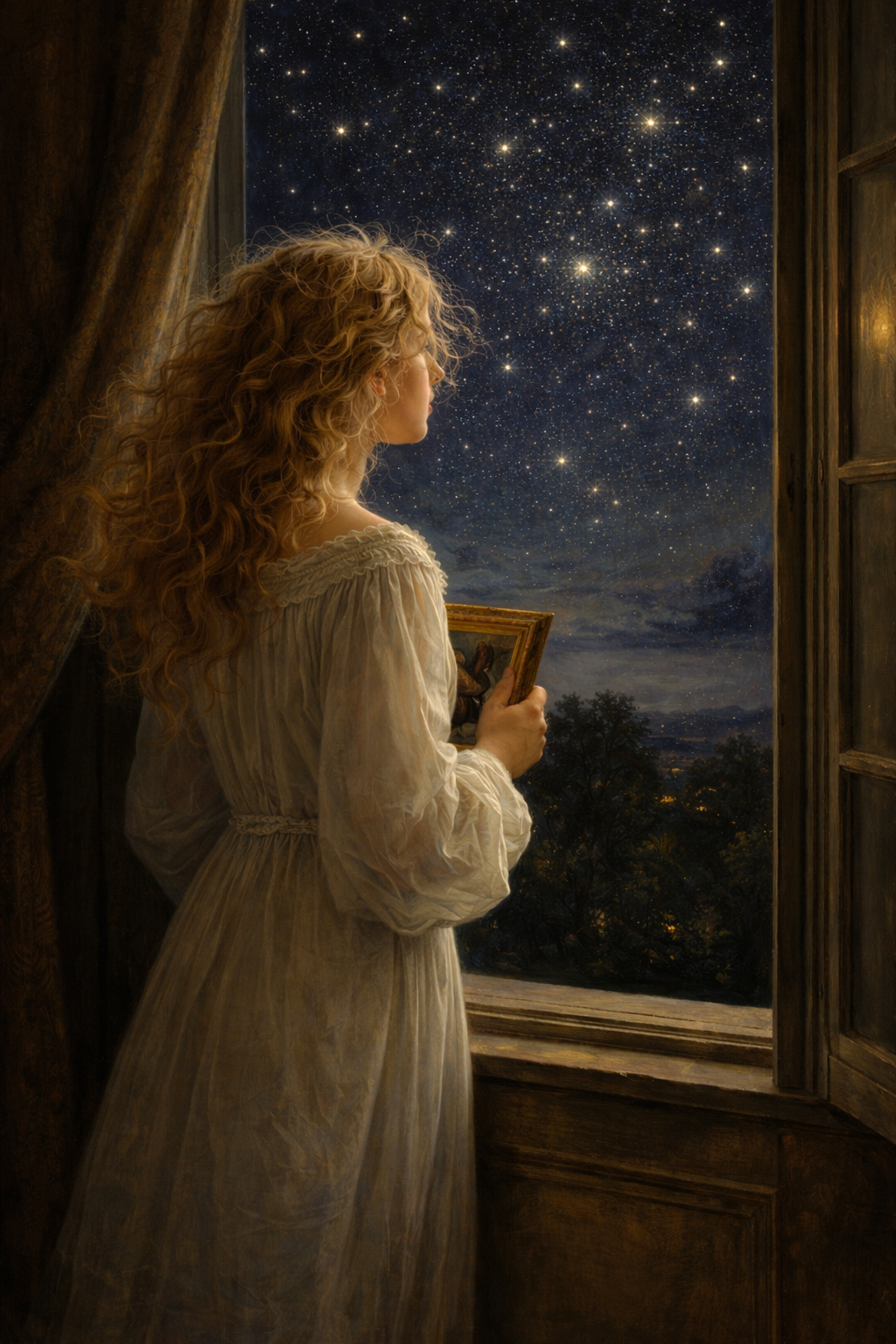
Artistic visualization by Evgenia Fölsche:
A woman stands at the open window, looking out
into the night sky. Her blonde hair
falls loose and untamed over shoulders and back,
as though she had just risen from sleepless unrest.
Nothing is ordered or arranged – the curls
appear as agitated as her thoughts.
She wears a simple nightdress in the style of
the 1830s. In her hands she holds a
picture frame, though its contents cannot be seen.
She does not look at it. Her gaze reaches outward,
far beyond the window frame.
Outside stretches a sky full of stars.
They glitter like diamonds in the darkness –
cool, distant, and of icy brilliance.
The “diamond splendour” of the poem
becomes here a cosmic image:
a radiant outer world
that offers no consolation.
The room remains in half-shadow.
The starlight does not truly enter.
Thus the central contrast of the song emerges:
outer brilliance and inner night.
The loose abundance of hair intensifies the emotional
tension. It contradicts every composure,
every controlled appearance. This image shows
no triumphant defiance, but rather
the turbulent night behind it. The words
“Ich grolle nicht” seem here like an
assertion of self against one’s own trembling –
spoken in darkness, beneath a sky
that remains cold and unreachable.
Analysis – Poetry
I bear no grudge, though my heart should break,
O love forever lost! I bear no grudge.
The poem begins with an emphatic negation: “I bear no grudge.” The repetition of the statement has an incantatory effect. Precisely through its insistence, however, it becomes clear that the resentment has by no means been overcome. The assurance stands in tension with the image of the breaking heart.
The address “O love forever lost!” lends the poem a pathetic dimension. The love is not merely lost, but irretrievably so. In spite of this finality, the speaker asserts his greatness – or at least attempts to do so.
However you shine in diamond splendour,
Not one ray falls into the night of your heart.
In the second half of the first stanza, a sharp contrast arises: outer radiance and inner darkness. The “diamond splendour” stands for brilliance, social rise, or apparent happiness. Yet no light reaches the interior.
Thus the focus shifts from the injury of the lyrical self to the emptiness of the beloved. The speaker elevates himself morally above her.
I have long known that. For I saw you in a dream,
And saw the night within your heart’s domain,
The second stanza intensifies the vision. The dream serves as a space of recognition. There one sees what remains hidden in waking life. The “night” in the heart becomes the central image of inner emptiness.
And saw the serpent that gnaws at your heart,
I saw, my love, how deeply wretched you are.
The serpent is a powerful, biblically charged symbol. It stands for guilt, temptation, or destructive self-consumption. It is no longer the lyrical self that is the victim – but the beloved.
The ending feels at once compassionate and triumphant. The speaker asserts insight and superiority. Yet the passionate imagery reveals that the emotional bond has by no means been extinguished.
Meaning & Effect within the Cycle
“Ich grolle nicht” forms within Dichterliebe a dramatic turning point. The earlier idealization of the beloved is here finally shattered.
The poem presents an attitude of apparent superiority. The speaker declares himself free of resentment – yet precisely this demonstrative negation makes the inner wound stand out all the more clearly.
The projection is reversed: whereas earlier the beloved was transfigured, she now appears inwardly dark and consumed by a “serpent.”
Schumann’s setting intensifies this ambivalence. The music sounds powerful and resolute, almost heroic. Yet beneath the surface a tension remains that does not resolve the pain. Thus a paradoxical image emerges: defiant self-assertion and injury stand side by side.
In the course of the cycle, the song marks the transition from Romantic transfiguration to bitter insight. Love is not only lost – it is disenchanted.
Evgenia Fölsche – Performances & Audio
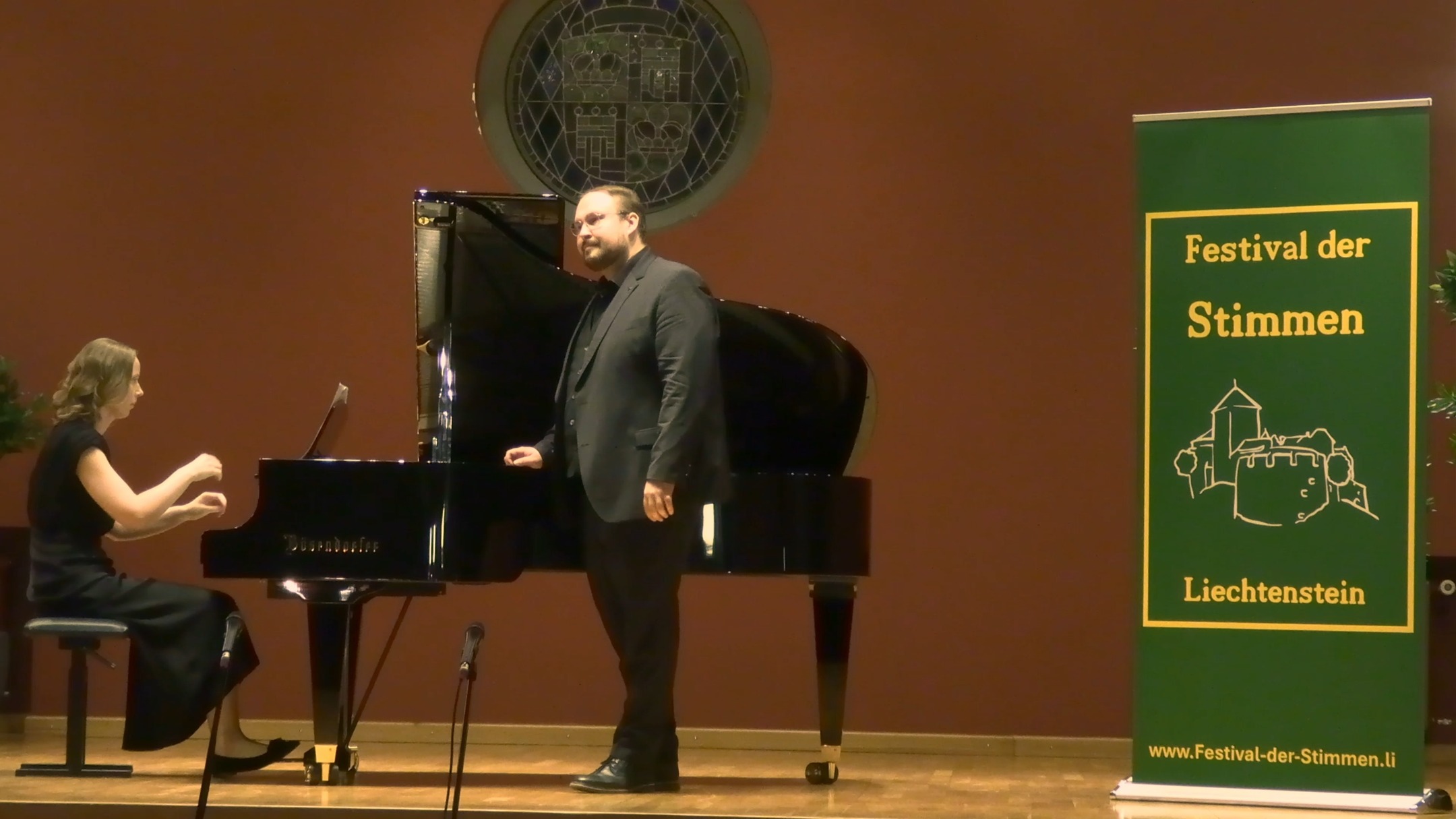
Pianist Evgenia Fölsche has accompanied “Ich grolle nicht” many times in complete Dichterliebe programmes; the concise piano writing requires deliberate weighting and clear articulation.