“Und wüßten’s die Blumen, die kleinen” is Song No. 8 from Robert Schumann’s cycle Dichterliebe op. 48 after Heinrich Heine. The poem develops a consoling allegory of nature that, at the end, turns into the bitter source of the suffering: the beloved herself. Schumann responds with an intimate tone, a simple gesture, and subtle variations that make the rising agitation beneath the surface audible.
The Poem (Heinrich Heine)
From: Lyrisches Intermezzo (Buch der Lieder)
And if the little flowers knew
How deeply wounded is my heart,
They would weep with me,
To heal my pain.
And if the nightingales knew
How sad and sick I am,
They would let resound in joy
Refreshing song.
And if they knew my sorrow,
The little golden stars,
They would come down from their height,
And speak words of comfort to me.
They all cannot know it,
Only one knows my pain:
For she herself has torn,
Torn my heart apart.
Work Data & Overview
- Composer: Robert Schumann (1810–1856)
- Cycle: Dichterliebe op. 48, No. 8
- Text source: Heinrich Heine, Lyrisches Intermezzo (part of the Buch der Lieder)
- Composition: May/June 1840 (year of song); first edition 1844
- Tonal space / notation: a minor-leaning tonal sphere with bright colouring; calm 2/4 pulse; arpeggiated broken accompaniment figure
- Tempo indications: Nicht zu langsam, intimate; cantabile
- Duration: approx. 1–2 minutes; intimate miniature
- Scoring: voice (various ranges in published editions) and piano
- Form: four stanzas, with fine variations and a short postlude
Data on the Poem
- Poet: Heinrich Heine (1797–1856)
- Origin (text): 1822/23; published in 1827 in the Buch der Lieder (Lyrisches Intermezzo)
- Stanza form: 4 stanzas of 4 lines each
- Rhyme scheme: alternating rhyme (ABAB)
- Stylistic devices: personification (flowers, nightingales, stars), imagined wish-image, punchline revealing the source of pain
Genesis & Contexts
In 1840 Schumann gathered several Heine settings into a larger whole; the 16 songs of the printed version condense an inner dramatic progression. No. 8 stands in the first third of the cycle and shows the fragile hope for consolation, before the bitterness of the later songs comes to dominate.
Heine’s text unfolds a small dramatic curve: from the imagined solidarity of beings of nature to the sharply personal confession. Schumann’s restraint in sound and line keeps the emotion close to speech.
Performance Practice & Reception
What is required is clarity of text, breathing p–mp, and elastic phrasing; the piano should let the arpeggiated figures “speak” softly. The final stanza can bear a slight intensification — without losing the fundamental tone of intimacy.
Reference Recordings (Selection)
- Dietrich Fischer-Dieskau – Gerald Moore
- Fritz Wunderlich – Hubert Giesen
- Peter Pears – Benjamin Britten
- Ian Bostridge – Julius Drake
- Matthias Goerne – Christoph Eschenbach
Analysis – Music
Intimate Gesture & Accompaniment Figure
The vocal line is syllabic and cantabile, sustained by broken chords in the piano. Gentle dynamic waves trace “weeping” and “refreshment” without roughening the surface.
Strophic Form & Intensification
While maintaining the basic gesture, Schumann intensifies harmony, dynamics, and target pitch in stanza 4 — the words “zerrissen” … “das Herz” receive marked contour; the postlude lowers the pulse again.
Visual Representation
Artistic visualization by Evgenia Fölsche:
The nocturnal scene is not
a nature image in the literal sense,
but rather a space of the soul.
The tree split by lightning
stands like a visible echo
of the word “heart” —
suddenly struck,
torn open,
no longer in balance.
Schumann’s music begins
simply and almost naively,
almost like a folk song.
Yet beneath the seeming
simplicity lies
a quiet urgency.
So too here:
the small campfire
glows calmly —
and yet its light recalls
something that does not die out.
The man looks at the flowers.
Not at the tree.
Not at the sky.
At what is delicate.
As though his question were directed
toward the innocent:
“And if the little flowers
only knew …”
In Heine’s text, it is nature
that might carry compassion.
In Schumann, this plea acquires,
through the harmony,
a quiet pain
that is never fully spoken aloud.
The flowers in the foreground
thus become silent witnesses —
they stand in warm light,
yet surrounded by night.
The glitter of the stars
feels distant and cool.
No storm anymore,
no thunder —
only aftersound.
As in the piano postlude,
something remains in the air:
an unspoken lament,
delicately sustained,
not dramatic,
but inward.
The image does not suggest the event itself,
but rather what comes after.
The lightning has passed.
The pain remains.
And between broken wood
and silent flowers
there sounds — invisibly —
Schumann’s soft, trembling
melody.
Analysis – Poetry
And if the little flowers knew,
How deeply wounded is my heart,
They would weep with me,
To heal my pain.
The poem opens with a hypothetical image. Nature is imagined as a feeling, responsive counterpart. Flowers appear not merely as decorative elements, but as possible fellow-sufferers.
The subjunctive (“knew”, “would”) emphasizes the unreality of the hope. Consolation remains an imagined possibility, not reality. Nature becomes the projection surface of a longing for understanding.
And if the nightingales knew,
How sad and ill I am,
They would let ring out joyfully
Refreshing song.
In the second stanza, the circle of invoked beings of nature widens. The nightingale — traditionally a symbol of Romantic love lyric — could grant healing through its song.
Worth noting is the contrast: “sad and ill” stands opposite “joyful” and “refreshing.” The music longed for becomes the counter-image to inner disintegration.
And if they knew my sorrow,
The little golden stars,
They would come down from their height,
And speak comfort to me.
The third stanza widens the gaze into the cosmic. The stars appear as distant, consoling powers. Yet here too everything remains in the realm of possibility.
Nature rises from flowers through birds to the stars — an intensification from the near to the infinite.
They all cannot know it,
Only one knows my pain:
For she herself has torn,
Torn my heart apart.
The final stanza brings disillusionment. All the imagined natural world remains ignorant. Consolation does not exist.
The double repetition of “torn” acts like a painful after-echo. The pain is not soothed, but concretely named. The beloved alone knows the suffering — because she herself caused it.
Meaning & Effect within the Cycle
Within Dichterliebe, this song marks a phase of deep isolation. Nature, which earlier functioned as a mirror of feeling, loses its consoling role.
Flowers, nightingales, and stars are invoked — yet they remain silent. The Romantic unity of human being and nature has been broken.
The central idea of the song is the radical loneliness of the wounded self. No cosmic consolation, no aesthetic sound can heal the broken heart.
Schumann’s setting intensifies this ambivalence: the music possesses a simple, almost folk-like grace, beneath which lies a deep melancholy. The apparent simplicity of the form contrasts with the existential harshness of the ending.
Thus, in the course of the cycle, the song becomes a moment of sober insight: pain is no longer vision or defiance — it is reality.
Evgenia Fölsche – Performances & Audio
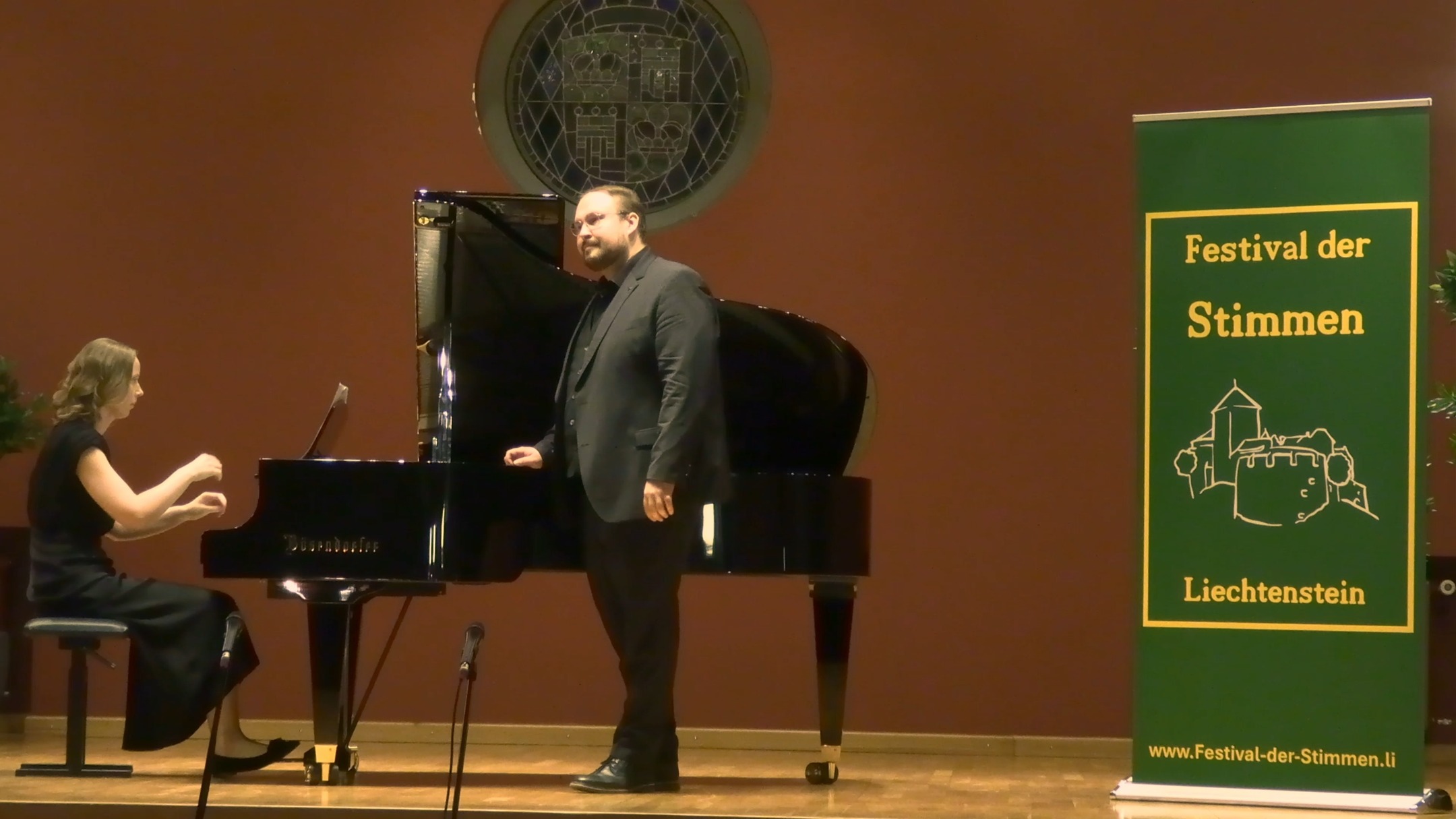
Pianist Evgenia Fölsche has presented “Und wüßten’s die Blumen, die kleinen” in complete Dichterliebe programmes; the balance between text and accompaniment figure lies at the centre of the interpretation.
Audio example: Add audio/video link here
Frequently Asked Questions about Schumann: “Und wüßten’s die Blumen, die kleinen” (Dichterliebe No. 8)
Click on a question to reveal the answer.
What is the song about?
The lyrical self imagines consolation from flowers, birds, and stars; in the end, the beloved is revealed as the source of his pain.
Which musical features shape the song?
An intimate, calm pulse, an arpeggiated accompaniment figure, cantabile declamation, and a fine intensification in the final stanza.
Is the song strophic?
Yes, four stanzas with subtle variations in dynamics, harmony, and target pitches, especially at the close.
Which voice types are common?
Editions and transpositions exist for different ranges; frequently soprano, mezzo-soprano, tenor, and baritone.
Interpretive tip?
Attend carefully to clarity of diction and a sustaining piano tone; use rubato sparingly so that the simplicity of the line can take effect.