“Im Rhein, im heiligen Strome” is Song No. 6 from Robert Schumann’s cycle Dichterliebe op. 48 after Heinrich Heine. Between the solemn imagery of the Rhine, the cathedral, and the Madonna image and a very personal emotion, the poem condenses sacred aura and love remembrance. Schumann shapes this into a simple, dignified scene with organ-like piano writing, a calm pulse, and restrained, intimate declamation.
The Poem (Heinrich Heine)
From: Lyrisches Intermezzo (Buch der Lieder)
In the Rhine, in the holy stream,
There is reflected in the waves,
With its great cathedral,
Great and holy Cologne.
In the cathedral there stands an image,
Painted on golden leather;
Into the wilderness of my life
It has shone kindly.
Flowers and little angels hover
Around our dear Lady;
The eyes, the lips, the little cheeks,
They resemble my beloved’s exactly.
Work Data & Overview
- Composer: Robert Schumann (1810–1856)
- Cycle: Dichterliebe op. 48, No. 6
- Text source: Heinrich Heine, Lyrisches Intermezzo (part of the Buch der Lieder)
- Composition: May/June 1840 (year of song); first edition 1844
- Tonal space / notation: solemn major-key sphere (often E-flat major in editions); calm 4/4 gesture; chorale-like, block piano texture
- Tempo indications: calm, dignified; vocally sustained (cantabile)
- Duration: approx. 2 minutes; a concentrated miniature
- Scoring: voice (various ranges in published editions) and piano
- Form: three stanzas, strophic / lightly varied; short, soft postlude
Data on the Poem
- Poet: Heinrich Heine (1797–1856)
- Origin (text): 1822/23; published in 1827 in the Buch der Lieder (Lyrisches Intermezzo)
- Stanza form: 3 stanzas of 4 lines each
- Rhyme scheme: alternating rhyme (ABAB)
- Stylistic devices: sacred image (cathedral / Marian image), mirror metaphor, comparison (Madonna – beloved)
Genesis & Contexts
As part of the year of song, 1840, Schumann composed a sequence of Heine settings that he initially planned on a larger scale. In the later printed 16-song version, No. 6 forms a point of contemplative repose within the current of changing affects.
Heine’s poem combines topography, sacred architecture, and religious imagery with personal love remembrance. It is precisely this interplay of outward holiness and inward projection that shapes Schumann’s musical reading.
Performance Practice & Reception
The scene calls for pianissimo culture, a sustained tempo, and clear articulation of the text. The piano writing should sound organ-like, yet be phrased with breath; large rubati disturb the contemplative stillness.
Reference Recordings (Selection)
- Dietrich Fischer-Dieskau – Jörg Demus
- Fritz Wunderlich – Hubert Giesen
- Ian Bostridge – Julius Drake
- Peter Schreier – András Schiff
- Matthias Goerne – Christoph Eschenbach
Analysis – Music
Schumann’s setting of “Im Rhein, im heiligen Strome” is shaped with clear architectural force. The song follows a distinctly recognisable A–B–A logic that mediates, in sonic correspondence to the poem, between monumentality and inwardness.
The first section feels firm and sustained. The accompaniment has weight and gravity, as though it were musically tracing the stone pillars of Cologne Cathedral. The harmony proceeds with dignity, and the vocal line unfolds in calm, declamatory phrases.
With the turn toward the “image painted on golden leather,” the tone colour changes. The music becomes gentler, the tone more personal. The monumental exterior space of the cathedral gives way to an inner, almost intimate contemplation. Here a lyrical counterpole arises to the architectural severity of the beginning.
In the return of the opening gesture, both planes are joined: outer greatness and inner feeling. Schumann thus makes audible the tension between sacred exaltation and personal projection.
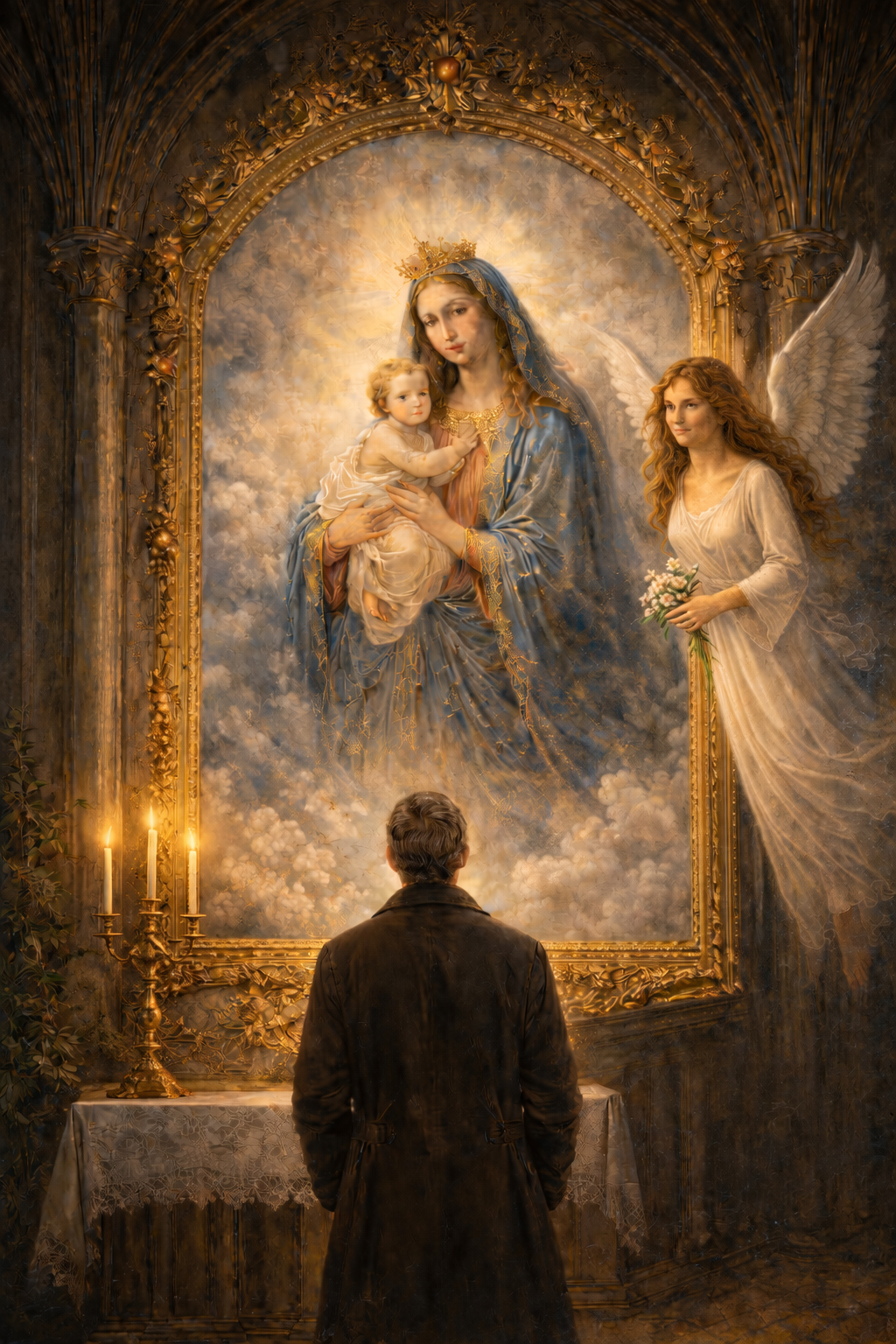
Visual Representation
Artistic visualization:
The new image does not condense the inner movement of the
song in documentary fashion, but symbolically.
At its centre is not simply a
topographical view of Rhine and cathedral,
but a transfigured world of dream and memory
in which sacred space and personal feeling
flow into one another.
The Rhine appears as a still, sustaining river
that holds together breadth, depth, and reflection.
Above it rises the cathedral not only as
a building, but as a sign of greatness,
exaltation, and religious order.
In this way the image makes visible what the poem’s opening
also formulates: a landscape that is at once real
and inwardly heightened.
The female figure seems like a
fusion of Marian image and beloved.
In this precisely the image reaches the core of
Heine’s text: the sacred image in the cathedral is
not merely observed, but transformed
in the feeling of the lyrical self into a
personal image of love.
Light, colour, and atmosphere contribute to
a solemn, quiet aura.
Nothing here is loud or dramatic;
rather, there reigns the calm transfiguration
that also shapes Schumann’s music.
The image therefore shows less a scene
of action than a state of
inward contemplation.
In this way the visualization makes clear
how in “Im Rhein, im heiligen Strome”
outward monumentality and intimate memory
come together: the cathedral gives the venerable
frame, yet at the centre stands a figure
in whom holiness and love-longing
have become inseparable.

Photo: © Raimond Spekking, CC BY-SA 4.0, via Wikimedia Commons
The probable original image in Cologne Cathedral to which Heine refers:
Alongside the artistic visualization, it is worth
looking at the concrete work of art
to which Heine most likely referred:
Stefan Lochner’s Altarpiece of the City Patrons,
also known as the Cologne Cathedral Altarpiece or
Altarpiece of the Three Kings.
What is meant in particular is the central panel with
Mary and the Child before a radiant gold ground.
This image corresponds to the description
“painted on golden leather” not in a strictly
material sense as a simple
everyday observation, but indeed in its
glittering, precious golden effect,
which Heine takes up poetically.
For reader and listener alike, this makes clear
why the Marian image in the poem does not remain
mere church furnishing, but
shines into the “wilderness” of life.
The decisive point then comes in Heine’s final turn:
the eyes, lips, and cheeks of the Madonna
resemble “the beloved exactly.”
Thus the religious image is not profaned,
but subjectively reinterpreted.
In the gaze of the lyrical self,
the sacred figure becomes the bearer of personal memory.
Precisely in the juxtaposition of the two images,
the structure of the song becomes especially clear:
the Cologne Cathedral Altarpiece stands for the historical,
iconographic, and real model,
while the new artistic visualization
makes visible that inner transformation
enacted by Heine’s poem and Schumann’s music.
Analysis – Poetry
In the Rhine, in the holy stream,
There is reflected in the waves
With its great cathedral
Great and holy Cologne.
The first stanza opens with an image of reflection. The cathedral appears twice — real and mirrored in the water. Outer world and reflected image enter into relation with one another.
In the cathedral there stands an image,
Painted on golden leather;
Into the wilderness of my life
It has shone kindly.
The image in the cathedral is described as a radiant counterpole to the “wilderness” of one’s own life. The metaphor of wilderness suggests inner unrest or lostness.
Flowers and little angels hover
Around our dear Lady;
The eyes, the lips, the little cheeks,
They resemble my beloved’s exactly.
In the final stanza, the decisive shift takes place: the Madonna is identified with the beloved. Sacred veneration and love-veneration fall into one another.
Meaning & Effect within the Cycle
Within Dichterliebe, this song marks a high point of Romantic idealization. The beloved is not merely admired, but raised to a sacred plane.
The cathedral stands for permanence and religious tradition, the image of the Madonna for divine purity. In recognizing the features of the beloved in it, the lyrical self fuses personal feeling and religious symbolism.
At the same time, a quiet ambivalence remains: the mirror structure of the poem leaves open whether this is genuine elevation or rather Romantic projection.
Schumann’s music intensifies this ambivalence through the contrast between monumental sonic architecture and tender inwardness. Thus there arises a many-layered interplay of image, word, and tone — a sacred vision that is at once the expression of personal longing.
Evgenia Fölsche – Performances & Audio
Pianist Evgenia Fölsche has accompanied “Im Rhein, im heiligen Strome” in complete Dichterliebe performances as well as in thematic Rhine programmes.
Frequently Asked Questions about Schumann: “Im Rhein, im heiligen Strome” (Dichterliebe No. 6)
Click on a question to reveal the answer.
What is the song about?
The poem describes the Rhine, Cologne Cathedral, and an image of the Virgin Mary; in the end, the lyrical self recognizes in the Madonna the features of his own beloved.
How does Schumann’s setting sound?
Simple and solemn: homophonic, chorale-like piano chords, a calm pulse, restrained dynamics — like a small cathedral scene in chamber-music form.
Is the song strophic?
Yes, three stanzas with slight variations in accompaniment and dynamics, especially in the final stanza.
Which voice types are common?
Editions and transpositions exist for different ranges; the song is often interpreted by tenor, baritone, soprano, and mezzo-soprano.
Interpretive tip?
Clarity of text and calm breath control are central; the piano writing may sound organ-like, but never heavy-handed.