“Allnächtlich im Traume” (opening: “Allnächtlich im Traume seh’ ich dich”) is Song No. 14 from Robert Schumann’s cycle Dichterliebe op. 48 after Heinrich Heine. In three stanzas, the poem unfolds a dream encounter that moves from longing closeness through mournful tears to the abrupt awakening, with the loss of both token and memory. Schumann sets all three stanzas with a subdued pulse, cantabile speech-like phrasing, and a short postlude that ebbs away.
The Poem (Heinrich Heine)
From: Lyrisches Intermezzo (Buch der Lieder)
Every night in dreams I see you,
And see you greeting me kindly,
And loudly weeping I throw myself
At your sweet feet.
You look at me sorrowfully,
And shake your little blond head;
From your eyes there steal away
Little pearl-like drops of tears.
You whisper to me a soft, secret word
And give me the bouquet of cypresses.
I wake up, and the bouquet is gone,
And I have forgotten the word.
Work Data & Overview
- Composer: Robert Schumann (1810–1856)
- Cycle: Dichterliebe op. 48, No. 14
- Text source: Heinrich Heine, Lyrisches Intermezzo (part of the Buch der Lieder)
- Composition: May/June 1840 (Year of Song); first edition 1844
- Tonal space / notation: muted minor sphere; calm, steady pulse; legato, chordal piano writing
- Tempo indications: Slow, intimate; speech-like melodic writing
- Duration: approx. 1–2 minutes; concentrated dream miniature
- Scoring: voice (various ranges in published editions) and piano
- Form: three stanzas, with subtle variations; short postlude fading away
Data on the Poem
- Poet: Heinrich Heine (1797–1856)
- Origin (text): 1822/23; published in 1827 in the Buch der Lieder (Lyrisches Intermezzo)
- Stanza form: 3 stanzas of 4 lines each
- Schumann’s setting: all 3 stanzas
- Rhyme scheme: alternating rhyme (ABAB)
- Stylistic devices: dream vision, diminutives, transfiguration of pain, symbolism of the cypress, abrupt transition from dream to waking
Genesis & Contexts
In 1840, Schumann assembled selected Heine poems into an inner dramaturgy. After the silent meditation of lament in No. 13, No. 14 remains within the dream-space – now as a tender but painfully clear vision of the beloved.
Heine’s poem comprises three stanzas, and Schumann sets them in full. In this way, the poem’s movement is preserved: from the nocturnal vision through the beloved’s mournful glance to the awakening, in which the dream’s gift and message immediately vanish again.
Performance Practice & Reception
What matters are text-centred declamation, a calm basic pulse, and a narrow pp–p range. The climax lies less in volume than in the inner tension of the words “wehmütiglich,” “Perlentränentröpfchen,” and the third stanza with “Zypressen,” “fort,” and “vergessen.”
Reference Recordings (Selection)
- Dietrich Fischer-Dieskau – Gerald Moore
- Fritz Wunderlich – Hubert Giesen
- Ian Bostridge – Julius Drake
- Peter Schreier – András Schiff
- Matthias Goerne – Christoph Eschenbach
Analysis – Music
Parlando Proximity & Sound Surfaces
The voice remains syllabic and cantabile; beneath it the piano lays out sustained chordal surfaces and gentle wave-like motions. The result is an impression of groping remembrance rather than dramatic outburst.
Three-Stanza Form & Postlude
The first two stanzas revolve around vision, gaze, and tears; in the third stanza expression intensifies around loss and withdrawal. The brief postlude feels like an echo of awakening: the sound lingers for a moment longer while the dream-world has already collapsed.
Visual Representation
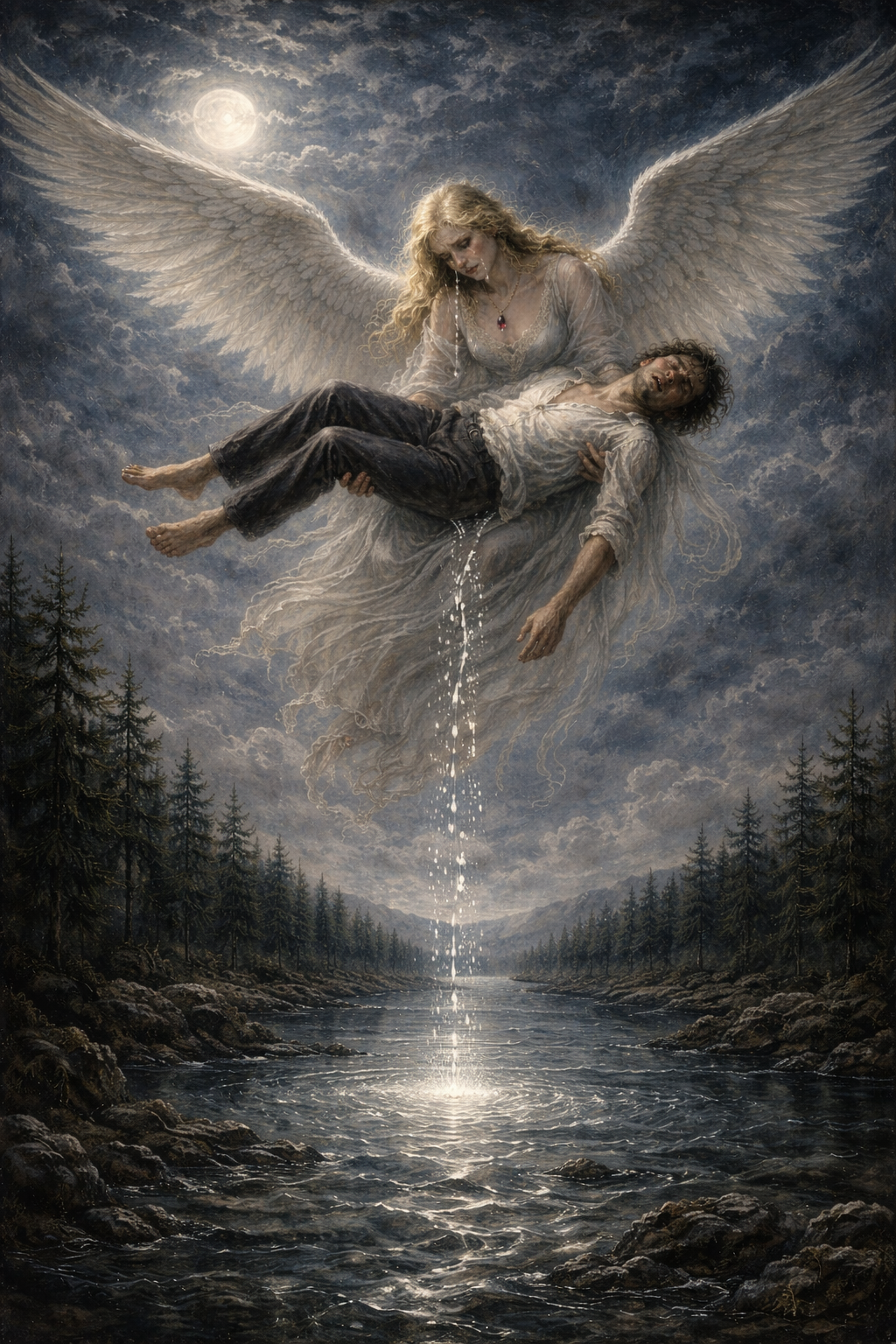
Artistic visualization:
In a nocturnal landscape, the woman no longer
appears as an earthly beloved but as an
angel-like figure of the dream. With widely
outspread wings she hovers beneath the moon
and holds the sleeping man in her arms.
The man lies heavily and surrenderingly in
her lap, as though removed from reality.
His face bears pain,
exhaustion, and inward suffering. He does not
seem sheltered in peace, but marked by dream and
longing.
The angel bends down to him in sorrow.
There is no cold majesty in her face,
but deep sadness and compassionate closeness.
She is at once consoling and unreachable –
an apparition between love, lament, and
farewell.
Particularly striking are the angel’s
pearl-like tears. They do not fall merely in
isolated drops, but gather into
a luminous stream that beneath them becomes
a great brook and flows away into the
distance. In this way the image becomes
a poetic counterpart to the
“little pearl-tear-drops” of the poem, magnifying
them into a whole landscape of
sorrow.
The night sky, the cold moonlight,
the dark banks, and the flowing water
make visible what Heine and Schumann only
suggest in words and tones: the beloved is near in the
dream, full of compassion and sorrow –
and yet everything remains in motion, in slipping away,
in what cannot be held fast. Thus the angel becomes
the emblem of a love that consoles and at the same time
is lost.
Analysis – Poetry
Every night in dreams I see you,
And see you greeting me kindly,
And loudly weeping I throw myself
At your sweet feet.
The poem opens within dream-space. The encounter with the beloved takes place not in reality, but exclusively in the nocturnal inner world. Already the word “every night” shows that the lyrical self is trapped in a recurring emotional motion.
The gesture of throwing oneself at her “sweet feet” expresses the utmost devotion and self-abasement. The lyrical self appears weeping, overwhelmed, and without distance. The dream makes possible the closeness that is lost in waking life.
You look at me sorrowfully,
And shake your little blond head;
From your eyes there steal away
Little pearl-like drops of tears.
The beloved does not respond harshly, but with sadness. The shaking of her little head feels gentle, and yet final. It is not a dramatic rejection, but a quiet confirmation that this closeness cannot pass into fulfilment.
The “little pearl-tear-drops” aestheticize the pain. The diminutives “little head” and “little tear-drops” lend the scene tenderness, intimacy, and an almost unreal delicacy of detail. Even in sorrow, the beloved remains idealized.
You whisper to me a soft, secret word
And give me the bouquet of cypresses.
I wake up, and the bouquet is gone,
And I have forgotten the word.
The third stanza brings the poem to its real core. The “soft word” remains unspoken, and therefore impossible to grasp in content. Precisely for that reason it acquires the character of a final truth that can never be held onto.
The “bouquet of cypresses” bears a clear symbolism: the cypress points toward grief, death, farewell, and the nearness of the grave. The beloved’s gift is therefore not a cheerful token of love, but an emblem of finality and transience.
With awakening, the dream-reality breaks off abruptly. Not only does the beloved vanish, but her message and her token are lost as well. The poem thus reveals a double powerlessness: closeness is experienced, yet can neither be preserved nor understood.
Thus the dream is not a place of fulfilment, but a place of repeated loss. In the dream, the lyrical self once more touches the possibility of love and communication – and loses it again in that very moment of waking.
Meaning & Effect within the Cycle
Within Dichterliebe, this song shows a further inward shift. Reality is no longer the scene of encounter – only the dream is.
The beloved remains unreachable, yet in the dream she appears gentle and compassionate. This makes the situation even more painful: even her sympathy changes nothing about the separation.
The third stanza sharpens this finding still further. The soft word and the bouquet of cypresses seem to contain a meaning, a sign, perhaps even a final message – but on waking both are erased.
Thus the dream-motif within the cycle is deepened further: the poet can reach the beloved only inwardly. Yet even there, what is experienced cannot be held fast. Closeness appears, touches, and immediately withdraws again.
Evgenia Fölsche – Performances & Audio
Pianist Evgenia Fölsche interprets “Allnächtlich im Traume” as an almost motionless vision – with narrow dynamics, a speech-close line, and a fine sense of the fragile closing effect of the third stanza.
Frequently Asked Questions about Schumann: “Allnächtlich im Traume” (Dichterliebe No. 14)
Click on a question to reveal the answer.
Does Schumann use Heine’s complete text?
Yes. In “Allnächtlich im Traume,” Schumann sets all three stanzas of Heine’s poem.
What is the song’s basic character?
Calm, intimate, with speech-like declamation and sustained piano textures – more vision than aria.
Is the song strophic?
Yes. The song is laid out in three stanzas and, in concise form, leads up to the awakening in the third stanza.
Which voice types are common?
Editions and transpositions exist for different ranges; the song often appears in soprano, mezzo-soprano, tenor, and baritone programmes.
What is the meaning of the bouquet of cypresses?
The cypress is traditionally associated with grief, death, and farewell. In the third stanza, the bouquet thus becomes a sign of transience and irrevocable loss.