“Auf einer Burg” (opening: “Eingeschlafen auf der Lauer”) is Song No. 7 from Robert Schumann’s cycle Liederkreis op. 39 after Joseph von Eichendorff. An ancient knight, lashed by rain, sits “above” in the silent cell — “below,” a wedding glides along the Rhine, and the beautiful bride weeps. Schumann draws this double perspective in a rigid, archaic-sounding upper world and a cuttingly sober, almost documentary turn below: a miniature about time, petrification, and an unresolved riddle.
The Poem (Joseph von Eichendorff)
From: Poems
Eingeschlafen auf der Lauer
Oben ist der alte Ritter;
Drüben gehen Regenschauer,
Und der Wald rauscht durch das Gitter.
Eingewachsen Bart und Haare,
Und versteinert Brust und Krause,
Sitzt er viele hundert Jahre
Oben in der stillen Klause.
Draußen ist es still und friedlich,
Alle sind in’s Tal gezogen,
Waldesvögel einsam singen
In den leeren Fensterbogen.
Eine Hochzeit fährt da unten
Auf dem Rhein im Sonnenscheine,
Musikanten spielen munter,
Und die schöne Braut, die weinet.
Work Data & Overview
- Composer: Robert Schumann (1810–1856)
- Cycle: Liederkreis op. 39 (Eichendorff), No. 7
- Text source: Joseph von Eichendorff (1788–1857)
- Origin (composition): May 1840 (year of song); first published 1842
- Tonal space / notation: a minor-coloured, “rigid” foundation (often E minor in editions) with modal inflections; little deviation, sparse texture
- Tempo indications: Calm, narrative – inner tension without an excess of rubato
- Duration: approx. 2 minutes; scenic tableau with an open ending
- Scoring: voice (various ranges) and piano
- Form: varied strophic form (4 quatrains) with a contrasting climax in the closing image (“wedding … she weeps”)
Data on the poem
- Poet: Joseph von Eichendorff
- Stanza form: 4 stanzas of 4 lines each
- Rhyme scheme: cross rhyme (ABAB)
- Devices: above/below contrast, standstill of time versus the flow of life, unexplained punchline (the bride’s weeping)
Origins & Contexts
Within the Liederkreis, “Auf einer Burg” contrasts an inwardly frozen image of time (the knight in his cell) with a bright outer scene (the wedding procession on the Rhine). The poem leaves the riddle unresolved: why is the bride weeping? Schumann takes over this openness and sharpens it musically.
In the arc of the cycle, the piece lies between the brightening Schöne Fremde (No. 6) and the second In der Fremde (No. 8) — a cold point of repose before renewed inner motion.
Performance Practice & Reception
Sound idea: above (the knight) = sparse narration, straight line, little vibrato; below (the wedding) = no sentimentality, but sober brightness. Piano: dry legato, sparing pedal changes — clarity before romantic haze.
Reference Recordings (Selection)
- Dietrich Fischer-Dieskau – Gerald Moore
- Elly Ameling – Dalton Baldwin
- Christian Gerhaher – Gerold Huber
- Ian Bostridge – Julius Drake
- Matthias Goerne – Christoph Eschenbach
Analysis – Music
“Above/Inside” and “Below/Outside”
Schumann shapes the “above” through static harmonies, open intervals, and little melismatic motion — the sound seems “frozen.” The outer world (“below”) appears not as festive jubilation, but as cool observation; the bride’s weeping meets this coolness — without any musical release into pathos.
Form, Tonal Spaces & Closing Effect
Four text-bound sections, hardly ever modulating toward “redemption.” The ending leaves the dissonance standing semantically (cheerfulness versus tears): an open finding rather than a moral interpretation. Precisely this lack of resolution gives the ending its force.
Visual Representation
Artistic visualisation by Evgenia Fölsche:
High above the
wide Rhine valley
rises an
ancient castle.
Its walls are weathered
and marked
by time.
The dark windows
resemble mute eyes
that have watched
over the valley
for centuries.
The forest
growing down
the hillside
resembles
a long,
unkempt beard —
as though the castle itself
had transformed
into the face
of an old knight.
Thus the landscape
becomes the image
of the knight
who, in Eichendorff’s
poem,
has sat motionless
on his castle
for centuries,
petrified
between past
and present.
Deep below in the valley
a cheerful wedding
passes by.
Music sounds,
people dance,
and life
moves onward.
But the knight
on the castle
remains behind —
lonely
and unmoving,
while time
continues to flow
beneath him.
Schumann’s music, too,
draws this image
with great intensity.
The slow,
almost motionless
piano accompaniment
acts like a quiet,
unwavering
current of time.
Above it,
the singer’s melody
stands like a memory
of a world
long gone.
Thus the castle
becomes a symbol
of a petrified
past —
while down in the valley
life
goes on.
Analysis – Poetry
“Auf einer Burg” is a still life of time. The poem sets two levels against one another: above, the rigid past; below, the flowing life. Motion and petrification stand in sharp contrast.
Stanza 1 – Sentinel of the past
Eingeschlafen auf der Lauer
Oben ist der alte Ritter;
Drüben gehen Regenschauer,
Und der Wald rauscht durch das Gitter.
The knight has “fallen asleep” — but not in peace, rather “on watch.” His posture points to former vigilance that has now become meaningless.
Nature continues to move: rain showers pass by, the forest rustles. Life and time move onward, while the knight remains fixed.
Stanza 2 – Petrified existence
Eingewachsen Bart und Haare,
Und versteinert Brust und Krause,
Sitzt er viele hundert Jahre
Oben in der stillen Klause.
Man and stonework have become one. “Overgrown” and “petrified” — organic life turns into matter.
The time indication “many hundred years” exceeds human measure. The knight is a relic, a monument of a vanished world.
Stanza 3 – Emptiness and departure
Draußen ist es still und friedlich,
Alle sind in’s Tal gezogen,
Waldesvögel einsam singen
In den leeren Fensterbogen.
Life has shifted elsewhere. “All have moved down into the valley” — the castle is no longer the centre, but a remnant.
The birds sing in “empty window arches”: nature takes over the space of history. The loneliness feels not dramatic, but resigned.
Stanza 4 – Wedding and tear
Eine Hochzeit fährt da unten
Auf dem Rhein im Sonnenscheine,
Musikanten spielen munter,
Und die schöne Braut, die weinet.
Below, the Rhine flows — symbol of life and time. A wedding passes by: celebration, music, sunshine.
But the bride weeps. This final line overturns the idyll. Joy and sorrow stand side by side.
Thus above and below mirror one another: the knight is petrified, the bride lives — and yet a shadow lies even over her happiness.
Meaning & Effect within the Cycle
“Auf einer Burg” belongs to the darkest moments of the Liederkreis op. 39. It shows not dramatic catastrophe, but silent petrification.
The past is not glorified, but shown as lifeless. The knight embodies an outdated ideal of the chivalric world.
The wedding below at the same time relativises the present: even within the celebration there is grief. Time continues to flow — but without final redemption.
Schumann’s setting underlines this rigidity with an almost motionless sonic plane. The music feels frozen, far removed from any pathetic gesture.
Thus there emerges an image of existential distance: between life and history, between motion and stone, between festivity and melancholy.
Evgenia Fölsche – Performances & Audio
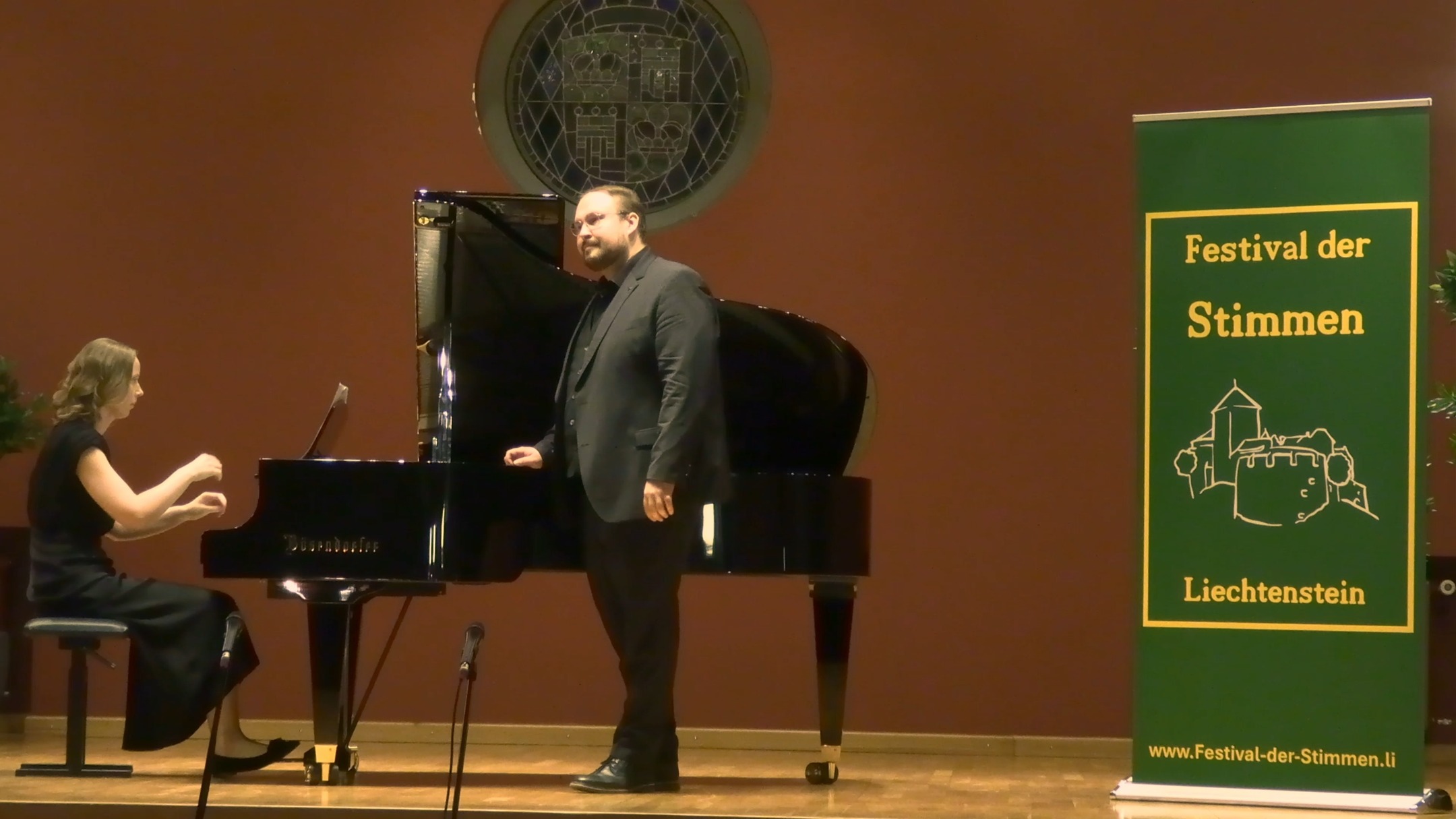
Pianist Evgenia Fölsche reads “Auf einer Burg” as a cold study: above, spare and timeless; below, sober — no rapturous tears, but a clear shaping of the double layer.
Frequently Asked Questions about “Auf einer Burg” (Liederkreis op. 39, No. 7)
Click on a question to show the answer.
Why is the bride weeping?
The text does not say. This not-knowing is part of the effect (an image of happiness with a crack in it); Schumann intensifies the openness rather than resolving it.
How does one differentiate “above” and “below” sonically?
“Above”: sparse, straight line, little vibrato; piano dry. “Below”: bright, but sober — no illusion of festive intoxication, so that the tear does not become sentimental.
Is the song strophic?
Yes — four stanzas with varied interpretation; the final stanza sets the semantic contrast (wedding/tear).
Interpretive tip?
Use pedal sparingly; keep consonants clear; avoid a “big” ending — the point lives from the open finding, not from resolution.