“In der Fremde” (opening: “Aus der Heimat hinter den Blitzen rot”) is Song No. 1 from Robert Schumann’s cycle Liederkreis op. 39 to poems by Joseph von Eichendorff. In only two stanzas, the text spans the arc from distance from home and lostness to the longed-for rest in the image of “forest solitude.” Schumann answers with a dark basic colouring, restless piano motion, and a resigned closing turn – the opening to the inward journey of the entire cycle.
The Poem (Joseph von Eichendorff)
From: Poems – “Liederkreis” group
Aus der Heimat hinter den Blitzen rot,
Da kommen die Wolken her;
Aber Vater und Mutter sind lange tot,
Es kennt mich dort keiner mehr.
Wie bald, ach, wie bald kommt die stille Zeit,
Da ruh’ ich auch, und über mir
Rauscht die schöne Waldeinsamkeit,
Und keiner kennt mich mehr hier.
Work Data & Overview
- Composer: Robert Schumann (1810–1856)
- Cycle: Liederkreis op. 39 (Eichendorff), No. 1
- Text source: Joseph von Eichendorff (1788–1857)
- Origin (composition): May 1840 (year of song); first published 1842
- Tonal space / notation: a minor-coloured opening tonal area (often F-sharp minor in editions); continuous figuration in the piano
- Tempo marking: Ziemlich langsam; restrained, with a speech-like line
- Duration: approx. 1–2 minutes; dark opening to the cycle
- Scoring: voice (various ranges) and piano
- Form: two stanzas with varied interpretation; short, resigned postlude
Data on the poem
- Poet: Joseph von Eichendorff
- Stanza form: 2 stanzas of 4 lines each
- Rhyme scheme: cross rhyme (ABAB)
- Devices: contrast of home/foreignness, nature image as soul landscape, foreboding of death (“stille Zeit”)
Origins & Contexts
Schumann’s op. 39 was written in May 1840 and is regarded as especially “Eichendorffian”: nature as mirror of the inner self, images of night and forest, distance and longing. No. 1 sets the cycle in a muted, introspective tone – far removed from any brilliant prologue.
Noteworthy: the cycle contains two songs entitled “In der Fremde” (Nos. 1 and 8) – different poems and different characters, illuminating the topos of uprootedness from two sides.
Performance Practice & Reception
What is required is text-led declamation, a quiet but tense basic pulse, and clear consonants. The “forest” image at the end must not become “big” – the effect lies in quiet acceptance.
Reference Recordings (Selection)
- Dietrich Fischer-Dieskau – Gerald Moore
- Fritz Wunderlich – Hubert Giesen
- Ian Bostridge – Julius Drake
- Christian Gerhaher – Gerold Huber
- Matthias Goerne – Christoph Eschenbach
Analysis – Music
Gesture & Accompaniment Figure
The piano traces a restless, quietly flowing figuration – like clouds or wind drifting from afar. Above it lies a syllabic, speech-close vocal line with sparing high accents on key words (Blitzen, stille Zeit, Waldeinsamkeit).
Form, Tonal Space & Closing Effect
Stanza 2 varies harmony and dynamics with care: a brief brightening before “stille Zeit,” then a sinking of tension. The postlude closes not heroically but like a deep inward breath – resigned stillness rather than redemption.
Visual Representation
Artistic visualisation by Evgenia Fölsche:
On a wooded height
stands a man, gazing
into the distance.
Before him stretches
a large lake,
calm and dark,
as though it reflected
his inward mood.
The trees around him
frame the scene,
yet they offer no shelter.
Between their trunks
the view opens
down toward the plain –
toward the place
where his home lies.
On the horizon
a storm is gathering.
Red lightning
tears across the sky
and casts
an uneasy glow
over the landscape.
Nature appears torn,
charged with tension
and ominous foreboding.
The image takes up
the song’s dark,
agitated sound-world.
Like the restless,
pressing figures in the piano,
which hardly provide
firm ground,
everything here too
is marked by inward
division.
The man is physically
in a foreign place –
yet the storm
above his homeland shows:
there is no peace
there either.
Nature becomes the mirror
of a state
between memory,
loss, and
painful recognition.
Analysis – Poetry
The poem “In der Fremde” opens Liederkreis op. 39 with a condition of existential lostness. It describes not a concrete place, but an inward landscape. Natural phenomena become the mirror of emotional motion. Home appears not as a reachable place, but as a lost and at the same time threatening memory.
Foreignness as a Basic Condition
Aus der Heimat hinter den Blitzen rot
Da kommen die Wolken her,
Aber Vater und Mutter sind lange tot,
Es kennt mich dort keiner mehr.
Already the first line links origin with unrest. Home lies “behind the red lightning” – it is not idyllic, but surrounded by storm and disturbance. The nature images carry an emotional colouring: clouds gather as if they came directly out of the past.
With the death of the parents, every bond is severed. Home loses its personal core. The line “Es kennt mich dort keiner mehr” marks a final estrangement: even one’s place of origin no longer offers identity.
Inner Upheaval
Wie bald, ach wie bald kommt die stille Zeit,
Da ruhe ich auch,
Und über mir rauschet die schöne Waldeinsamkeit,
Und keiner kennt mich auch hier.
The “stille Zeit” points toward rest – possibly death, or final silence. Rest appears here not as consolation, but as the consequence of total solitude.
“Waldeinsamkeit” evokes a Romantic ideal, yet it too is ambivalent: beauty and isolation coincide. The final line repeats the motif of being unknown. Neither home nor foreign land offers belonging.
The poem thus unfolds a circular motion: from the lost homeland, the gaze leads not into a new community, but into existential solitude.
Meaning & Effect within the Cycle
As the opening of Liederkreis op. 39, “In der Fremde” sets the basic tone of the entire cycle. Nature here is not an idyllic retreat, but an expression of inner tension. Home appears at once as origin and as loss.
The song formulates a fundamental Romantic motif: the longing for belonging remains unfulfilled. The movement leads not back, but into ever deeper solitude.
In this way the song establishes that atmosphere between nature-image, memory, and existential loneliness which shapes the entire cycle.
Evgenia Fölsche – Performances & Audio
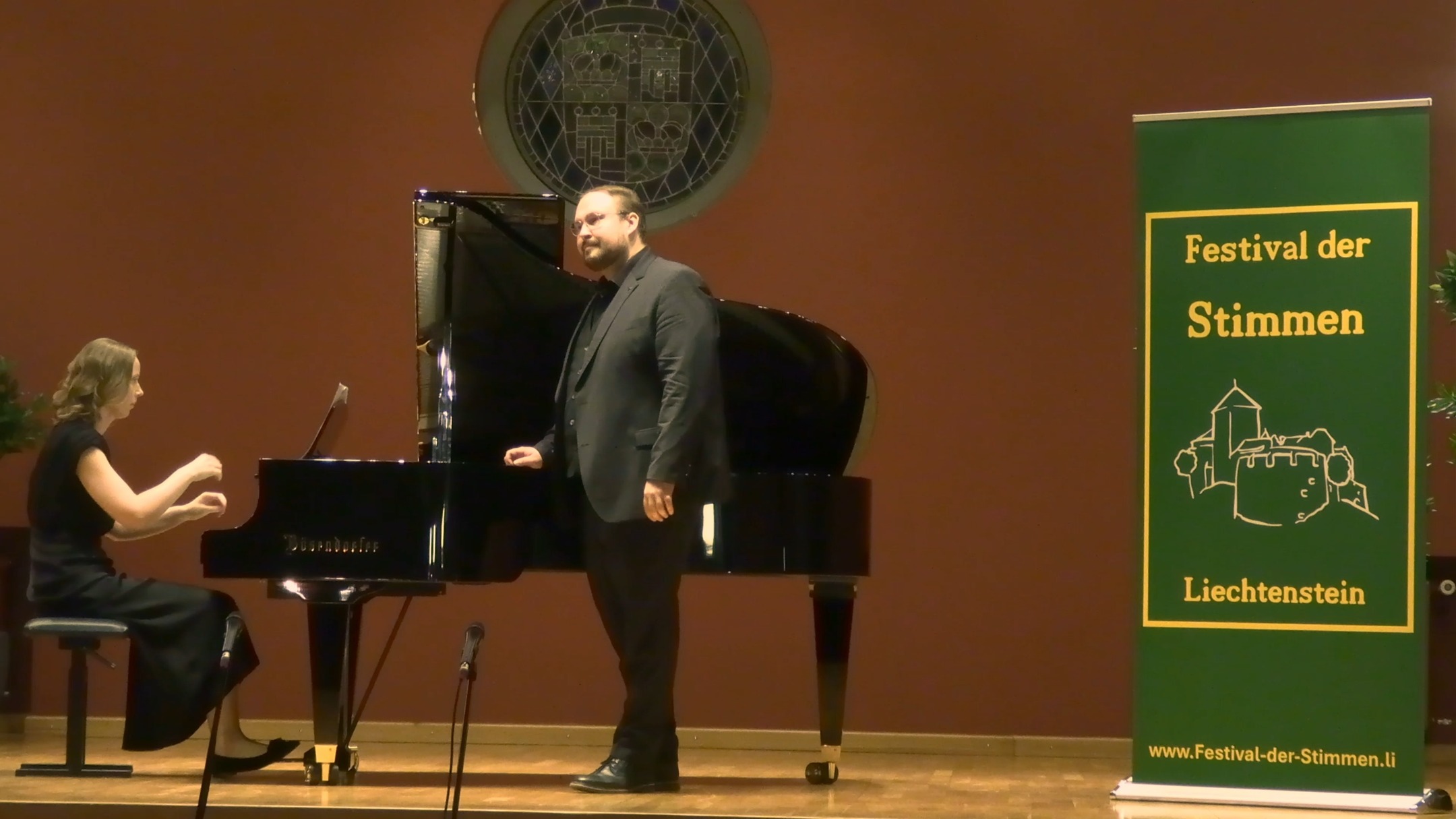
Pianist Evgenia Fölsche interprets “In der Fremde” (No. 1) as a muted prologue: breathing figuration, speech-focus in the voice, and a genuine withdrawal in the postlude.
Frequently Asked Questions about “In der Fremde” (Liederkreis op. 39, No. 1)
Click on a question to show the answer.
Are there two songs called “In der Fremde” in op. 39?
Yes. No. 1 begins “Aus der Heimat hinter den Blitzen rot,” No. 8 begins “Ich hör’ die Bächlein rauschen.” They are different poems and settings.
How should “Ziemlich langsam” be understood here?
As a calm, tense pulse with clear verbal articulation – not stretched; the inner unrest lies in the piano figure, not in a dragging tempo.
Which voice types are common?
There are editions/transpositions for high and low ranges; commonly soprano/mezzo-soprano as well as tenor/baritone.
Interpretive tip?
Consonants precise, vibrato narrow, dynamics restrained. Do not “load up” the ending – the effect lies in the quiet release.