“Im Walde” (opening: “Es zog eine Hochzeit den Berg entlang”) is song no. 11 from Robert Schumann’s cycle Liederkreis op. 39 on poems by Joseph von Eichendorff. A fleeting outer scene—wedding procession, flashing riders, hunting-horn calls—suddenly tips into night, silence, and inward shuddering. Schumann shapes this reversal as a brief hunting scherzo with bright 6/8 momentum and a dark fade-out that draws the sound back into depth.
The Poem (Joseph von Eichendorff)
From: Poems
Original German text
Es zog eine Hochzeit den Berg entlang,
Ich hörte die Vögel schlagen,
Da blitzten viel Reiter, das Waldhorn klang,
Das war ein lustiges Jagen!
Und eh’ ich’s gedacht, war alles verhallt,
Die Nacht bedecket die Runde;
Nur von den Bergen noch rauschet der Wald
Und mich schauert’s im Herzensgrunde.
English translation
A wedding procession moved along the mountain,
I heard the birds singing,
many riders flashed by, the forest horn sounded,
it was a merry hunt!
And before I had even thought it, everything had faded away,
night covered the whole scene;
only from the mountains the forest still rustled,
and I shuddered deep within my heart.
Work Details & Overview
- Composer: Robert Schumann (1810–1856)
- Cycle: Liederkreis op. 39 (Eichendorff), no. 11
- Text source: Joseph von Eichendorff (1788–1857)
- Origin (composition): May 1840 (year of song); first print 1842
- Tonal space / notation: bright, animated 6/8 field in the first part; muted, darker colouring in the closing section
- Tempo indications: fairly lively / animated; clear pulse, precise articulation
- Duration: approx. 1½–2 minutes; the shortest hunting miniature of the cycle
- Scoring: voice (various registers) and piano
- Form: strophic (2 quatrains) with a strong change of mood between stanzas 1 and 2
Poem Details
- Poet: Joseph von Eichendorff
- Stanza form: 2 stanzas of 4 lines each
- Rhyme scheme: alternating rhyme (ABAB)
- Devices: scene cut (festival → night), onomatopoeia (“Waldhorn”, “rauschet”), affective punchline (“schauert’s …”)
Origins & Contexts
Within op. 39, “Im Walde” belongs to the sequence of night and forest pieces and contrasts the static time-image of Auf einer Burg (no. 7) as well as the warning inner tension of Zwielicht (no. 10) with a lightning-fast outer episode. The Romantic point lies in the abrupt dying-away: the festival vanishes, and what remains is the solitary listener.
The song stands immediately before the closing apotheosis Frühlingsnacht (no. 12)—dramaturgically a brief darkness before the final brightening.
Performance Practice & Reception
Sound idea: stanza 1 as a springing 6/8 with clear accents on the “horn” and “rider” words; light articulation, text in front. In stanza 2, immediately withdraw: less pedal, darker timbre, the pulse remains—but silence “moves in.”
Reference Recordings (selection)
- Dietrich Fischer-Dieskau – Alfred Brendel
- Elly Ameling – Dalton Baldwin
- Brigitte Fassbaender – Irwin Gage
- Christian Gerhaher – Gerold Huber
- Ian Bostridge – Julius Drake
Analysis – Music
Hunt Gesture & Horn Call
Arpeggiated or dotted figures make the hunting and wedding scene flicker past; short accent peaks on “blitzten,” “Waldhorn,” and “lustiges Jagen” support the imagery. Important: stay light—no operatic forte.
Two-Part Dramaturgy of Contrast
The turn after stanza 1 is the centre: harmonically and dynamically “darker,” the space grows larger, the movement smaller. The postlude (if present / more pronounced depending on the edition) preserves the silence—the inner “shudder” becomes audible as a residue.
Visual Representation
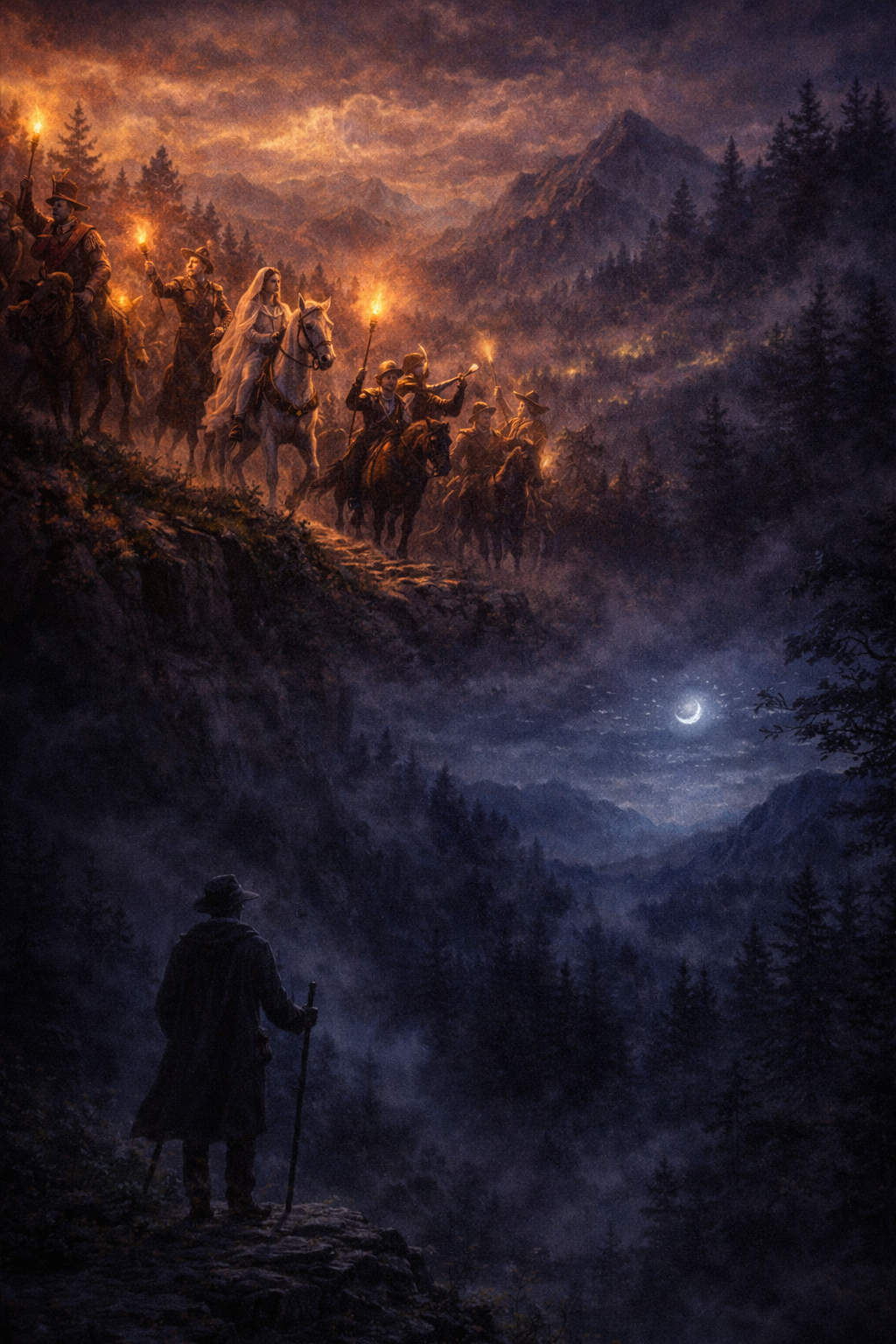
Artistic visualisation by Evgenia Fölsche:
A narrow path
leads through
a dark mountain
forest.
On the ridge,
a festive procession
passes by:
riders,
torches,
and music
accompany a
wedding
moving through
the woods.
For a moment,
living movement
fills
the nocturnal
landscape.
Light,
sound,
and voices
break through
the forest’s
silence.
Yet in the foreground,
a single wanderer
remains behind.
From his elevated
vantage point
he watches
the scene—
as though he no longer
belonged
to this world
of celebration
and community.
Soon enough,
the lights
disappear
among the trees.
The music
dies away,
and the forest
sinks once more
into nocturnal
silence.
It is precisely
this fleeting shift
between
movement
and solitude
that Eichendorff’s poem
describes:
a moment
of life
passes by,
while the wanderer
is left behind
alone
in the dark.
Schumann’s music,
too, follows
this dramatic
motion.
The rapid figures
in the piano
recall the passing
riders
and the sound
of the horns,
before the music
returns at the end
to a mysterious
silence.
Thus the forest
becomes the setting
of a brief,
almost dreamlike
moment
that vanishes
as quickly
as it appeared—
leaving behind
in the wanderer’s heart
a quiet
shudder.
Analysis – Poetry
“Im Walde” combines vivid imagery and sudden silence. At its centre stands a scene of transition: from loud festivity into nocturnal forest silence. Nature functions as a resonant space for human experiences of joy and fear.
Stanza 1 – Festival and Hunt
Es zog eine Hochzeit den Berg entlang,
Ich hörte die Vögel schlagen,
Da blitzten viel Reiter, das Waldhorn klang,
Das war ein lustiges Jagen!
The first line describes a “wedding”— an image of community and festivity. Yet it is embedded in nature: it moves “along the mountain,” half wild in character.
The jubilation is acoustic: birdsong, hunting horn, hunting scenes. Everything suggests movement and vitality. The riders “flash”— light and action create a cheerful restlessness.
The doubling of wedding and hunt is striking: festival and pursuit lie close together. The merry hunt works associatively alongside the wedding— a procession in nature, not merely a celebration.
Stanza 2 – The Sudden Silence
Und eh’ ich’s gedacht, war alles verhallt,
Die Nacht bedecket die Runde;
Nur von den Bergen noch rauschet der Wald
Und mich schauert’s im Herzensgrunde.
Suddenly everything is over: “before I thought it,” life disappears.
Night “covers the circle”: the scene of light and sound gives way to darkness. Where there had just been laughter and music, there is now only the rustling of the forest.
The final line changes the mood: “my heart’s depths shudder.” What remains is not joy, but an inward trembling.
Nature is no longer the resonant space of celebration, but the mirror of a deeper unrest.
Meaning & Effect in the Cycle
Within Liederkreis op. 39, “Im Walde” brings together two basic states: loud life and silent darkness. The hunting and wedding images express human community and movement.
Yet everything is fleeting: night swallows the scene, and the heart is left with a shudder.
Schumann’s music reflects this contrast: lively figures dominate the first half, while the second is shaped by darkness and inner tension.
Thus “Im Walde” becomes an allegory: joys are transient, and in silence the self recognises its own vulnerability.
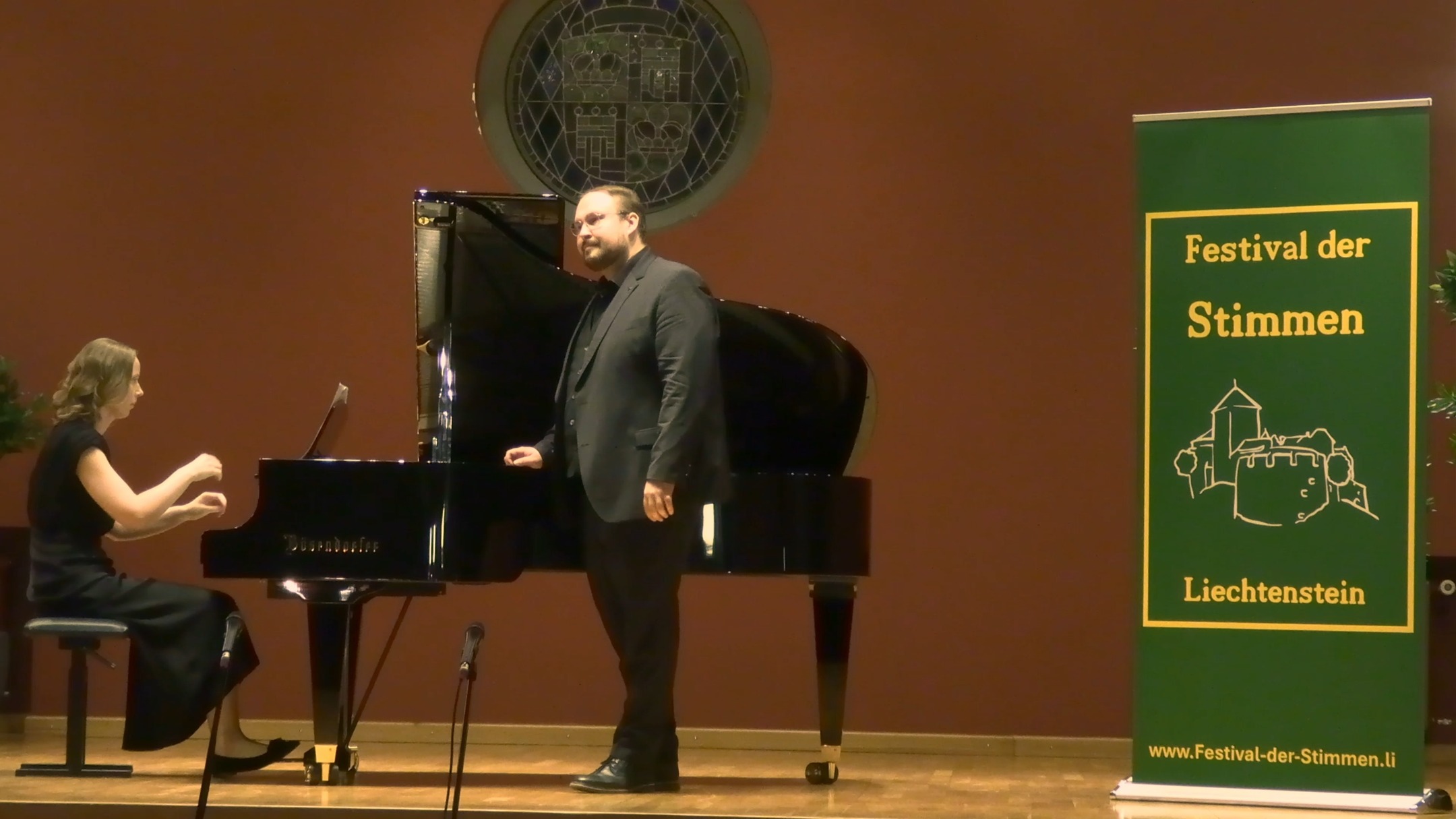
Evgenia Fölsche – Performances & Audio
Pianist Evgenia Fölsche emphasises the contrast between the stanzas: springing 6/8 pulse, clear “horn” peaks—then immediate darkening and calm exhalation at the close.
Frequently Asked Questions about “Im Walde” (Liederkreis op. 39, No. 11)
Click on a question to reveal the answer.
Is “Im Walde” strophic?
Yes. Two quatrains—stanza 1 (festival/hunt) and stanza 2 (night/inwardness) form the central contrast.
How fast and how loud?
Quite lively in 6/8 (stanza 1), then clearly withdraw (stanza 2). Basic dynamic mp → p; no operatic climax.
What carries the imagery?
Short accented “horn” gestures, light articulation, clear consonants; in stanza 2, darken pedal and colour while keeping the “rustling” transparent.
Interpretive tip?
Set the turn without dramatic ritardando: move directly from light to twilight—that is what makes the point so strong.