“Zwielicht” (opening: “Dämmrung will die Flügel spreiten”) is Song No. 10 from Robert Schumann’s cycle Liederkreis op. 39 after Joseph von Eichendorff. The poem unfolds a warning twilight scene: nature as omen, distrust of friend and world, and finally a brief admonition to remain awake. Schumann responds with sharply drawn contrasts, harmonic suspension, and a line that whispers more than it declares — an inner alarm-piece without loud effects.
The Poem (Joseph von Eichendorff)
From: Poems
Dämmrung will die Flügel spreiten,
Schaurig rühren sich die Bäume,
Wolken ziehn wie schwere Träume –
Was will dieses Graun bedeuten?
Hast ein Reh du lieb vor andern,
Laß es nicht alleine grasen,
Jäger ziehn im Wald und blasen,
Stimmen hin und wieder wandern.
Hast du einen Freund hienieden,
Trau ihm nicht zu dieser Stunde,
Freundlich wohl mit Aug’ und Munde,
Sinnt er Krieg im tück’schen Frieden.
Was heut müde gehet unter,
Hebt sich morgen neugeboren.
Manches bleibt in Nacht verloren –
Hüte dich, bleib wach und munter!
Work Data & Overview
- Composer: Robert Schumann (1810–1856)
- Cycle: Liederkreis op. 39 (Eichendorff), No. 10
- Text source: Joseph von Eichendorff (1788–1857)
- Origin (composition): May 1840 (year of song); first published 1842
- Tonal space / notation: dark basic colouring with modal shadings; abrupt colour shifts between stanzas
- Tempo indications: Quite slow, with tension; stable pulse, inner agogics at verbal hinges
- Duration: approx. 2 minutes; warning miniature
- Scoring: voice (various ranges) and piano
- Form: strophic (4 stanzas) with pronounced interpretive dramaturgy
Data on the poem
- Poet: Joseph von Eichendorff
- Stanza form: 4 stanzas of 4 lines each
- Rhyme scheme: cross rhyme (ABAB)
- Devices: personification (twilight), parenesis (warning), axioms of distrust, antithesis (peace/war)
Origins & Contexts
Within the cycle, “Zwielicht” stands between Wehmut (No. 9) and Im Walde (No. 11) — it forms the dark hinge-point: inward vulnerability turns into outward alertness. The poem condenses romantic signs of nature into sentences of warning; Schumann translates this into sonic disquiet rather than dramatic explosion.
The poetic core is ambivalence: nature vs. threat, friendship vs. betrayal, night vs. new morning. The music sustains this suspension and deliberately avoids any “solution.”
Performance Practice & Reception
Sound idea: pp–mp, straight pulse, text in front; piano with dry legato, sparing pedal (clarity before “twilight haze”). Stanza 3 (“Trau ihm nicht…”) without forte pathos — coldness is more effective than loudness.
Practice: stanza profile
- Stanza 1 – Signs of twilight: covered tone, micro-dynamics on “heavy dreams” and “dread”; no excessive rubato.
- Stanza 2 – Roe deer / hunters: rhythmically tighter, a light accent-edge on “hunters” / “blow”; the voice remains slender.
- Stanza 3 – Friend / distrust: consonants precise; “treacherous peace” with cool sharpness, not over-pointed.
- Stanza 4 – Formula of warning: brief brightening at “newborn,” then immediate withdrawal; let “Beware…” sound dry and spoken.
Reference Recordings (Selection)
- Dietrich Fischer-Dieskau – Christoph Eschenbach
- Christian Gerhaher – Gerold Huber
- Ian Bostridge – Julius Drake
- Elly Ameling – Dalton Baldwin
- Matthias Goerne – Christoph Eschenbach
Analysis – Music
Twilight Gesture & Warning Signal
The accompaniment remains connected and cool; harmonic sideways movements create placelessness. Sharp speech-consonants (g, k, t) carry the warning — the timbre stays narrow, not heroic.
Strophic Form, Harmony & Closing Formula
The strophic form serves the intensification from sign in nature to social warning and back to a general formula of admonition. A brief brightening (“newborn”) immediately tips back into the sobriety of the close: “Beware, stay awake and alert!” — musically without triumph, but with quiet resolve.
Visual Representation
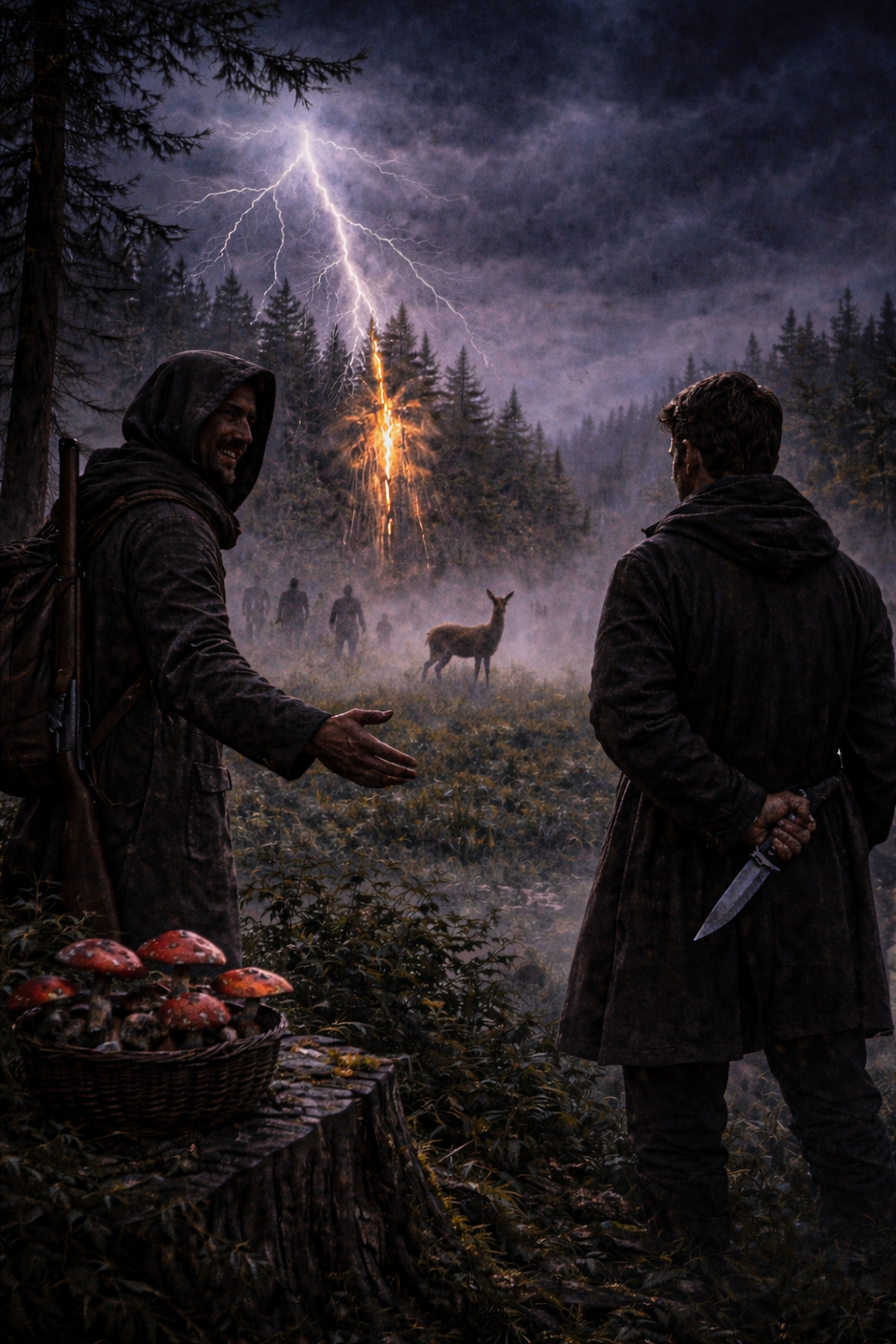
Artistic visualisation by Evgenia Fölsche:
Heavy storm clouds
gather
over a dark
forest.
A bolt of lightning
strikes a tree
and floods the scene
for a moment
with glaring light.
Before the forest edge,
in a lonely clearing,
stands a roe deer —
alert,
though still unaware
of the danger
hidden in the shadows.
Among the trees
hunters appear
as shadowy forms,
their horns
echoing
through the wood.
In the foreground,
two people meet.
One extends
a seemingly friendly
hand,
while behind
his back
a knife is hidden.
The image condenses
several motifs
of the poem
into a single
scene:
nature,
the hunt,
and human
deceit
merge
into an atmosphere
of mistrust
and impending danger.
Eichendorff describes
a world
in which, in twilight,
nothing appears
entirely certain:
friends can become
enemies,
and behind
apparent calm
betrayal
lurks.
Schumann’s music,
too,
mirrors this
uncertainty.
The accompaniment
moves nervously
and restlessly,
while the harmony
repeatedly turns
toward dark
tonal colours.
Like the lightning
that briefly
illuminates
the landscape,
the song lets us glimpse
for a moment
what is happening
in secret.
Thus twilight becomes
the symbol
of a world
in which one must
remain watchful —
for not everything
that seems friendly
truly is.
Analysis – Poetry
“Zwielicht” is one of the most restless poems in the cycle. It unfolds an atmosphere of latent threat. Twilight is described not as a gentle transition, but as a zone of danger. Everything becomes uncertain — perception, relationship, trust.
Stanza 1 – Nature in an ominous tone
Dämmrung will die Flügel spreiten,
Schaurig rühren sich die Bäume,
Wolken ziehn wie schwere Träume –
Was will dieses Graun bedeuten?
Twilight appears personified. It “wants to spread its wings” — like a great dark being.
Nature becomes uncanny. “Ghastly,” “heavy dreams,” “dread” — words of threat dominate. The question at the end remains open: disaster is felt, but not explained.
Stanza 2 – The threatened roe deer
Hast ein Reh du lieb vor andern,
Laß es nicht alleine grasen,
Jäger ziehn im Wald und blasen,
Stimmen hin und wieder wandern.
The roe deer stands as an image of innocence and vulnerability. Love requires vigilance.
The hunters with their horns introduce the motif of pursuit. The voices “wander” — nothing is fixed, everything uncertain.
Stanza 3 – Distrust toward the friend
Hast du einen Freund hienieden,
Trau ihm nicht zu dieser Stunde,
Freundlich wohl mit Aug’ und Munde,
Sinnt er Krieg im tück’schen Frieden.
Now the warning becomes existential. Not only animals are threatened, but human relationships as well.
The “friend” appears double-edged. Outward friendliness can conceal inward hostility. “Treacherous peace” is a mask.
Trust itself becomes questionable.
Stanza 4 – Call to vigilance
Was heut müde gehet unter,
Hebt sich morgen neugeboren.
Manches bleibt in Nacht verloren –
Hüte dich, bleib wach und munter!
The final stanza combines cycle and loss. Some things are renewed, yet others vanish beyond recall.
The ending is imperative: “Beware!” Responsibility lies with the individual. Vigilance becomes a strategy of survival.
Meaning & Effect within the Cycle
“Zwielicht” marks a high point of existential uncertainty within Liederkreis op. 39. While other songs show nature as a mirror of the soul, here it becomes a zone of threat.
The poem thematises the collapse of certainties: perception deceives, friends may be enemies, peace may conceal war.
Schumann’s setting intensifies this unrest through nervous motion and hovering harmony. The music is tense without dissolving into dramatic outbursts.
Thus “Zwielicht” becomes a key psychological piece: between day and night, trust and distrust, security and loss. The self remains called upon to stay awake — outwardly and inwardly.
Evgenia Fölsche – Performances & Audio
Pianist Evgenia Fölsche focuses on the coldness of the language: narrow line, clear consonants, economical pedal. The brief brightness of stanza 4 remains inward — the postlude withdraws rather than resolves.
Frequently Asked Questions about “Zwielicht” (Liederkreis op. 39, No. 10)
Click on a question to show the answer.
Is “Zwielicht” strophic?
Yes. Four stanzas with a clear intensification from sign in nature to formula of warning; Schumann uses the strophic form for contrast and escalation.
How loud and how fast?
Quite slow, with tension; basic dynamic pp–mp. The effect comes from coldness and clarity, not from loudness.
How does one shape the warning musically?
Consonants precise, vowels slender; brief crescendi on key words (“Beware,” “treacherous peace”), then immediate withdrawal.
Is there a “positive” moment?
Yes, briefly at “newborn” — but it remains inward. The ending avoids resolution in order to sharpen the warning.