“Waldesgespräch” (opening: “Es ist schon spät, es wird schon kalt”) is Song No. 3 from Robert Schumann’s cycle Liederkreis op. 39 after Joseph von Eichendorff. This nocturnal dialogue deliberately leaves the rider’s intention suspended between gallant assistance and intrusive presumption, while the woman (Loreley) warns him clearly. Schumann mirrors the shift in power through striking sound contrasts and an eerily sober closing spell.
The Poem (Joseph von Eichendorff)
From: “Ahnung und Gegenwart” (1815); later in the poems
Es ist schon spät, es wird schon kalt,
Was reit’st du einsam durch den Wald?
Der Wald ist lang, du bist allein,
Du schöne Braut! Ich führ’ dich heim!
„Groß ist der Männer Trug und List,
Vor Schmerz mein Herz gebrochen ist,
Wohl irrt das Waldhorn her und hin,
O flieh! Du weißt nicht, wer ich bin.“
So reich geschmückt ist Roß und Weib,
So wunderschön der junge Leib,
Jetzt kenn’ ich dich – Gott steh’ mir bei!
Du bist die Hexe Lorelei.
„Du kennst mich wohl – von hohem Stein
Schaut still mein Schloß tief in den Rhein.
Es ist schon spät, es wird schon kalt,
Kommst nimmermehr aus diesem Wald!“
Work Data & Overview
- Composer: Robert Schumann (1810–1856)
- Cycle: Liederkreis op. 39 (Eichendorff), No. 3
- Text source: Joseph von Eichendorff (1788–1857)
- Origin (composition): May 1840 (year of song); first published 1842
- Tonal area / notation: dark minor foundation; striking call and horn gestures in the piano; clear textural contrasts
- Tempo indication: Bewegt, with stable pulse; prioritise dialogue contrasts
- Duration: approx. 2–3 minutes; ballad-like miniature
- Scoring: voice (various ranges) and piano
- Form: four stanzas/turns (alternation rider – Loreley – rider – Loreley); brief, soberly closing postlude
Data on the poem
- Poet: Joseph von Eichendorff
- Stanza form: 4 stanzas of 4 lines each
- Rhyme scheme: couplets (AABB)
- Devices: dialogue form, framing formula (opening/ending), Romantic uncanniness, spell formula
Origins & Contexts
Liederkreis op. 39 gathers Eichendorff’s images of night, forest, and estrangement. “Waldesgespräch” varies the Loreley legend away from the Rhine cliff: the woman warns against male deceit (“Vor Schmerz mein Herz gebrochen ist”) — the rider ignores the boundary, the balance of power shifts, the spell follows.
Important for interpretation: Brentano’s convent-and-cliff story does not belong to this poem; Eichendorff concentrates the scene on warning, gaze, and spell. The indeterminacy of the ending (death? getting lost? damnation?) is intentional.
Performance Practice & Reception
Basic setup: pulse “bewegt” without haste; piano left hand horn-like and dotted (clarity before pedal mist), right hand bound as “forest shimmer”; two vocal colours: rider bright, articulated – Loreley bound, cool, straight line.
Two convincing readings – with concrete execution
- A) Gallant turning into guilt (ambiguity → spell):
- Stanza 1 (rider): mf, buoyant, courteous rather than splendid; piano clear, no booming bass.
- Stanza 2 (Loreley): p–mp, warning and cool; “O flieh!” bright, without pathos.
- Stanza 3 (rider): brief cresc. on “junge Leib,” then immediately back — moment of transgression, followed by shock (“Gott steh’ mir bei!”) with narrowing core.
- Stanza 4 (Loreley): calmer than stanza 2, p, “nimmermehr” with an icy edge; postlude dry.
- B) Threat turning into damnation (encroachment → spell):
- Stanza 1: mf→mp, sharper articulation, minimal push on “Ich führ’ dich heim.”
- Stanza 2: p, icily calm — clear drawing of the boundary.
- Stanza 3: palpable contrast (accented gaze), then immediate sobering at recognition.
- Stanza 4: mp→mf without ritardando pathos: the spell works straight ahead.
Pitfalls & fixes: too much pedal → forest soup; rider as operatic hero → less weight, more edge; Loreley as vengeful fury → coldness is stronger; do not “spread out” the ending — the spell lives from a straight pulse.
Reference Recordings (Selection)
- Dietrich Fischer-Dieskau – Gerald Moore
- Ian Bostridge – Julius Drake
- Christian Gerhaher – Gerold Huber
- Fritz Wunderlich – Hubert Giesen
- Matthias Goerne – Christoph Eschenbach
Analysis – Music
Dialogue Dramaturgy & Piano Writing
Schumann colours the changes of speaker: rider calls with dotted “horn” intervals and sharper articulation; Loreley’s answers on a darker, bound surface, later with cold alterations. “O flieh!” works most powerfully without drama — as a clear, cold edge.
Form, Tonal Areas & Closing Effect
Four stanzas, mirror frame (beginning/end). The “gaze” moment (“wunderschön der junge Leib”) briefly brightens the sonority — then at recognition it tips into a thickened middle register. The ending maintains the pulse and withdraws pathos: “Kommst nimmermehr …” as a sober spell — the indeterminacy (death/getting lost) remains sonically open.
Visual Representation
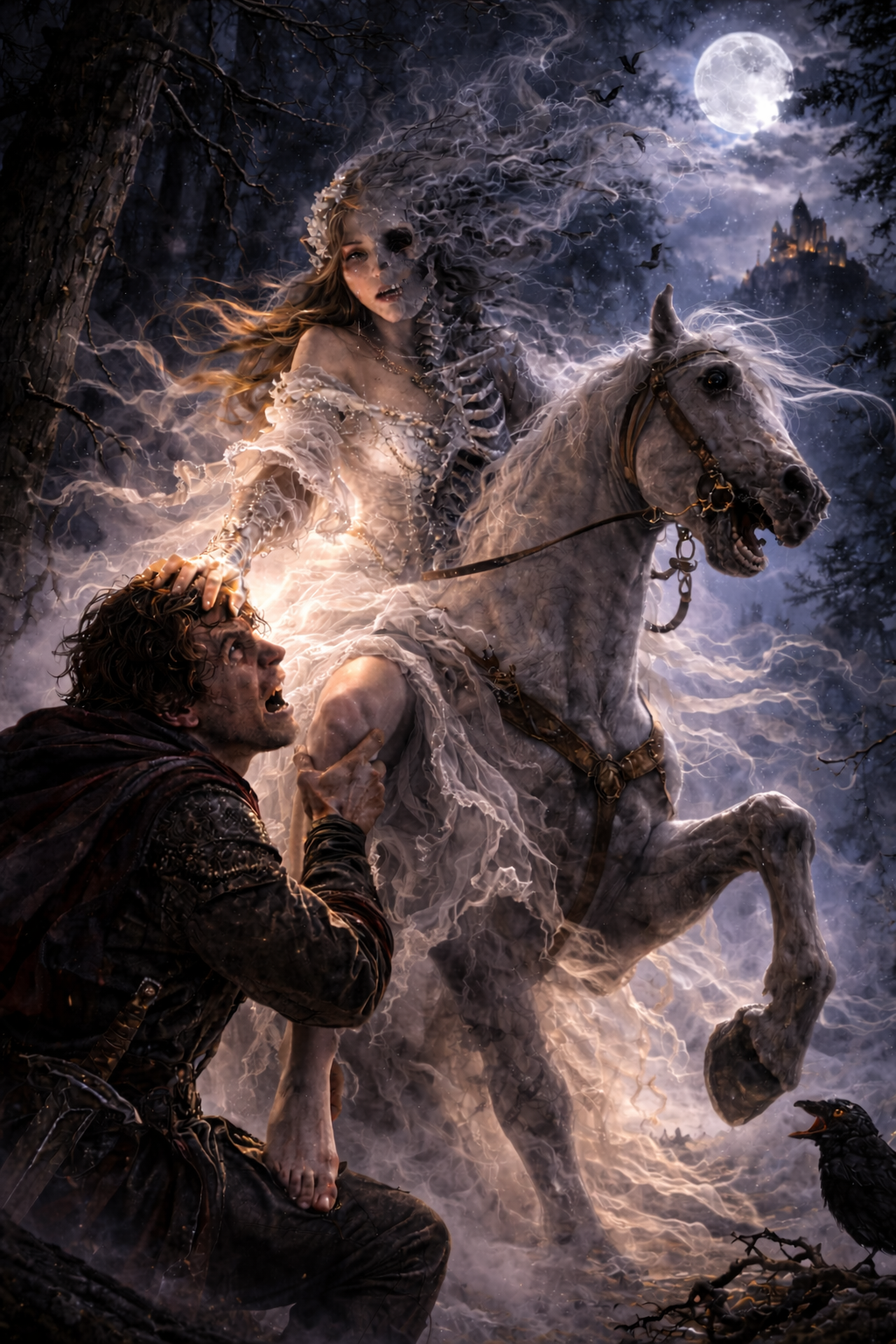
Artistic visualisation by Evgenia Fölsche:
In a nocturnal forest,
lit by cold
moonlight,
a white horse
rears up.
On its back sits a woman
in a pale garment —
beautiful,
mysterious,
and yet
uncanny.
Beside the horse
kneels a knight.
He desires the woman’s beautiful body
and reaches for her leg.
But precisely in this
moment
her figure
begins to change.
One half of her body
remains human,
marked by beauty
and grace.
The other
is already dissolving
into a ghostly,
skeletal figure,
as though the mist
itself
were devouring
her body.
Nature, will, power, and human suffering in one intensely concentrated moment.
In Schumann’s music,
this moment is mirrored
in the nervous,
forward-driving
piano figures,
which sound like
a restless ride
through the forest.
The encounter,
which at first
seems shaped by
beauty
and seduction,
suddenly
turns.
Analysis – Poetry
“Waldesgespräch” is a ballad in dialogue form. Two voices meet in the nocturnal forest: a rider and a woman. At first the scene appears gallant — almost courtly. Yet from the very beginning a shadow lies over the encounter. The forest is not merely a natural setting, but a borderland between seduction and danger.
Stanza 1 – Who is offering protection here?
Es ist schon spät, es wird schon kalt,
Was reit’st du einsam durch den Wald?
Der Wald ist lang, du bist allein,
Du schöne Braut! Ich führ’ dich heim!
The opening sounds caring: “Es ist schon spät” — a sign of vulnerability. Yet the tone can be read in two ways. Is it concern — or a claim of possession?
The address “du schöne Braut” objectifies. The woman is not addressed as an individual, but as a desired image. “Ich führ’ dich heim” formulates a seemingly chivalric gesture, but at the same time an overreaching: he claims guidance and control.
The rider’s intention remains deliberately ambiguous (gallant ↔ intrusive). From the woman’s perspective, however, he is a threat — she answers not with gratitude, but with warning.
Stanza 2 – The warning
„Groß ist der Männer Trug und List,
Vor Schmerz mein Herz gebrochen ist,
Wohl irrt das Waldhorn her und hin,
O flieh! Du weißt nicht, wer ich bin.“
The woman speaks from experience. “Trug und List” generalises male behaviour — she knows deception.
The forest horn wanders astray — an acoustic sign of disorientation. The scene gains uncanny depth. The decisive line: “O flieh!” — she explicitly warns him. Turning back is still possible.
Stanza 3 – The mistake
So reich geschmückt ist Roß und Weib,
So wunderschön der junge Leib,
Jetzt kenn’ ich dich – Gott steh’ mir bei!
Du bist die Hexe Lorelei.
Here lies the turning point. The rider ignores the warning. Instead of taking distance, he continues to look — and reduces her to a “junge Leib.”
The objectification sharpens. His recognition (“Jetzt kenn’ ich dich”) comes too late. He names her as “Lorelei” — but the naming does not protect him.
Stanza 4 – The spell
„Du kennst mich wohl – von hohem Stein
Schaut still mein Schloß tief in den Rhein.
Es ist schon spät, es wird schon kalt,
Kommst nimmermehr aus diesem Wald!“
The final stanza mirrors the first. The opening words return — but now as judgment.
The original line “Ich führ’ dich heim” is reversed: “Kommst nimmermehr aus diesem Wald!” Guidance home turns into a formula of damnation.
The spell is not pronounced loudly, but coolly and finally. It is precisely this calm that makes the uncanny so powerful.
Thus the ballad becomes a chamber scene about boundaries and consequence: whoever disregards warnings loses orientation — and the self.
Meaning & Effect within the Cycle
Within Liederkreis op. 39, “Waldesgespräch” forms a dramatic contrast. Here the uncanny comes openly to the surface.
The scene’s ambiguity is what makes it modern: gallant tone and latent threat stand side by side. The woman appears not only as seductress, but also as one who warns. The actual misstep lies with the rider — in his disregard of the boundary.
Schumann’s setting intensifies this structure. The music does not sound angry, but cold in its judgment. No eruptive drama, but controlled uncanniness.
It is precisely this restraint that creates tension: destruction does not happen in an outcry, but in the inescapable, sober ending.
Evgenia Fölsche – Performances & Audio
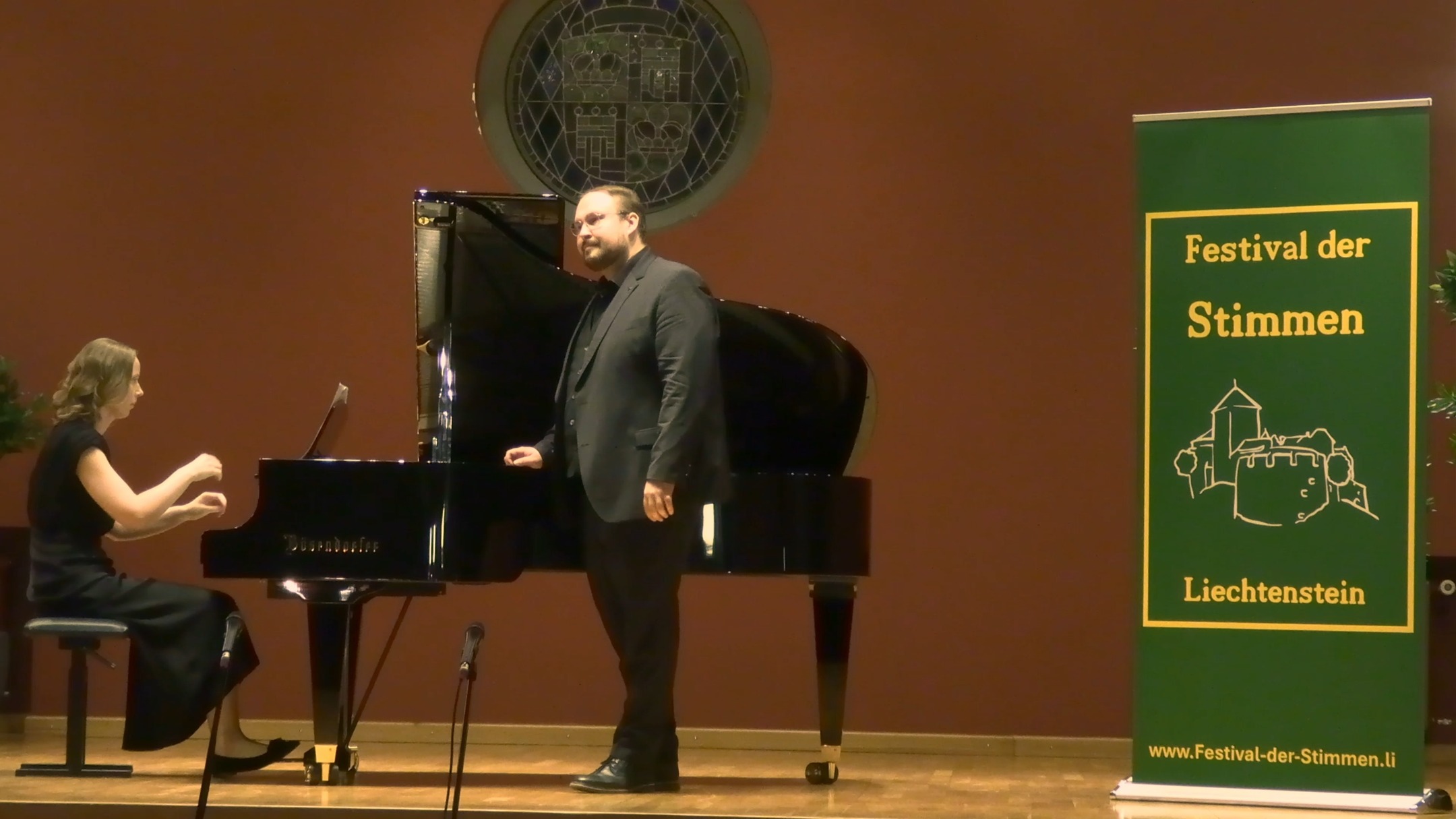
Pianist Evgenia Fölsche emphasises the tipping point between gaze and recognition: firm rider accents, warning-cool Loreley textures, an ending without ritardando — the line itself speaks the judgment.
Frequently Asked Questions about “Waldesgespräch” (Liederkreis op. 39, No. 3)
Click on a question to show the answer.
Is the rider gallant or intrusive?
The text leaves it open; the music can support both readings. The crucial point is that the woman warns clearly (“O flieh!”), and the rider disregards it — that is where the scene tips.
Should the Loreley sound vengeful?
A cool, warning colour is more effective than anger: the spell gains force through sobriety, not through pathos.
What does “Kommst nimmermehr aus diesem Wald” mean?
A Romantic spell: open between death, getting lost, or damnation. The music leaves that indeterminacy standing — and therein lies the uncanniness.
How can one differentiate the roles acoustically?
Rider: articulated, forward-moving; Loreley: bound, cool. Piano: “horn” gesture versus bound forest texture; stable pulse, little pedal.