“Wehmut” (opening: “Ich kann wohl manchmal singen”) is Song No. 9 from Robert Schumann’s cycle Liederkreis op. 39 after Joseph von Eichendorff. Behind apparently simple strophic form lies a poetic paradox: public singing — and yet “secret tears” that set the heart free. Schumann answers with spare, homophonic clarity that places the word in the foreground, and only in the postlude quietly unfolds the colour of “deep sorrow.”
The Poem (Joseph von Eichendorff)
From: Poems
Ich kann wohl manchmal singen,
Als ob ich fröhlich sei,
Doch heimlich Tränen dringen,
Da wird das Herz mir frei.
Es lassen Nachtigallen,
Spielt draußen Frühlingsluft,
Der Sehnsucht Lied erschallen
Aus ihres Kerkers Gruft.
Da lauschen alle Herzen,
Und alles ist erfreut,
Doch keiner fühlt die Schmerzen,
Im Lied das tiefe Leid.
Work Data & Overview
- Composer: Robert Schumann (1810–1856)
- Cycle: Liederkreis op. 39 (Eichendorff), No. 9
- Text source: Joseph von Eichendorff (1788–1857)
- Origin (composition): May 1840 (year of song); first published 1842
- Tonal space / notation: simple, homophonic writing; few digressions, chromatic darkening in the postlude
- Tempo indications: Calm, simple; breath shaped by the flow of speech
- Duration: approx. 1½–2 minutes; intimate confessional miniature
- Scoring: voice (various ranges) and piano
- Form: strophic (3 stanzas) with delicate variation; eloquent postlude
Data on the poem
- Poet: Joseph von Eichendorff
- Stanza form: 3 stanzas of 4 lines each
- Rhyme scheme: cross rhyme (ABAB)
- Devices: paradox (public singing / secret tears), allegory (nightingale / prison), mirror of the audience (“all hearts … delighted”)
Origins & Contexts
“Wehmut” stands in the cycle after In der Fremde (2) (No. 8) and before Zwielicht (No. 10): from placeless night-hearing it leads into a personal confession before the threatening element closes in. Schumann reduces the means — a programmatic act of trust in word and line.
What is striking is the distance between public effect (“all … delighted”) and inner reality (“secret tears”) — a romantic image of the artist’s self that Schumann draws without operatic gesture.
Performance Practice & Reception
Sound idea: p–mp, text-centred line, simple cantabile; piano homophonic, with sparing pedal changes (clarity before “emotional fog”). Do not inflate the peaks of the stanzas — the truth lies in the postlude.
Reference Recordings (Selection)
- Dietrich Fischer-Dieskau – Christoph Eschenbach
- Elly Ameling – Dalton Baldwin
- Christian Gerhaher – Gerold Huber
- Ian Bostridge – Julius Drake
- Matthias Goerne – Christoph Eschenbach
Analysis – Music
Homophonic & Text-led
The accompaniment supports the syllables — no garlands, no glitter. The voice remains close to speech; micro-dynamics on key words (“heimlich,” “frei,” “Kerker”) replace broad emphasis.
Strophic Form, Postlude & Colour of Sorrow
Stanza 1 states the paradox (singing / tears); stanza 2 turns it into allegory (nightingale in the “prison”); stanza 3 mirrors the gap between audience and self. The postlude condenses the meaning: often a chromatic sinking in the bass — a tonal “exhalation” that marks the unspoken sorrow.
Visual Representation
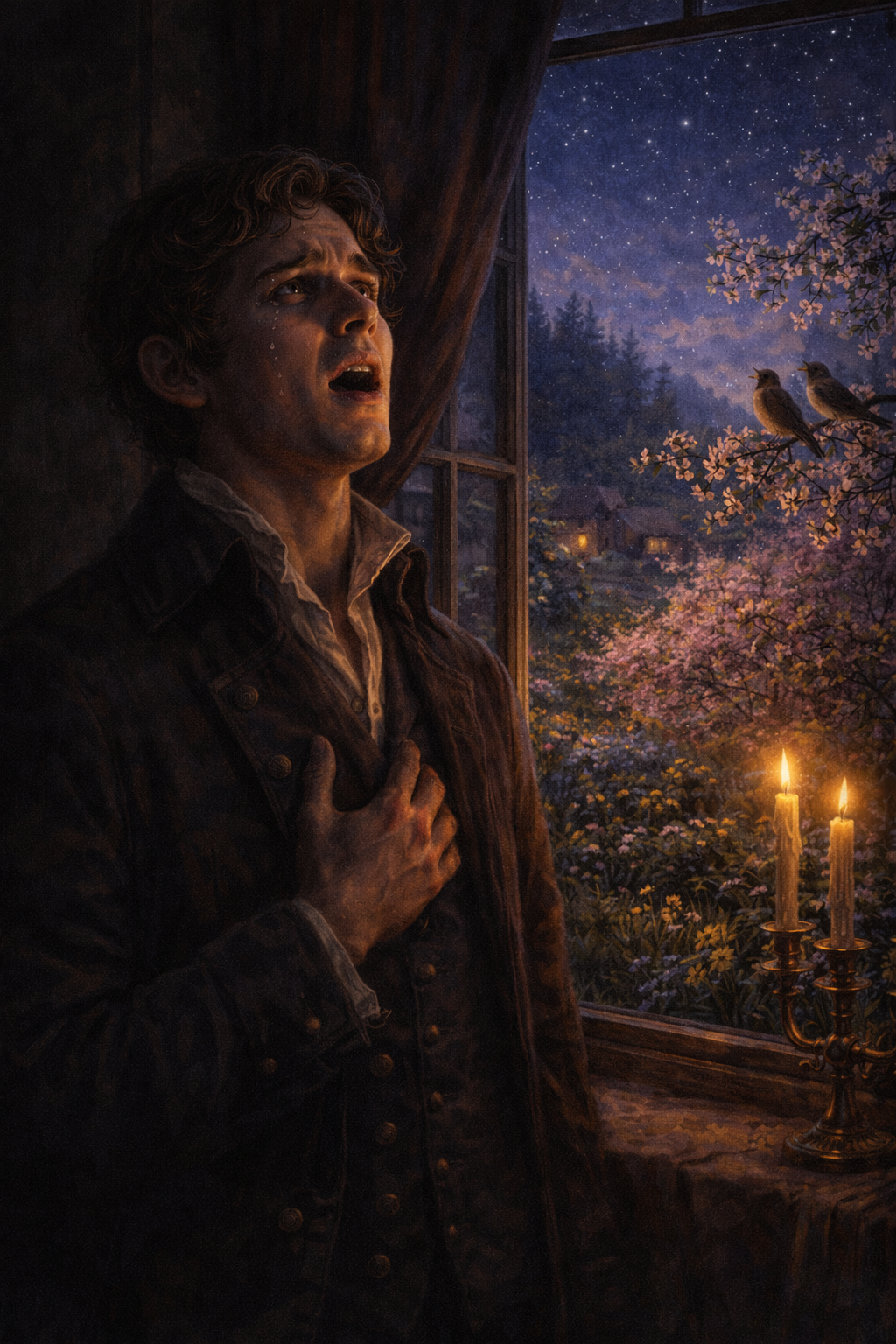
Artistic visualisation by Evgenia Fölsche:
In a quiet
room,
a singer stands
at the open window.
The light
in the room
is muted,
while outside
spring
fills the night.
In the branches
before the window
sit nightingales.
Their song
sounds light
and free
into the warm
spring air.
The singer, however,
remains alone
with his
thoughts.
Although his voice
outwardly sounds
like a joyful
song,
the tears
on his face
reveal
the hidden
truth.
The image takes up
the inner
contradiction
of the poem:
a song
that radiates
beauty
and joy
yet at the same time
carries
a hidden
sorrow within.
Eichendorff compares
the singer
to the nightingale,
whose song
is admired
by all,
although it sounds forth
from a
“prison vault”
of longing.
Schumann, too,
shapes the music
with deliberate
simplicity.
The accompaniment
remains calm
and restrained,
so that
the expression
of the voice
can unfold
directly.
Thus there arises
a song
of quiet
melancholy —
a singing
that offers outwardly
beauty
and consolation
while inwardly
it is borne
by pain
and longing.
Analysis – Poetry
“Wehmut” is one of the most self-reflective poems of the cycle. It thematises singing itself — and reveals the tension between outward sound and inward pain. Art appears as a double-edged expression: it conceals — and liberates at the same time.
Stanza 1 – Mask and liberation
Ich kann wohl manchmal singen,
Als ob ich fröhlich sei,
Doch heimlich Tränen dringen,
Da wird das Herz mir frei.
The lyrical self describes a discrepancy: the singing sounds “as if I were joyful” — an appearance.
Yet tears well up “secretly.” Precisely in this hidden pain lies the actual truth.
Paradoxically, the heart is set free by suffering. Art becomes the outlet for inner distress.
Stanza 2 – The song from the prison
Es lassen Nachtigallen,
Spielt draußen Frühlingsluft,
Der Sehnsucht Lied erschallen
Aus ihres Kerkers Gruft.
The nightingale again stands as a symbol of song. Outside, spring air is playing — an atmosphere of renewal and joy.
But the “song of longing” rises out of a “prison vault.” The image joins imprisonment and grave.
Song thus springs not from freedom, but from inner captivity. Art is the echo of an enclosed soul.
Stanza 3 – Unperceived suffering
Da lauschen alle Herzen,
Und alles ist erfreut,
Doch keiner fühlt die Schmerzen,
Im Lied das tiefe Leid.
The audience listens — and is delighted. The outward effect is positive.
Yet what matters most goes unnoticed: “No one feels the pain.” The real suffering remains hidden behind aesthetic form.
Thus a bitter irony arises: the song is admired, but its origin is not understood.
Meaning & Effect within the Cycle
“Wehmut” is a poetic key text within Liederkreis op. 39. It reflects the role of the artist himself: singing does not mean expressing joy, but transforming pain.
The poem shows the romantic double structure of surface and depth. Outwardly, there is lightness; inwardly, longing dwells.
Schumann’s setting intensifies this ambivalence. The music seems simple and calm, almost consoling — and yet it carries a hidden weight.
Thus “Wehmut” becomes a musical confession: true art arises from suffering, even when it appears as beauty.
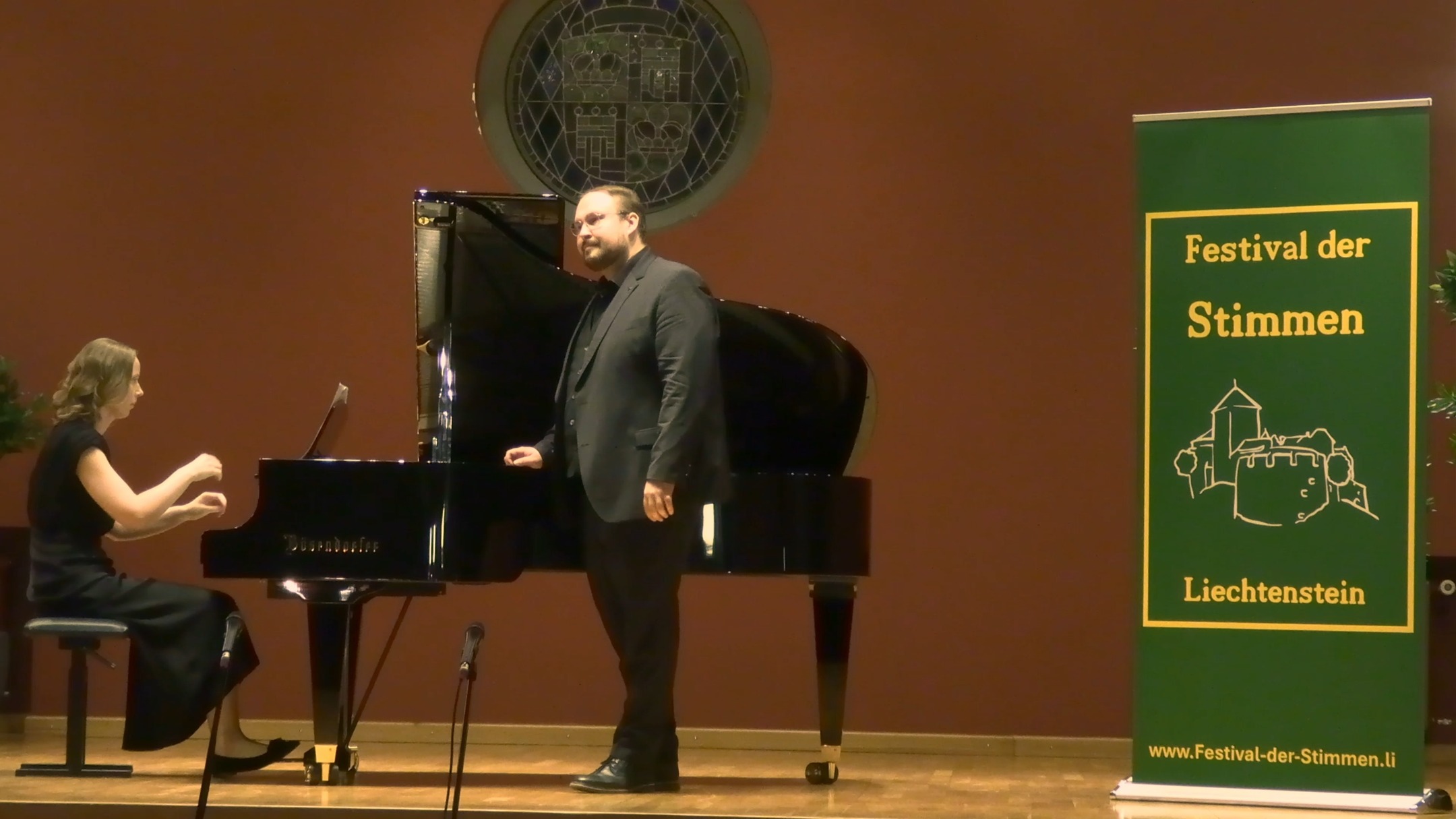
Evgenia Fölsche – Performances & Audio
Pianist Evgenia Fölsche shapes “Wehmut” as a concentrated confession: clear diction, slender middle register, and in the postlude a brief dark breath — nothing more.
Frequently Asked Questions about “Wehmut” (Liederkreis op. 39, No. 9)
Click on a question to show the answer.
Is this the original Eichendorff text?
Yes. It is the usual three-stanza version with the “nightingale / prison” image.
Why is the music so simple?
Schumann places the text and its paradox in the foreground; the homophonic simplicity makes the “secret” sorrow credible.
How loud and how fast?
Calm, simple; basic dynamic p–mp. No pathos climax — the statement lies in the postlude.
Interpretive tip?
Keep consonants clear and vowels rounded; really withdraw on “heimlich.” Change the pedal often — transparency before “emotional fog.”