“Intermezzo” (opening: “Dein Bildnis wunderselig”) is Song No. 2 from Robert Schumann’s cycle Liederkreis op. 39 after Joseph von Eichendorff. In eight lines, the text condenses an intimate devotion: the image preserved in the heart, and a quiet “old beautiful song” rising upward toward the beloved. Schumann answers with a bright, moving pulse, supple declamation, and a short postlude that lets the inner vibration fade away.
The Poem (Joseph von Eichendorff)
From: Poems – “Intermezzo”
Dein Bildnis wunderselig
Hab’ ich im Herzensgrund,
Das sieht so frisch und fröhlich
Mich an zu jeder Stund’.
Mein Herz still in sich singet
Ein altes schönes Lied,
Das in die Luft sich schwinget
Und zu dir eilig zieht.
Work Data & Overview
- Composer: Robert Schumann (1810–1856)
- Cycle: Liederkreis op. 39 (Eichendorff), No. 2
- Text source: Joseph von Eichendorff (1788–1857)
- Origin (composition): May 1840 (year of song); first published 1842
- Tonal space / notation: bright major/minor interplay with floating middle register; flowing piano figuration
- Tempo indications: moving basic pulse (lively, but light), cantabile
- Duration: approx. 1½–2 minutes; lyric miniature
- Scoring: voice (various ranges) and piano
- Form: two stanzas, strophic with variation; short, fading postlude
Data on the poem
- Poet: Joseph von Eichendorff
- Stanza form: 2 stanzas of 4 lines each
- Rhyme scheme: cross rhyme (ABAB)
- Devices: devotional image (“Bildnis”), inward song, rising metaphor (“in die Luft sich schwinget”)
Origins & Contexts
Liederkreis op. 39 was written in May 1840 and is regarded as Schumann’s most inward Eichendorff cycle: images of nature and night as mirrors of emotional movement. After the muted opening of No. 1, No. 2 turns inward – toward the quiet contemplation of the image preserved in the heart.
The simple two-stanza design invites chamber-musical refinement: minimal dynamic range, great effect drawn from textual clarity and breath control.
Performance Practice & Reception
More important than volume is vibration: a buoyant pulse, softly connected piano writing, syllabically clear cantabile. The second stanza may brighten discreetly (the upward motion of the “old beautiful song”) without breaking the intimate frame.
Reference Recordings (Selection)
- Dietrich Fischer-Dieskau – Gerald Moore
- Peter Pears – Benjamin Britten
- Christian Gerhaher – Gerold Huber
- Ian Bostridge – Julius Drake
- Matthias Goerne – Christoph Eschenbach
Analysis – Music
Moving Pulse & Cantabile
The piano lays down a steady, light figuration above which the voice moves in a parlando-like yet genuinely lyrical way. Accent points lie on Bildnis, Herzensgrund, altes schönes Lied – inner intensity instead of outward intensification.
Two-Stanza Design & Postlude
Stanza 2 colours the harmony slightly brighter (the upward gesture of the “song”). The brief postlude draws the motion back: the upward sweep becomes memory – the sound floats away.
Visual Representation
Artistic visualisation by Evgenia Fölsche:
A nightingale
flies through
the still night.
In its beak
it carries
a single
red rose.
The image transforms
the poem’s central
idea
into a poetic
symbol.
The “old beautiful song”
of which Eichendorff
speaks
arises in the inner
chamber of the heart –
hidden,
quiet,
and full
of longing.
Like the nightingale,
which has long been
a symbol
of song,
this melody rises
out of silence
and lifts itself
into the air.
The rose
stands for the beloved,
whose image
the singer
carries in the heart.
In this way
the bird’s flight
becomes a visible
metaphor
for the song itself:
a song
that rises from
the human interior
and seeks
its way
toward the beloved.
Schumann’s music
follows this movement as well.
The accompaniment in the piano
feels light
and hovering,
as though the song
were truly
lifting itself
into the air.
Music,
memory,
and longing
join together
in a message
that leaves the room
and seeks
its way
to the beloved.
Analysis – Poetry
The poem “Intermezzo” from Liederkreis op. 39 by Robert Schumann (text: Joseph von Eichendorff) unfolds a lyrical inner image of memory. Unlike many other poems in the cycle, outer nature does not stand in the foreground here, but an inner space: the heart as the place of preserved love. Memory appears not as painfully destructive, but as living and present.
The image in the heart
Dein Bildnis wunderselig
Hab’ ich im Herzensgrund,
Das sieht so frisch und fröhlich
Mich an zu jeder Stund’.
Right from the first line, the emphasis falls on the “Bildnis” – not the beloved person herself is present, but her inward image. This image is “wunderselig,” filled with an almost unearthly bliss.
The “Herzensgrund” points to depth and inwardness. Love is shown not as a fleeting feeling, but as a firmly anchored, protected memory. What is remarkable is its presentness: the image looks at the speaker “zu jeder Stund’.” Memory is not past, but an enduring presence within.
The inward song
Mein Herz still in sich singet
Ein altes schönes Lied,
Das in die Luft sich schwinget
Und zu dir eilig zieht.
The heart itself now becomes musical. It “sings” – yet “still in itself.” The song remains at first hidden, an expression of inward concentration and intimacy.
The “old beautiful song” suggests permanence: love appears timeless. At the same time, the song loosens itself from within, “schwinget” itself into the air and moves “zu dir.” The movement thus leads from the inner realm to the outer. Love does not remain enclosed, but seeks connection.
In this way, a delicate dynamic arises: from the preserved image in the heart to the longing motion of the song. Memory transforms into sound, inwardness into a quiet hope of response.
Meaning & Effect within the Cycle
Within Liederkreis, “Intermezzo” feels like a moment of intimate inward gathering. After the existential tensions of other songs, a resting point appears here, in which love becomes perceptible as a consoling, preserved force.
The poem formulates a Romantic ideal: the true presence of the beloved lies within. Memory is not mere loss, but a creative, musical energy.
Thus poetry and music unite in a special way: the “old beautiful song” in the text is mirrored in the actual singing. The inward becomes sound – and longing takes on a gentle, hopeful form within the cycle.
Evgenia Fölsche – Performances & Audio
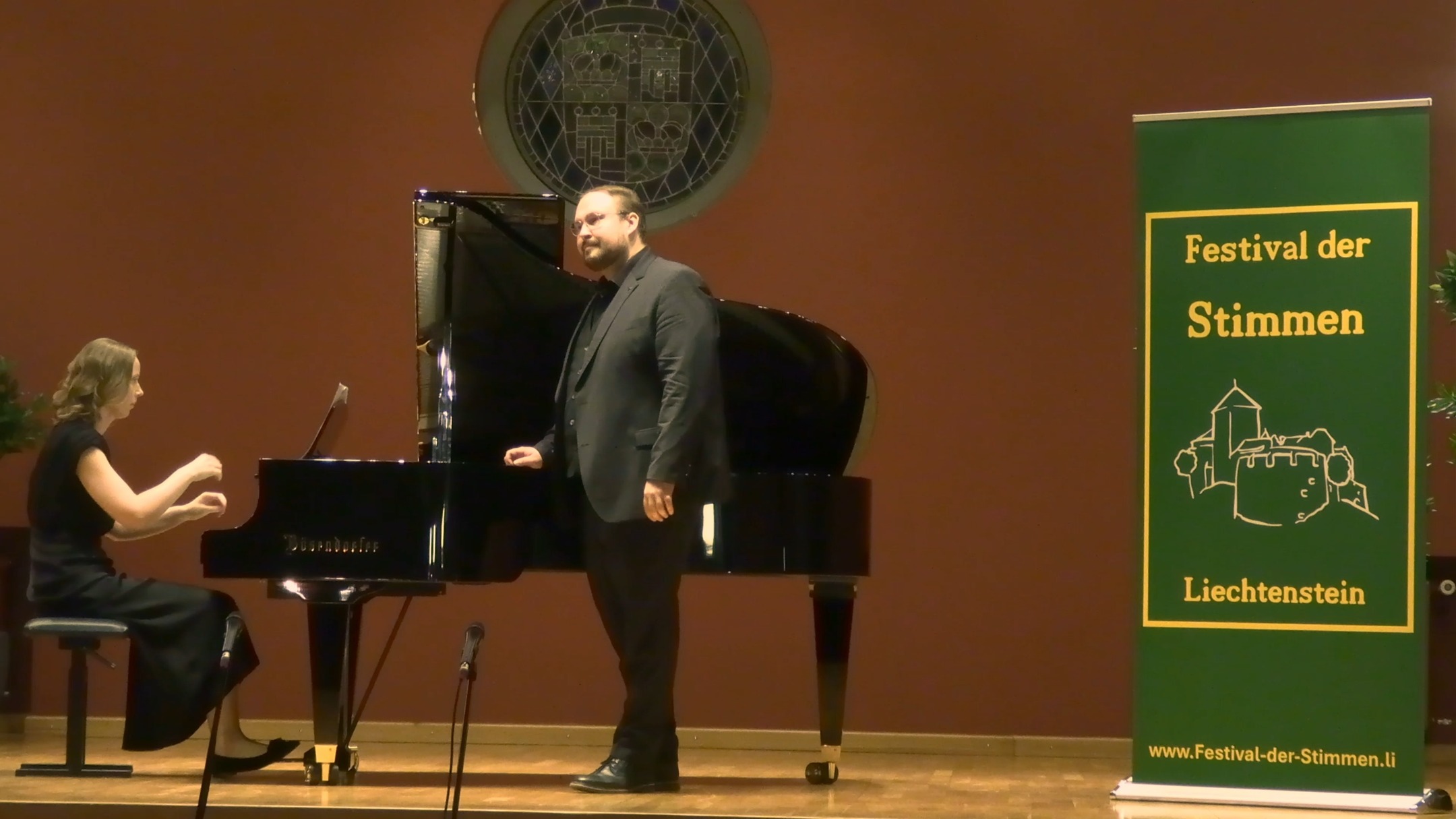
Pianist Evgenia Fölsche shapes “Intermezzo” as an inward piece of breathing: elastic pulse, focus on the text, and at the end a true withdrawal in the postlude.
Frequently Asked Questions about “Intermezzo” (Liederkreis op. 39, No. 2)
Click on a question to show the answer.
Is the poem set in full?
Yes, Schumann sets both quatrains in full – without cuts.
How is the tempo best characterised?
Moving, but light and breathing – the momentum carries the line, not the volume.
Which voice types are common?
Editions/transpositions exist for high, middle, and low ranges; often soprano/mezzo-soprano as well as tenor/baritone.
Interpretive tip?
Keep the sound buoyant, consonants clear, open slightly on “altes schönes Lied” – and truly let the postlude fade away.