“Frühlingsnacht” — incipit: “Über’n Garten durch die Lüfte” — is Lied No. 12 and the jubilant conclusion of Robert Schumann’s Liederkreis Op. 39 on poems by Joseph von Eichendorff. From the signs of nature — the passing of migratory birds, moonlight, the calls of nightingales — an ecstatic declaration of love emerges: “Sie ist deine! Sie ist dein!” Schumann responds with shimmering harmony, a bright upper register and an irresistible forward momentum: a brief, luminous apotheosis of the entire cycle.
The poem, Joseph von Eichendorff
From: Poems
Original German text
Über’n Garten durch die Lüfte
Hört’ ich Wandervögel ziehn,
Das bedeutet Frühlingsdüfte,
Unten fängt’s schon an zu blühn.
Jauchzen möcht’ ich, möchte weinen,
Ist mir’s doch, als könnt’s nicht sein!
Alte Wunder wieder scheinen
Mit dem Mondesglanz herein.
Und der Mond, die Sterne sagen’s,
Und im Traume rauscht’s der Hain,
Und die Nachtigallen schlagen’s:
Sie ist deine! Sie ist dein!
English translation
Above the garden, through the air,
I heard migratory birds pass by;
that means the scents of spring are coming,
down below, everything is already beginning to bloom.
I would like to rejoice, I would like to weep,
for it seems to me almost too wonderful to be true!
Ancient miracles shine forth again,
entering with the brightness of the moon.
And the moon, the stars say it,
and in dreams the grove murmurs it,
and the nightingales sing it:
She belongs to you! She is yours!
Work data & overview
- Composer: Robert Schumann (1810–1856)
- Cycle: Liederkreis Op. 39, on poems by Eichendorff, No. 12, concluding Lied
- Text source: Joseph von Eichendorff (1788–1857)
- Genesis, composition: May/June 1840, the so-called year of song; first edition in 1842
- Tonal space / notation: jubilant F-sharp major atmosphere, high register, pulsating chord chains, short postlude
- Tempo indications: Very lively / Animated; forward momentum without haste
- Duration: approx. 1–1½ minutes; the most brilliant piece in the cycle
- Scoring: voice, in various ranges, and piano
- Form: strophic, 3 quatrains, with growth directed toward the final cry
Data on the poetic text
- Poet: Joseph von Eichendorff
- Strophic form: 3 stanzas of 4 lines
- Rhyme scheme: alternating rhyme, ABAB
- Figures: signs of nature as omens of love, motif of return, “ancient miracles”, collective cry of confirmation: moon, stars, grove, nightingales
Genesis & contexts
“Frühlingsnacht” closes the cycle with an ecstatic yes: after the dark Lieder, Nos. 9–11, the sound suddenly opens toward the light and concentrates the hope of love in a single exclamation. Within the dramatic arc, the Lied functions as an apotheosis: an intense condensation lasting barely a minute.
The elevated sound image is characteristic: clear chords in the upper register, flowing surfaces almost like triplet motion, hardly any pause, as if the signs of nature themselves were pushing the confession of love forward.
Performance practice & reception
Sound ideal: a flexible, agile very lively with a light touch; supple voice, clear text, without an “operatic crown”. The final line may shine, but it must remain elastic: never broad or heavy.
Reference recordings, selection
- Elly Ameling – Dalton Baldwin
- Dietrich Fischer-Dieskau – Christoph Eschenbach
- Christian Gerhaher – Gerold Huber
- Ian Bostridge – Julius Drake
- Dorothea Röschmann – Malcolm Martineau
Analysis – music
Ecstatic pulse & brilliance of the upper register
From the very beginning, Schumann places rapid, pulsating chords in the upper register; the voice flows, close to speech, above this shimmering surface. The sound seems “charged with tension”: forward energy without heaviness.
Strophic structure, chains of seventh chords & final cry
The first stanza marks nature’s omen; the second intensifies the colour of the marvellous, with moonlight. The third gathers all signs into a collective confirmation and culminates in the cry “Sie ist deine! Sie ist dein!”, often with a motif expanding upward; the short postlude continues to “shine” for a brief moment.
Visual representation
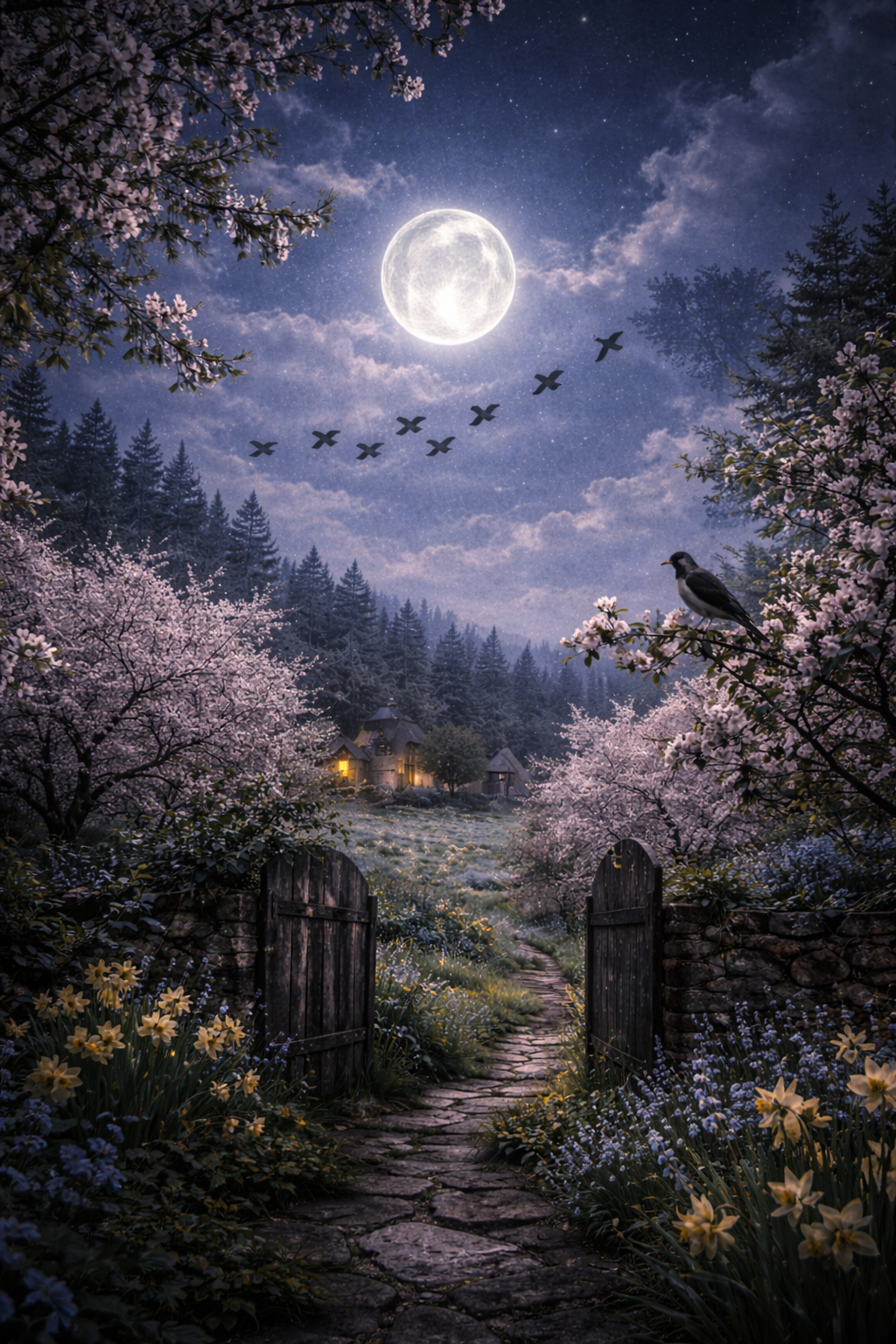
Artistic visualisation by Evgenia Fölsche:
A flowering garden
opens
in the clear
spring night.
Between trees
and bushes
runs a silent
path,
above which
the sky
unfolds
wide and clear.
High above,
the birds
cross the air,
while the moon
and the stars
fill the scene
with their silver
light.
Everything seems
to be in motion
and yet
held
by a profound
inner peace:
the branches
in the spring wind,
nature in bloom,
the open sky.
In this way,
the image captures
the central atmosphere
of the Lied:
the moment
when
the omen of spring,
certainty of love
and nocturnal enchantment
merge
into one another.
Eichendorff’s poem
describes a night
in which all of nature
seems to announce
the glad tidings
of love.
Migratory birds,
moon,
stars
and nightingales
become the voices
of a world
that confirms
happiness.
Schumann’s music
also carries
this movement.
The piano
accompaniment
is lively
and flowing,
as if
the spring air itself
were turning
into sound.
Above it all,
the vocal line
rises
with jubilant
lightness,
until at the end
everything gathers
into a great
certainty:
the beloved is near,
and the night itself
seems to speak
this happiness.
Thus the garden
in the moonlight
becomes the image
of a romantic
spring night,
in which nature
and feeling
coincide
perfectly
for one moment.
Analysis – poetry
“Frühlingsnacht” is a poem of lyrical fusion: perception of nature, emotional experience and Romantic symbolism unite in an intense atmosphere. The outer world resonates within the inner world of the lyrical self.
Stanza 1 – Spring as a sign
Über’n Garten durch die Lüfte
Hört’ ich Wandervögel ziehn,
Das bedeutet Frühlingsdüfte,
Unten fängt’s schon an zu blühn.
Perception begins acoustically: the migratory birds pass “through the air”, a classic motif of spring.
Their presence “means scents of spring”: sound becomes an omen. Spring is not only a season, but a feeling of renewal.
The flowers begin to open, but at first only “down below”: in the image of nature, awakening happens in stages.
Stanza 2 – An ambivalent exaltation
Jauchzen möcht’ ich, möchte weinen,
Ist mir’s doch, als könnt’s nicht sein!
Alte Wunder wieder scheinen
Mit dem Mondesglanz herein.
The lyrical self is full of contradictions: joy and emotion coexist. “I would like to rejoice, I would like to weep”: the expression here goes beyond a simple state of mind.
The idea of “ancient miracles” brings the past back to life. The moon “shines again”: light becomes a metaphor for a beauty that has returned, inexplicably.
Stanza 3 – Nature as messenger of love
Und der Mond, die Sterne sagen’s,
Und im Traume rauscht’s der Hain,
Und die Nachtigallen schlagen’s:
Sie ist deine! Sie ist dein!
In the final stanza, the experience becomes personal: nature proclaims a promise of love.
The moon and the stars “say it”, not rationally, but symbolically. The grove “murmurs”, the nightingales “sing it”: the world becomes a messenger of certainty.
The conclusion takes the form of a double cry: she is yours, and you belong to her.
Nature is therefore not merely a background, but an active part of the revelation of love.
Meaning & effect within the cycle
“Frühlingsnacht” constitutes the lyrical arrival of Liederkreis Op. 39. After the existential, unsettling or melancholic scenes, a moment of intense unity appears here: nature, feeling and longed-for certainty merge.
The poem formulates a central Romantic motif: love appears not only as a feeling, but as cosmic confirmation. It is not only the self that feels: the entire cosmos speaks: She is yours!
Schumann’s music carries this breadth into sound: the melodic line opens, harmony and piano tend toward light and peace.
Thus “Frühlingsnacht” becomes the transcendent culmination of the cycle: not disorientation, not twilight, but belonging; not pain, but confirmation.
Evgenia Fölsche – performances & audio
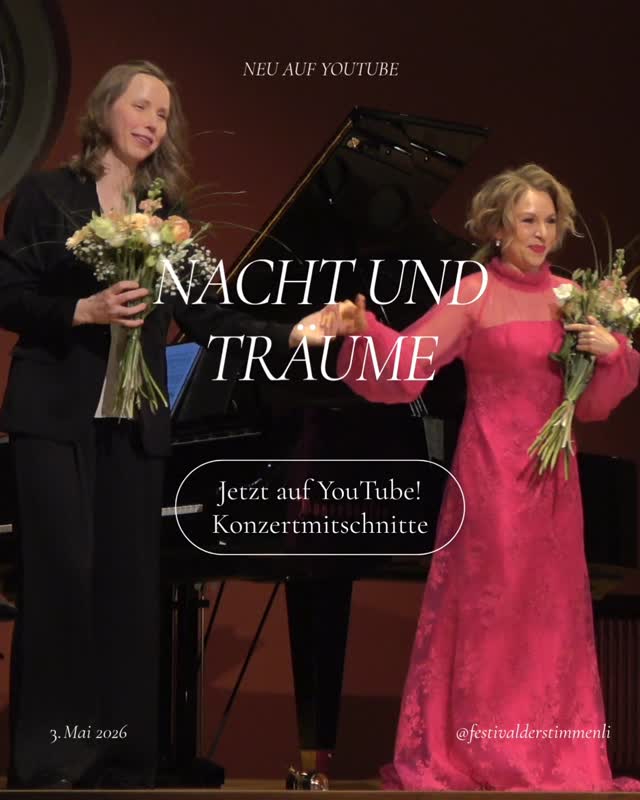
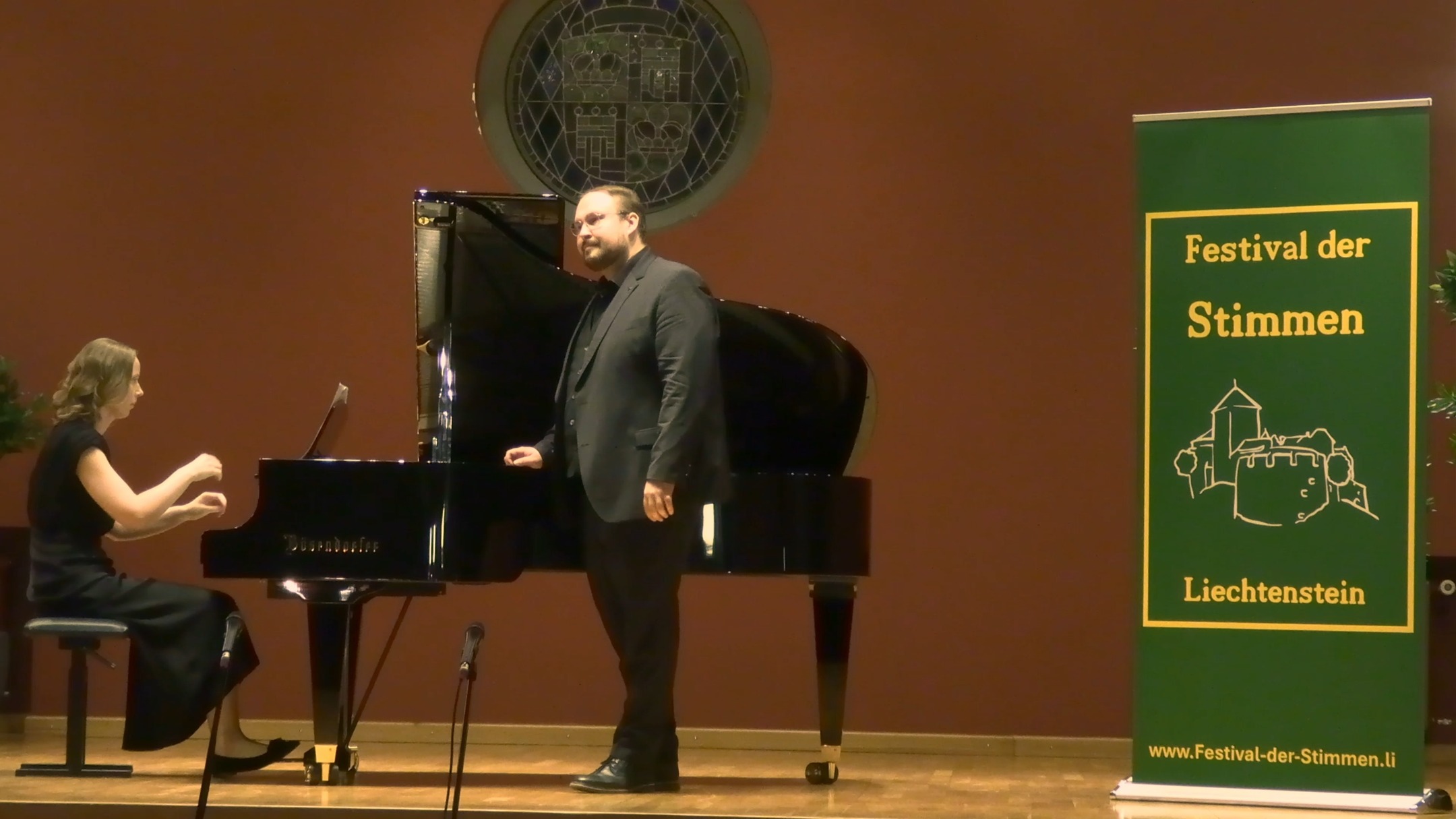
Pianist Evgenia Fölsche shapes the ending as a luminous, elastic arc: supple middle register, clear diction, pearly piano writing in the upper register; the final cry radiates light, and then the postlude continues to shimmer briefly.
Frequently asked questions about “Frühlingsnacht”, Liederkreis Op. 39, No. 12
Click on a question to view the answer.
Is the text transmitted in three stanzas?
Yes. Schumann sets Eichendorff’s three quatrains to music; the final line is: “Sie ist deine! Sie ist dein!”
What basic musical features characterise the piece?
Very lively tempo, elastic pulse, bright register, shimmering chord chains; a brief growth directed toward the final cry.
In which key is the ending often notated?
In editions, often in F-sharp major; transpositions for different vocal ranges are common.
Any performance advice?
Keep it light! The text should remain in the foreground, without overly broadened notes or too expansive fermatas; the final cry should be clear and elastic, then fade immediately.