“Mondnacht” (opening: “Es war, als hätt’ der Himmel”) is Song No. 5 from Robert Schumann’s cycle Liederkreis op. 39 after Joseph von Eichendorff. The poem unfolds a cosmic still scene: a kiss between heaven and earth, breathing nature, and a soul that “stretches wide its wings.” Schumann responds with one of the most inward pages in his song output: a hovering E-major space, delicate sound-weaving, and strophic clarity with the finest crescendo toward the third stanza.
The Poem (Joseph von Eichendorff)
From: Poems
Es war, als hätt’ der Himmel
Die Erde still geküsst,
Dass sie im Blütenschimmer
Von ihm nun träumen müsst’.
Die Luft ging durch die Felder,
Die Ähren wogten sacht,
Es rauschten leis die Wälder,
So sternklar war die Nacht.
Und meine Seele spannte
Weit ihre Flügel aus,
Flog durch die stillen Lande,
Als flöge sie nach Haus.
Work Data & Overview
- Composer: Robert Schumann (1810–1856)
- Cycle: Liederkreis op. 39 (Eichendorff), No. 5
- Text source: Joseph von Eichendorff (1788–1857)
- Origin (composition): May 1840 (year of song); first published 1842
- Tonal space / notation: E-major basic space with gentle brightening; arpeggiated, connected piano writing
- Tempo indications: Very calm, tender (pp–mp, broad breath)
- Duration: approx. 2–3 minutes; an inward central number of the cycle
- Scoring: voice (various ranges) and piano
- Form: strophic (3 stanzas) with subtle variation; hovering postlude
Data on the poem
- Poet: Joseph von Eichendorff
- Stanza form: 3 stanzas of 4 lines each
- Rhyme scheme: cross rhyme (ABAB)
- Devices: cosmic metaphor (kiss), personification, synaesthesia, homecoming motif
Origins & Contexts
“Mondnacht” gathers together Eichendorff’s core Romantic images – nature as a figure of the inner life, night as a space of insight, the soul’s homecoming. In Schumann’s op. 39, the song becomes a point of repose between inner shocks (No. 3, Waldesgespräch) and dark forebodings (No. 10, Zwielicht).
The poem’s balance between outer image (fields, woods, night) and inner image (the soul’s flight) is mirrored by Schumann in music that remains outwardly simple yet inwardly highly differentiated.
Performance Practice & Reception
Sound ideal: pp–mp, a carrying middle register, covered vowel colours; piano legatissimo with sparing pedal changes (clarity before haze). Breath shaped in half-phrases, rubato only as inner agogic movement at hinges of speech.
Reference Recordings (Selection)
- Elisabeth Schwarzkopf – Edwin Fischer
- Dietrich Fischer-Dieskau – Christoph Eschenbach
- Elly Ameling – Dalton Baldwin
- Christian Gerhaher – Gerold Huber
- Ian Bostridge – Julius Drake
Analysis – Music
Delicate Pulse & Sound Weaving
The piano lays down a calm, arpeggiated web; the voice moves syllabically and cantabile, with little intervallic sharpness. The effect is a “standing” breath in which words such as still geküsst, wogten sacht, and leis emerge through micro-dynamic shading.
Strophic Form & the Soul’s Ascent
Stanza 1 remains in a gentle basic colour (the kiss metaphor); stanza 2 sets the surface in slight motion (fields / woods). In stanza 3, Schumann broadens the line (“weit ihre Flügel”) and allows the only true glowing expansion – the postlude withdraws the tension again, as if heaven’s kiss were closing once more.
Visual Representation
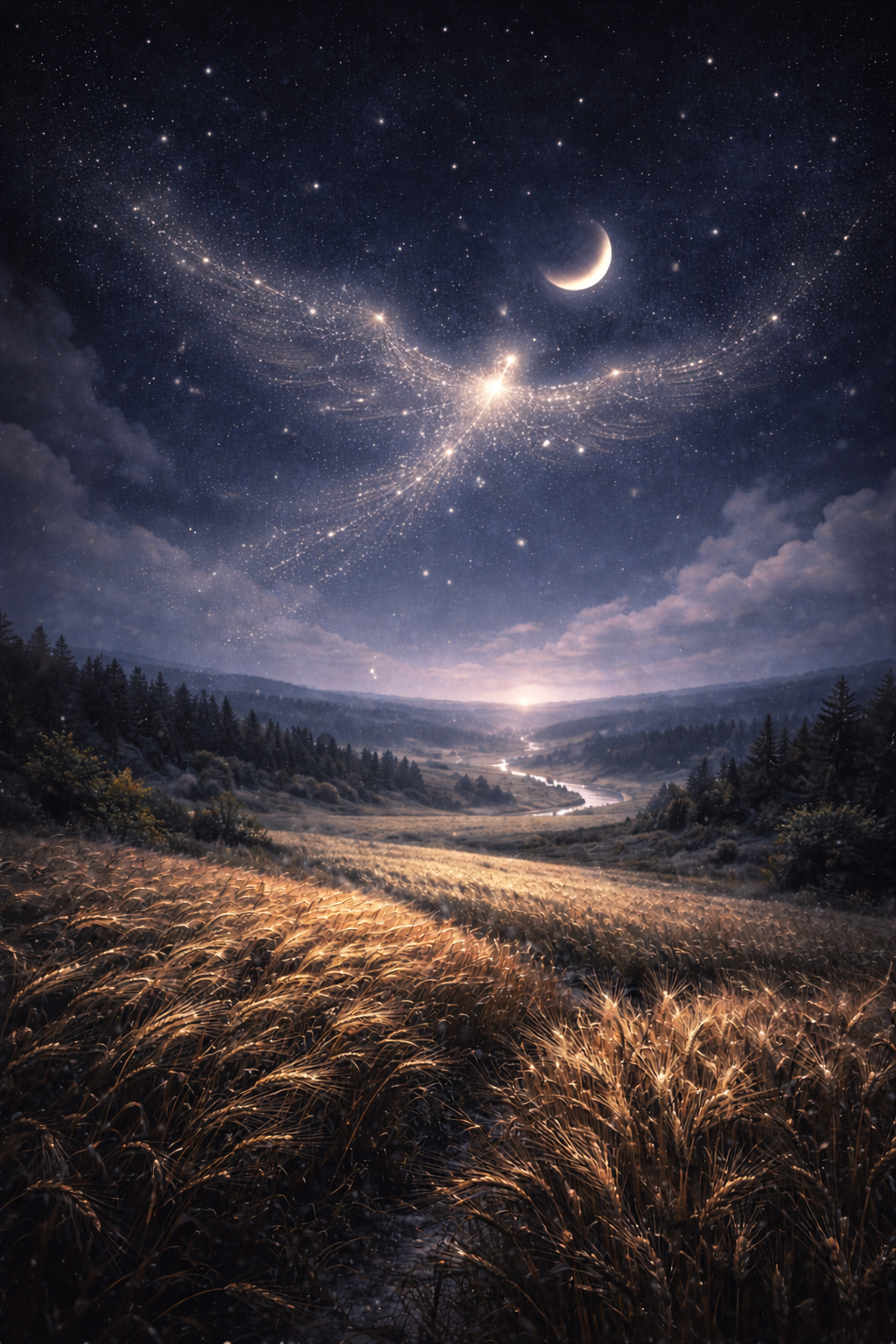
Artistic visualisation by Evgenia Fölsche:
From above,
the gaze opens
onto wide
cornfields
lying in the soft
light of the moon.
The ears of grain move
gently in the wind,
while the dark sky
stretches
far above
the landscape.
Countless stars
shine in the firmament.
Some of them
stand out especially bright
and form
the figure
of a bird
with outstretched
wings.
The landscape appears
still
and boundless –
as though heaven itself
were inclining
over the earth.
In this way the image
takes up the poem’s
central vision:
the mysterious moment
in which heaven
and earth
touch one another.
The star-bird
becomes a symbol
of the soul,
rising out of the
earthly world
and flying
through the
still night.
Schumann’s music, too,
seems to trace
this movement.
The calm,
widely-spun
piano figures
unfold
like a hovering breath
over the landscape.
Thus there arises
a moment
of perfect
Romantic unity:
nature,
heaven,
and the human soul
unite
in a quiet dream
of homecoming.
Analysis – Poetry
“Mondnacht” is often regarded as the very image of Romantic nature mysticism. The poem unfolds no narrative, but rather a transformation: out of the still night grows a movement of the soul. Outer world and inner world pass into one another.
Stanza 1 – Cosmic kiss
Es war, als hätt’ der Himmel
Die Erde still geküsst,
Dass sie im Blütenschimmer
Von ihm nun träumen müsst’.
The famous opening stands in the subjunctive: “Es war, als hätt’ …” – the scene is vision, not event.
Heaven and earth appear personified. The “kiss” is not a dramatic act, but gentle and “still.” The earthly is touched by the heavenly.
The “Blütenschimmer” suggests blossoming, a bright transfiguration of the world. The earth dreams – it has become receptive to a higher sphere.
Stanza 2 – Nature breathed through
Die Luft ging durch die Felder,
Die Ähren wogten sacht,
Es rauschten leis die Wälder,
So sternklar war die Nacht.
Nature is in gentle motion. Nothing is rigid. Air, fields, woods – all are pervaded by the same breath.
The adverbs “sacht” and “leis” underline the tenderness. The world seems like a single breathing organism.
The “star-clear night” forms the still space in which this harmony can unfold.
Stanza 3 – Homecoming of the soul
Und meine Seele spannte
Weit ihre Flügel aus,
Flog durch die stillen Lande,
Als flöge sie nach Haus.
Only in the last stanza does the lyrical self step forward. The outer movement passes into an inner one.
The soul is given wings – a motif of transcending boundaries. The flying is not escape, but homecoming.
“Als flöge sie nach Haus”: once again the subjunctive remains. Home appears as an intimation, not as a concrete place. It lies beyond the visible world.
Thus a Romantic transfiguration takes place: the experience of nature becomes the image of the unity of heaven and soul.
Meaning & Effect within the Cycle
“Mondnacht” forms a poetic high point of Liederkreis op. 39. Here nature is not threatening or ambivalent, but permeable to the transcendent.
The poem formulates a central Romantic ideal: the visible world is the mirror of a higher reality. In the stillness of night, the soul comes to itself – or to a longed-for home beyond the earthly realm.
Schumann’s setting carries this rapture in hovering calm. The music is not pathetic, but inward and spacious. Precisely the restraint of expression allows the greatness of the vision to arise.
Thus “Mondnacht” becomes the very emblem of Romantic longing for unity: between heaven and earth, between nature and soul, between the present moment and eternal home.
Evgenia Fölsche – Performances & Audio
Pianist Evgenia Fölsche shapes “Mondnacht” with a hovering pulse and a slender middle register; the third stanza opens “from within” – the postlude closes like a quiet breath.
Frequently Asked Questions about “Mondnacht” (Liederkreis op. 39, No. 5)
Click on a question to show the answer.
Is “Mondnacht” strophic?
Yes. Three stanzas with subtle variations; the third stanza carries the high point (“weit ihre Flügel”).
How loud and how fast?
Very calm, tender; basic dynamic pp–mp. The line must carry – broad arches rather than highlighting individual words.
What makes the song so famous?
The perfect balance of simplicity and depth: elemental sound-weaving that allows Eichendorff’s imagery to glow without pathos.
Interpretive tip?
Keep vowels rounded and sustained, consonants soft; change pedal frequently so the texture remains clear. Let the ascent of the third stanza grow “from within” – no outward pressure.