Robert Schumann: Liederkreis (Song Cycle) op. 39
Robert Schumann: Liederkeis op. 39
- In der Fremde (1) – In a Foreign Land (1)
- Intermezzo – Intermezzo
- Waldesgespräch – Forest Dialogue
- Die Stille – Silence
- Mondnacht – Moonlit Night
- Schöne Fremde – Lovely Foreign Land
- Auf einer Burg – In a Castle
- In der Fremde (2) – In a Foreign Land (2)
- Wehmut – Melancholy
- Zwielicht – Twilight
- Im Walde – In the Forest
- Frühlingsnacht – Spring Night
Robert Schumann: Liederkreis op. 39 (Eichendorff) is regarded as one of the densest and most poetically unified song cycles of Romanticism. In twelve miniatures, Schumann links images of night, forest, and distance with inner states – from unrest and warning to the bright “yes” of Frühlingsnacht. This overview page brings together context, dramaturgy, and performance tips, and links to all the individual articles on the website.
Work Details & Overview
- Composer: Robert Schumann (1810–1856)
- Work: Liederkreis op. 39 (after Joseph von Eichendorff)
- Composition: May 1840 (year of song)
- First publication: 1842 (Leipzig)
- Scoring: voice (various ranges) and piano
- Duration: approx. 25–30 minutes (depending on tempo and edition)
- Character: a cycle of night and forest, with an inner “journey” from estrangement to affirmative resolution
Origins & Poetic Context
Schumann composed op. 39 under the sign of his hard-won marriage to Clara Wieck. Joseph von Eichendorff’s poems unfold a Romantic “topography” of forest, night, distance, homecoming, and poetic warning. Schumann’s music does not mirror these images naturalistically; rather, it translates them into sound gestures that make inner states audible.
Dramaturgy of the Cycle
The sequence can be broadly divided into three fields of tension:
- No. 1–6: Outer perception (strangeness, encounter, signs of nature) – with Mondnacht (No. 5) as the inward still point and Schöne Fremde (No. 6) as a brightening.
- No. 7–10: Densification/darkening – a rigid image of time (Auf einer Burg), placelessness (In der Fremde (2)), confession (Wehmut), warning (Zwielicht).
- No. 11–12: Break & resolution – a momentary flicker of the outside world (Im Walde) and the bright apotheosis of Frühlingsnacht.
Thus op. 39 forms not a plot, but a dramaturgy of experience: perception – disquiet – inward gathering – assent.
The 12 Songs – with Links to the Individual Articles
- In der Fremde (1) – “Aus der Heimat hinter den Blitzen rot”
- Intermezzo – “Dein Bildnis wunderselig”
- Waldesgespräch – Loreley ballad
- Die Stille – “Es weiß und rät es doch Keiner”
- Mondnacht – “Es war, als hätt’ der Himmel…”
- Schöne Fremde – “Es rauschen die Wipfel…”
- Auf einer Burg – “Eingeschlafen auf der Lauer”
- In der Fremde (2) – “Ich hör’ die Bächlein rauschen”
- Wehmut – “Ich kann wohl manchmal singen”
- Zwielicht – “Dämmrung will die Flügel spreiten”
- Im Walde – “Es zog eine Hochzeit den Berg entlang”
- Frühlingsnacht – “Über’n Garten durch die Lüfte”
Performance Practice
- Sound line: chamber-musical, text-led, micro-dynamics instead of operatic pathos. Points of contrast: Waldesgespräch, Zwielicht (cool sharpness), Frühlingsnacht (bright forward motion).
- Pedal & transparency: frequent changes for clarity of figuration; avoid “mist,” especially in Mondnacht and Die Stille.
- Dramaturgical breath: keep the cycle character in view: resting points (Nos. 4/5), darkening (7–10), brief darkness (11), resolution (12).
- Transpositions: common and useful; more important is tonal and colour coherence of the voice across the cycle.
Evgenia Fölsche – Performances & Audio
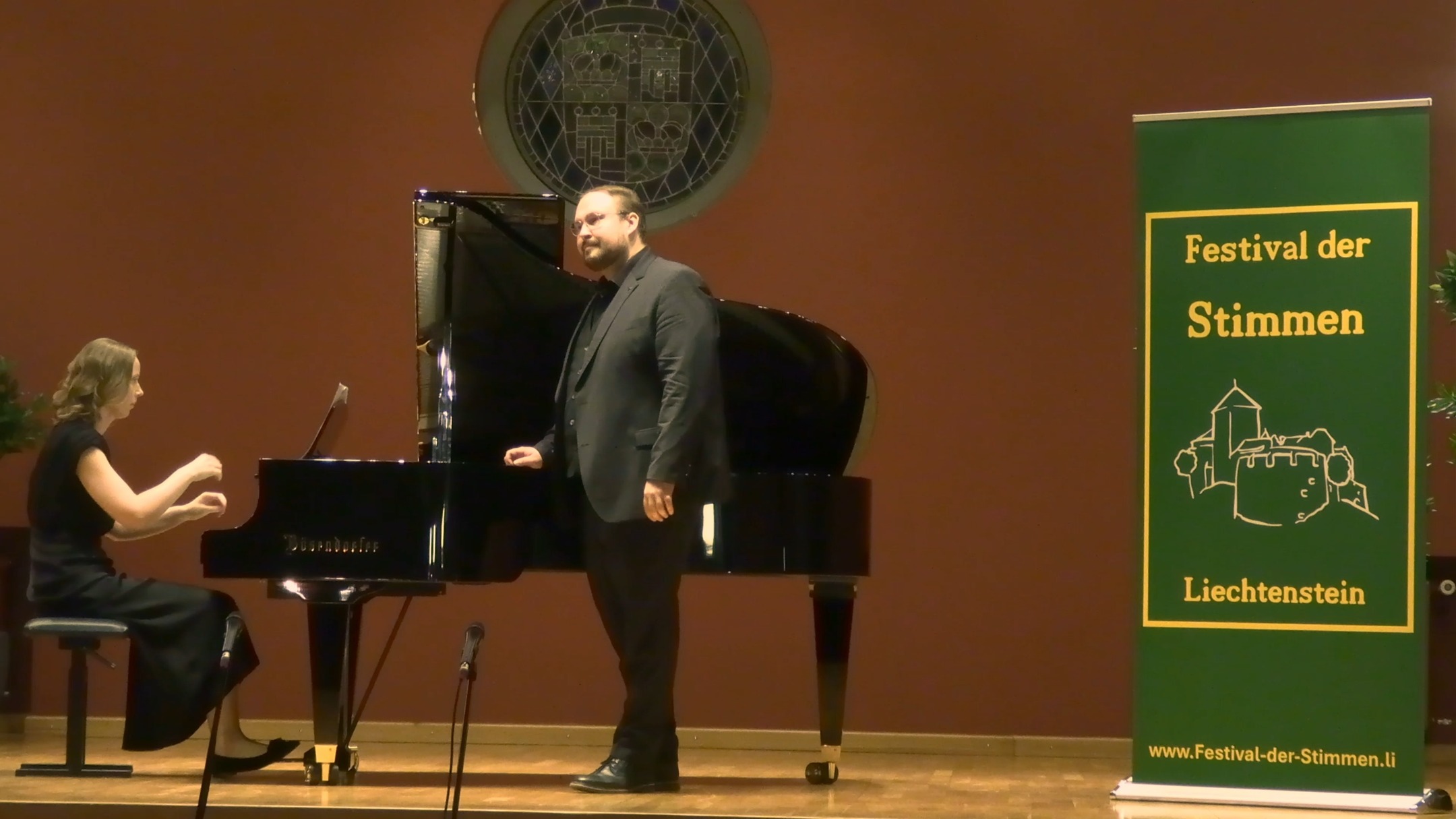
Pianist Evgenia Fölsche presents the Liederkreis op. 39 with a lean middle register, clear diction, and carefully shaped cyclic dramaturgy. Audio examples and programmes can be found in the linked individual articles.
Frequently Asked Questions about Liederkreis op. 39
Click on a question to show the answer.
Should all 12 songs be performed as a whole?
Yes, ideally as a cycle. Individual numbers are popular, but the inner dramaturgy, especially Nos. 7–12, gains significantly in context.
Which keys are “typical”?
Editions vary because of transpositions. More important than absolute keys are register balance and tonal coherence between still points (Mondnacht) and climaxes (Frühlingsnacht).
How long does a performance last?
In concert, around 25–30 minutes, depending on tempos, decisions about repeats, and room acoustics.
What is the greatest interpretive pitfall?
Too much “mist” (pedal) and dynamics that are too broad. The cycle works through precision, closeness to the text, and clearly set contrasts – not through constant forte or constant melancholy.