“Schöne Fremde” (opening: “Es rauschen die Wipfel und schauern”) is Song No. 6 from Robert Schumann’s cycle Liederkreis op. 39 after Joseph von Eichendorff. Between mythically flickering night and promised happiness, the poem unfolds a path from the uncanny toward brightening. Schumann responds with strophic clarity, hovering harmony, and a bright conclusion that makes the “future, great happiness” audible.
The Poem (Joseph von Eichendorff)
From: Poems
Es rauschen die Wipfel und schauern,
Als machten zu dieser Stund’
Um die halb versunkenen Mauern
Die alten Götter die Rund’.
Hier hinter den Myrtenbäumen
In heimlich dämmernder Pracht,
Was sprichst du wirr, wie in Träumen,
Zu mir, phantastische Nacht?
Es funkeln auf mich alle Sterne
Mit glühendem Liebesblick,
Es redet trunken die Ferne
Wie von künftigem, großem Glück!
Work Data & Overview
- Composer: Robert Schumann (1810–1856)
- Cycle: Liederkreis op. 39 (Eichendorff), No. 6
- Text source: Joseph von Eichendorff (1788–1857)
- Origin (composition): May 1840 (year of song); first published 1842
- Tonal space / notation: initially hovering, “placeless” harmony; at the end a clear major-mode brightening (luminous closing space)
- Tempo indications: Moving, light; a breathing pulse without haste
- Duration: approx. 1½–2 minutes; lyrical night miniature with an optimistic close
- Scoring: voice (various ranges) and piano
- Form: strophic (3 stanzas) with subtle variations; short, radiant postlude
Data on the poem
- Poet: Joseph von Eichendorff
- Stanza form: 3 stanzas of 4 lines each
- Rhyme scheme: cross rhyme (ABAB)
- Devices: personification (old gods, night), dream-speech, metaphors of distance and happiness
Origins & Contexts
In op. 39, Schumann groups motifs of night, forest, and distance into an inner cycle. “Schöne Fremde” marks a point of light in the first half: after the turn toward danger in “Waldesgespräch” and the withdrawal of “Die Stille,” the perspective here opens—despite all its night-magic—toward future and happiness.
Remarkable is the poem’s balance: mythic shudder (the gods making their rounds), the dreamlike address of the night—and at the end the turned-toward, promising distance.
Performance Practice & Reception
Sound idea: a springing, bright pulse (mp as the basic level), textual clarity before haze. Piano legato with sparing pedal changes; the radiance of the 3rd stanza may open audibly—without operatic overstatement.
Reference Recordings (Selection)
- Elly Ameling – Dalton Baldwin
- Dietrich Fischer-Dieskau – Christoph Eschenbach
- Ian Bostridge – Julius Drake
- Christian Gerhaher – Gerold Huber
- Matthias Goerne – Christoph Eschenbach
Analysis – Music
Nocturnal Gesture & Brightening
Stanza 1 sketches a shuddering suspension: a syllabic line over a calm, arpeggiated accompanimental field—the “placeless” quality remains harmonically suspended. Stanza 2 maintains the tension; the text-bearing words are “wirr,” “Träumen,” “phantastische Nacht”—micro-dynamically shaped, not loud.
Strophic Form, Harmony & Closing Effect
The 3rd stanza opens sonically (images of stars and distance) and leads to major-mode clarification in the closing and postlude area: the promised happiness becomes perceptible as sonic brightness. Important is the withdrawal after the peak—not triumph, but purified radiance.
Visual Representation
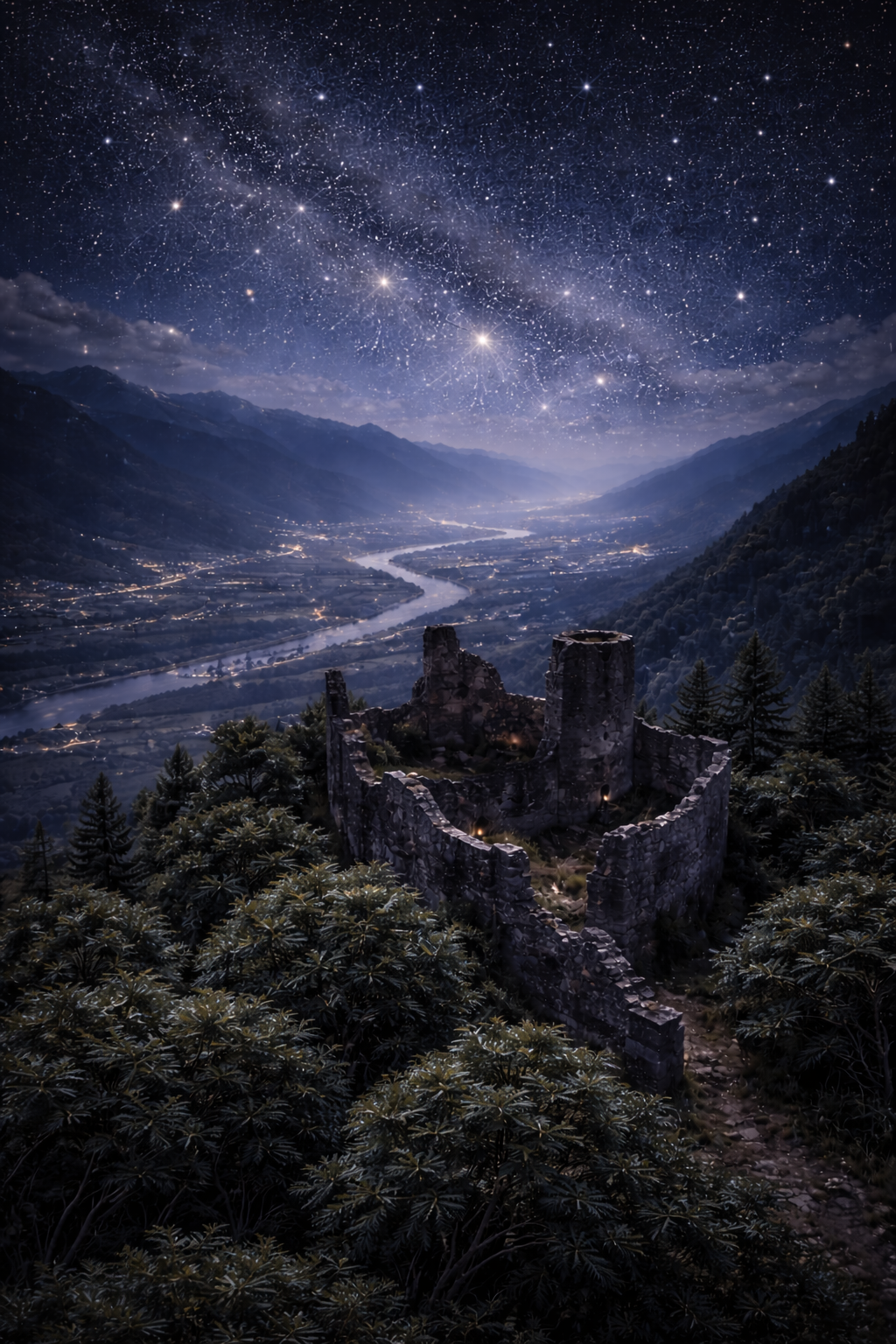
Artistic visualisation by Evgenia Fölsche:
High above the
wide Rhine valley
rises an
ancient castle ruin.
Its walls seem
half sunken
into the landscape,
as though they were
relics
from a
vanished world.
Between them
grow myrtle trees,
their dark leaves
moving in the
night wind.
Above the scene
stretches a clear
starry sky.
The stars glitter
brightly
and cast
a mysterious
light
across the landscape.
The image captures
the atmosphere
of Eichendorff’s poem,
in which nature
seems filled
with invisible powers.
The rustling treetops,
the ancient walls,
and the mysterious night
make the world appear
enchanted
for a moment.
In Schumann’s music, too,
this hovering uncertainty
arises.
The harmony
at first remains
without a firm centre,
as though the landscape
were only slowly
emerging
from the darkness.
Only at the end
does the view open
toward a distant future,
when the stars
with “glowing looks of love”
gaze down
upon the lyrical self,
and distance itself
seems to speak
of a possible
happiness.
Thus the ruin,
the night,
and the wide view
into the valley
become a symbol
of Romantic longing—
an intimation
of something
still unknown,
hidden beyond
the visible world.
Analysis – Poetry
“Schöne Fremde” unfolds a nocturnal vision. Nature appears here not as idyll, but as a space mysteriously permeated. Past, myth, and expectation of the future overlap one another. The “distance” is both uncanny and full of promise.
Stanza 1 – Myth in the landscape
Es rauschen die Wipfel und schauern,
Als machten zu dieser Stund’
Um die halb versunkenen Mauern
Die alten Götter die Rund’.
Nature is animated. The treetops “rustle” and “shudder”— movement and trembling become one.
The “half-sunken walls” suggest ruins, relics of a vanished world. Within them myth seems to stir: “the old gods” make their rounds.
The past is not dead, but ghostlike present. The foreign realm becomes a threshold-space between history and the present.
Stanza 2 – The address to the night
Hier hinter den Myrtenbäumen
In heimlich dämmernder Pracht,
Was sprichst du wirr, wie in Träumen,
Zu mir, phantastische Nacht?
The myrtle—traditionally a symbol of love— frames the scene. Yet the splendour is “secret” and “twilit”: nothing is clearly defined.
The night is directly addressed. It speaks—but “confusedly.” Dream and reality begin to blur.
The foreign realm is not merely an outer place, but a state of heightened perception.
Stanza 3 – The promise of distance
Es funkeln auf mich alle Sterne
Mit glühendem Liebesblick,
Es redet trunken die Ferne
Wie von künftigem, großem Glück!
The scene widens into the cosmic. The stars look down “glowing”— heaven itself seems to take part.
“Distance” speaks, and it speaks “drunkenly”: not soberly, but intoxicated with possibility.
The poem ends openly, in expectation. Happiness lies not in the present, but in a coming future. The foreign realm becomes a projection screen for longing.
Meaning & Effect within the Cycle
“Schöne Fremde” expands Liederkreis with a mythical dimension. Here nature is not merely the mirror of inner states, but itself ensouled and speaking.
The poem connects three temporal levels: the trace of the past (ruins, old gods), the experienced present (night, shudder), and the promised future (“future, great happiness”).
Schumann’s setting intensifies this suspended state. The music makes the rustling, the shuddering, the mysterious excitement audible without tipping into the dramatic.
Thus the “beautiful foreign realm” appears as a Romantic ideal: a place where the self loses itself— and at the same time hopes for a greater happiness.
Evgenia Fölsche – Performances & Audio
Pianist Evgenia Fölsche shapes the number as “luminous stillness”: a slender middle register, elastic pulse, a clear upward opening in the 3rd stanza—postlude with gentle yet definite brightness.
Frequently Asked Questions about “Schöne Fremde” (Liederkreis op. 39, No. 6)
Click on a question to show the answer.
Is the song strophic?
Yes. Three stanzas with subtle variations; the 3rd stanza brings the clear brightening.
How loud and how fast?
Moving, light; basic dynamic mp, radiance in the 3rd stanza, then a fade. Chamber-musical rather than operatic.
What role does the harmony play?
At first hovering and placeless (night-magic), at the end a clear major-mode clarification—the musical image of “future happiness.”
Interpretive tip?
Keep consonants delicate, vowels rounded; change pedal frequently for clarity. In stanza 3, open “stars / distance / happiness” through micro-dynamics—then truly withdraw again.