“Die alten, bösen Lieder” is the final song (No. 16) of Robert Schumann’s cycle Dichterliebe op. 48, after Heinrich Heine. With the large-scale metaphor of the huge coffin carried to the sea by twelve giants, the narrator draws a final line under love and suffering. Schumann’s extended piano postlude transforms this poetic burial into a quiet, transfiguring closing vision.
The Poem (Heinrich Heine)
From: Lyrisches Intermezzo (Buch der Lieder)
The old, evil songs,
The dreams so evil and grim,
Let us now bury them,
Bring me a great coffin.
Into it I shall lay much,
Though I will not yet say what;
The coffin must be still larger
Than the Heidelberg Tun.
And bring a funeral bier
Of boards firm and thick;
It too must be still longer
Than the bridge at Mainz.
And bring me as well twelve giants,
They must be stronger
Than mighty Saint Christopher
In Cologne Cathedral on the Rhine.
They shall carry the coffin away
And sink it down into the sea;
For such a great coffin
Deserves a great grave.
Do you know why the coffin
Must surely be so large and heavy?
I laid into it as well my love
And my sorrow.
Work Data & Overview
- Composer: Robert Schumann (1810–1856)
- Cycle: Dichterliebe op. 48, No. 16 (Finale)
- Text source: Heinrich Heine, Lyrisches Intermezzo (part of the Buch der Lieder)
- Date of composition: May/June 1840 (year of song), revised 1844; first printed edition 1844
- Tonal space / notation: 4 sharps (E major/C-sharp minor area) in the vocal section; extended piano postlude in the D-flat major region (5 flats)
- Tempo markings: Ziemlich langsam (“Fairly slow”) – later Adagio – postlude Andante espressivo
- Duration: approx. 4–5 minutes; the longest song in the cycle
- Scoring: voice (various ranges in published editions) and piano
- Form: through-composed; a large instrumental epilogue closes the cycle
Data on the Poem
- Poet: Heinrich Heine (1797–1856)
- Date of text: 1822/23; published 1827 in Buch der Lieder (Lyrisches Intermezzo)
- Stanza form: 6 stanzas of 4 lines each
- Rhyme scheme: alternating rhyme (ABAB)
- Literary devices: hyperbole, imagery broken by irony, final “revelation” (love/pain) as punchline
Origins & Contexts
Schumann wrote the twenty Heine songs of the original version between 24 May and 1 June 1840 (his “Liederjahr,” marked by the hard-won prospect of marrying Clara Wieck). He described the collection as a “great song-work” and emphasized that he had worked on it “with so much love” (letters from 1840/1843–44). The 16-song printed version of Dichterliebe appeared in 1844 through C. F. Peters.
Heine’s poem belongs to the Lyrisches Intermezzo (1822/23; published 1827). As in the cycle, it also closes the larger arc there: from the tender beginning (“Im wunderschönen Monat Mai”) to the ritual burial of the old songs—that is, of love and pain.
Performance Practice & Reception
Dichterliebe is among the most frequently performed song cycles in the repertoire. An early fully documented complete performance in London was given by Harry Plunket Greene (baritone) and Leonard Borwick (piano) on 11 January 1895. Finale No. 16 is the longest song in the cycle and, with its postlude, forms an autonomous “instrumental closing chorus” – often experienced as the summation of the whole cycle.
Reference Recordings (Selection)
- Dietrich Fischer-Dieskau – Alfred Brendel
- Fritz Wunderlich – Hubert Giesen
- Peter Pears – Benjamin Britten
- Lotte Lehmann – Bruno Walter
- Hermann Prey – Karl Engel
Analysis – Music
Declamation & “Coffin” Gesture
The syllabic vocal writing (in the E major/C-sharp minor area) lies in a speech-like and dignified manner; block-like piano chords act like the supporting beams of the coffin image. Before the punchline (“Wißt ihr, warum …”), Schumann slows down (Adagio) – a pause before the revelation that sharply frames the final statement.
Postlude as Epilogue
In the Andante espressivo, the piano opens a distant D-flat major sphere (5 flats). The broad-arched postlude continues to “speak” while the voice falls silent: it is often interpreted as a poetic retrospective and transfiguration of the cycle; motivic threads point back to earlier songs.
Visual Representation
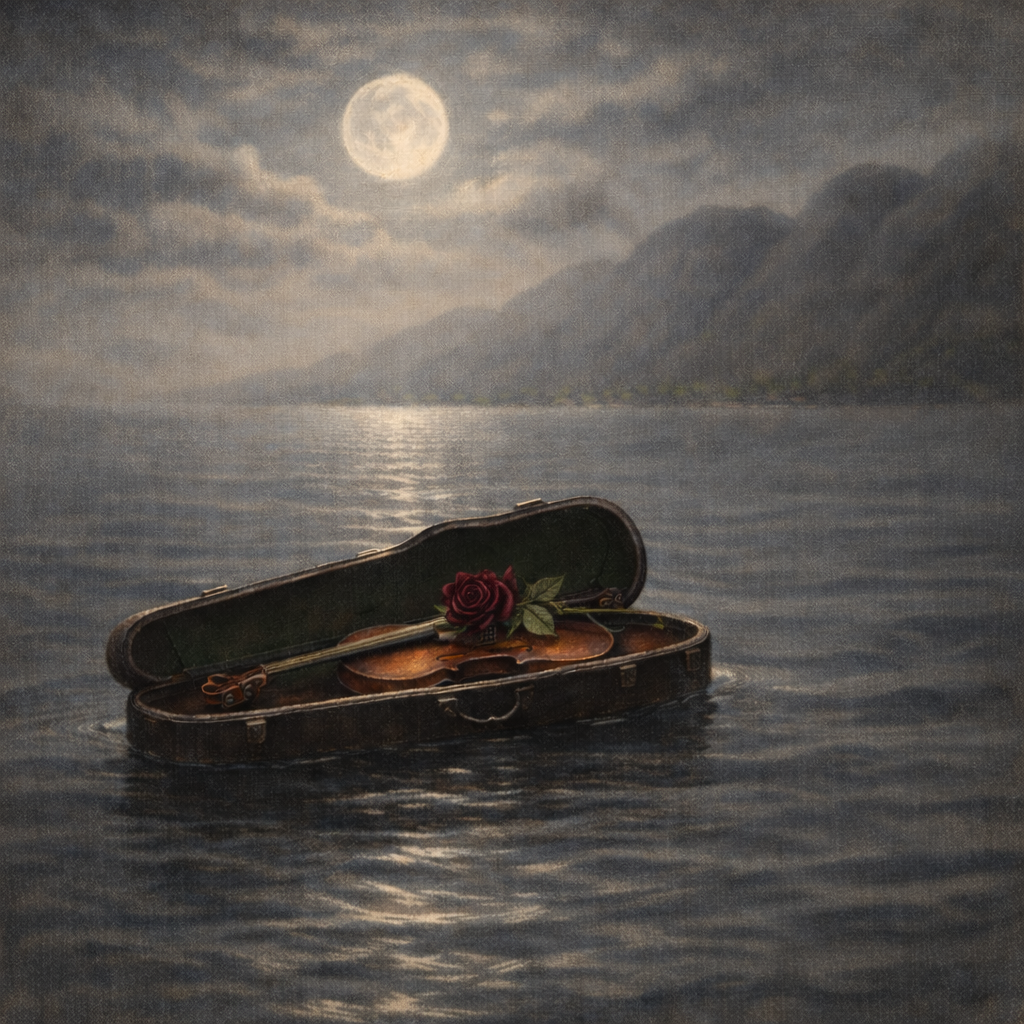
Artistic visualisation:
An open violin case drifts on calm water.
Inside lie a violin and a dark red rose.
In the background, a distant mountain massif
rises against the sky in silvery moonlight.
The image takes up the central idea of the song
“Die alten, bösen Lieder” from the cycle
Dichterliebe by Robert Schumann:
the poet resolves to bury his painful
memories.
In the poem, a gigantic coffin is described,
as large as Cologne Cathedral.
Yet the musical setting leads
not into dramatic heaviness,
but into a wide-ranging,
inwardly turned piano postlude.
The singing voice ends,
but the piano continues to speak.
The violin in the case stands here
in place of the now-silenced voice.
It is not destroyed,
but laid to rest.
The rose points to the love theme
of the entire cycle –
not as pathos,
but as remembrance.
The water replaces the grave.
It bears, it carries away, it creates distance.
Like the long postlude of the song,
the landscape of the image also opens
into a wide, peaceful distance.
Thus farewell is shown not as annihilation,
but as letting go.
The “old, evil songs”
do not disappear violently –
they drift away.
Analysis – Poetry
The old, evil songs,
The dreams so evil and grim,
Let us now bury them,
Bring me a great coffin.
The poem begins with a decisive imperative. The “old, evil songs” and “dreams” are to be buried. Memory appears here not as tender longing, but as something burdensome, almost sinister.
The tone at first seems sober and determined. The lyrical self appears to act actively – a counter-image to the passivity previously endured.
Into it I shall lay much,
Though I will not yet say what;
The coffin must be still larger
Than the Heidelberg Tun.
With the comparison to the “Heidelberg Tun,” a grotesque exaggeration enters. The size of the coffin exceeds every realistic dimension.
The hyperbole has a double effect: it seems ironic and at the same time despairing. What is to be buried is immeasurably large.
And bring a funeral bier
Of boards firm and thick;
It too must be still longer
Than the bridge at Mainz.
And bring me as well twelve giants,
They must be stronger
Than mighty Saint Christopher
In Cologne Cathedral on the Rhine.
The excess keeps intensifying. Bridges, giants, Saint Christopher – everything is summoned to underline the scale of the undertaking.
The imagery becomes almost fairy-tale-like. Yet beneath the exaggeration lies a serious element: the pain is so vast that only gigantic means can contain it.
They shall carry the coffin away
And sink it down into the sea;
For such a great coffin
Deserves a great grave.
The sea appears as the place of final sinking. Water here stands not for reflection or longing, but for erasure.
Do you know why the coffin
Must surely be so large and heavy?
I laid into it as well my love
And my sorrow.
Only in the final lines is it openly stated what had previously only been implied: not only songs and dreams, but love itself is buried.
The final point is simple – and for that very reason shattering. Behind all the grotesque imagery lies an existential truth.
Meaning & Effect in the Cycle
“Die alten, bösen Lieder” forms the conclusion of Dichterliebe. After infatuation, disappointment, defiance, and pain, what follows here is the attempt at a final closure.
The tone is ambivalent. On the one hand, it sounds resolute: the past is to be buried and sunk away. On the other hand, the oversized imagery shows how impossible this task really is.
Love cannot simply be disposed of. Its magnitude demands an equally great grave.
Schumann’s setting intensifies this double meaning. The song begins almost march-like and determined, but in the extended piano postlude the energy dissolves into breadth and resonance.
It is precisely this postlude that seems like the sea itself: what has been buried does not sink without trace – it echoes on. Thus the cycle ends not in triumphant liberation, but in an open, melancholic fading away.
Evgenia Fölsche – Performances & Audio
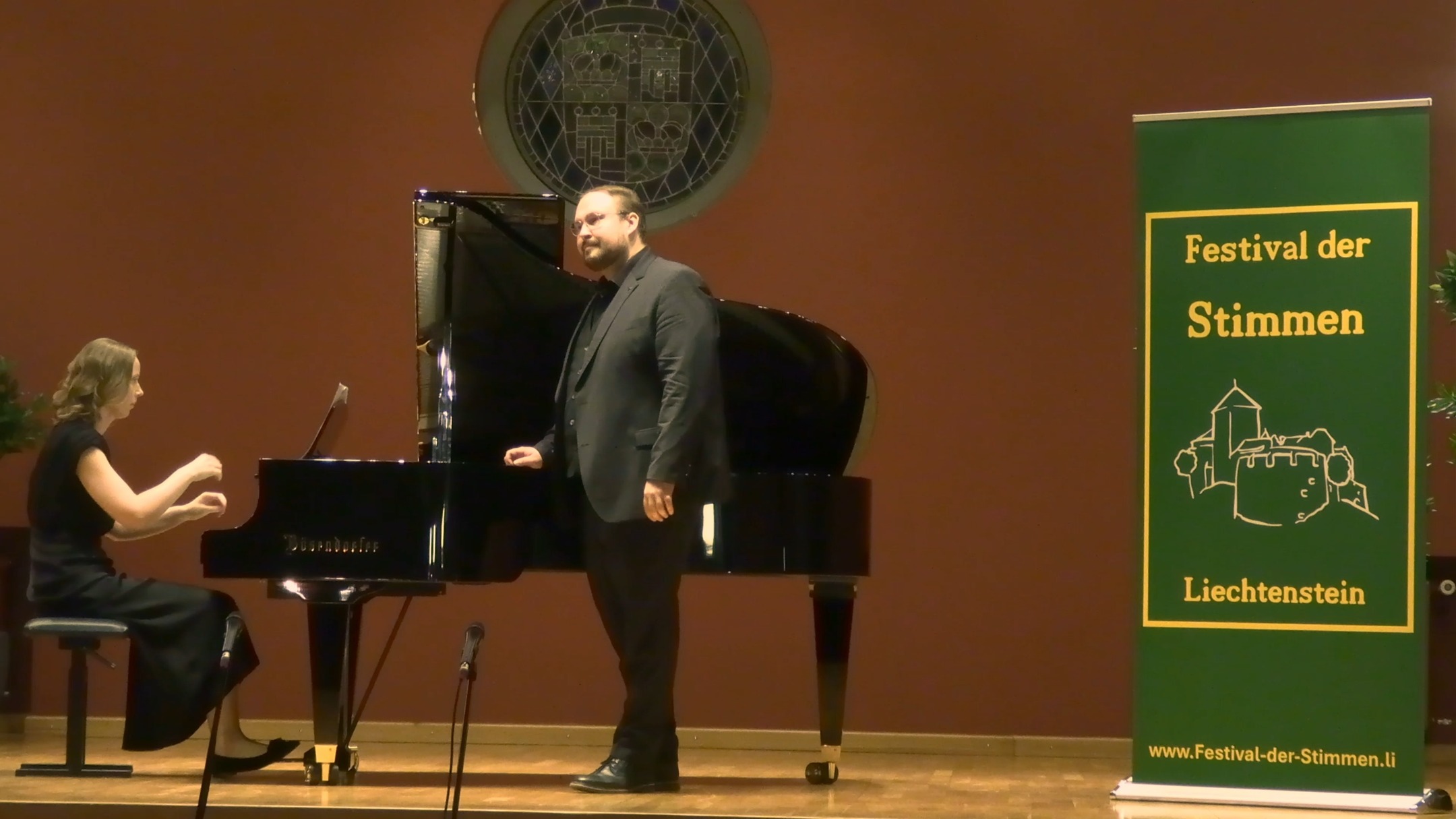
Pianist Evgenia Fölsche has performed “Die alten, bösen Lieder” many times in concert – including in collaboration with singers such as Benjamin Russell – and has recorded it on CD.
Frequently Asked Questions about Schumann: “Die alten, bösen Lieder” (Dichterliebe No. 16)
Click on a question to reveal the answer.
What is “Die alten, bösen Lieder” about?
The narrator wants to bury the “old songs” – symbols of past love and pain – in an enormous coffin. At the end he names what lies inside it: “my love and my sorrow.”
Why is the piano postlude so important?
It functions as the instrumental epilogue of the entire cycle: the voice falls silent, but the piano “continues speaking.” The distant D-flat major sphere creates an atmosphere of transfiguration and retrospection.
Which keys and tempi shape the piece?
The vocal section lies in the E major/C-sharp minor area (Ziemlich langsam, later Adagio), while the postlude moves into a 5-flat sphere (D-flat major region, Andante espressivo).
For which voice types is the song suitable?
There are editions and transpositions for different ranges (high / medium / low). In practice it is performed by tenor, baritone, mezzo-soprano, and others.
Is the song performed often?
Yes. As the finale of Dichterliebe, it belongs to the core repertoire of recital programmes and is regularly performed in concert.