“Am leuchtenden Sommermorgen” is Song No. 12 from Robert Schumann’s cycle Dichterliebe op. 48 after Heinrich Heine. In a quiet garden scene, the flowers speak compassionately to the “sad, pale man” – a moment of tender, painful consolation. Schumann shapes this into a gently breathing miniature: simple cantabile, finely shaded dynamics, and a soft fading away in the postlude.
The Poem (Heinrich Heine)
From: Lyrisches Intermezzo (Buch der Lieder)
On a radiant summer morning
I wander through the garden;
The flowers whisper and speak,
But I walk in silence.
The flowers whisper and speak,
And look at me with pity:
“Do not be angry with our sister,
You sad, pale man.”
Work Data & Overview
- Composer: Robert Schumann (1810–1856)
- Cycle: Dichterliebe op. 48, No. 12
- Text source: Heinrich Heine, Lyrisches Intermezzo (part of the Buch der Lieder)
- Composition: May/June 1840 (Year of Song); first edition 1844
- Tonal space / notation: a bright major/minor shaded tonal sphere (often around A major in editions); calm 2/4 or 4/4 pulse; legato piano writing
- Tempo indications: Calm, intimate; cantabile
- Duration: approx. 1–2 minutes; contemplative miniature
- Scoring: voice (various ranges in published editions) and piano
- Form: two stanzas; short, fading postlude
Data on the Poem
- Poet: Heinrich Heine (1797–1856)
- Origin (text): 1822/23; published in 1827 in the Buch der Lieder (Lyrisches Intermezzo)
- Stanza form: 2 stanzas of 4 lines each
- Rhyme scheme: alternating rhyme (ABAB)
- Stylistic devices: personification (speaking flowers), compassionate address, delicate irony (“our sister”)
Genesis & Contexts
In the Year of Song, 1840, Schumann created a poetically condensed sequence of Heine settings. After the laconic love-ballad of No. 11, No. 12 returns to introverted contemplation: outwardly the bright summer nature, inwardly the quiet suffering.
Heine’s poem stages a soft, consoling juxtaposition: the flowers speak for the beloved – or against her. Schumann answers with gestural restraint and delicate colour transitions.
Performance Practice & Reception
What matters is a calm basic pulse, text-centred declamation, and a sustained p. The second stanza may brighten slightly (the flowers’ gesture of pity), without disturbing the delicate balance of sound.
Reference Recordings (Selection)
- Fritz Wunderlich – Hubert Giesen
- Dietrich Fischer-Dieskau – Gerald Moore
- Ian Bostridge – Julius Drake
- Peter Schreier – András Schiff
- Matthias Goerne – Christoph Eschenbach
Analysis – Music
Sound World & Declamation
Legato accompanying figures in the piano support a soft, syllabic vocal line. Accents are placed sparingly on key words (flüstern, mitleidig), so that the scene seems to appear in half-light.
Strophic Form & Postlude
The return of the opening motif in stanza 2 functions like a close-up: the same words – a different colouring. The short postlude leaves the garden “standing”; the listener remains suspended in the interplay of harmonic light and shadow.
Visual Representation

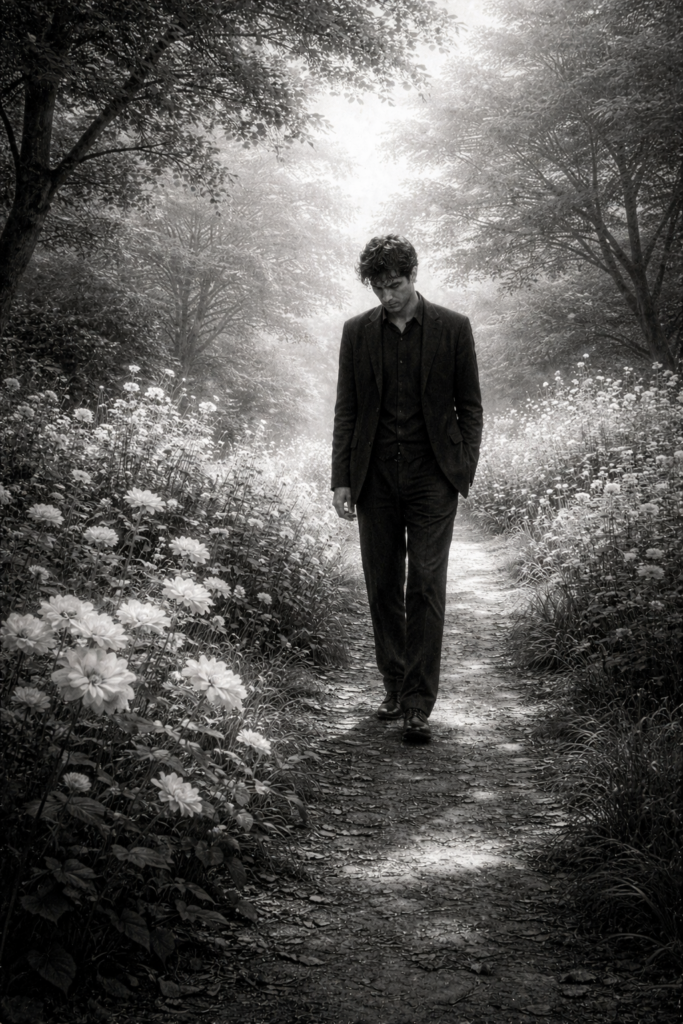
Artistic visualization:
A garden in summer light – yet without colour.
In black and white, a bright,
blooming landscape unfolds. Flowers line the path,
dense and alive, as though engaged
in a whispering conversation.
Among them, a man walks slowly.
His gaze is lowered, his posture
slightly bent forward.
He seems not to belong to the radiant
surroundings, but rather to have been
detached from them. While nature
suggests movement and life,
he remains in silent inwardness.
The decision for black and white
intensifies the poem’s
inner contrast. The “radiant summer morning”
appears without colour –
just as the perception of the “sad, pale man”
loses all outer brightness.
The flowers frame the path almost like
silent witnesses. One feels
they could speak – and yet
the man remains silent. The image
captures this moment of estrangement:
the world is flooded with light,
but the heart remains closed.
Schumann’s music, too, feels
transparent and bright, without
dramatic heaviness. Beneath
the apparent lightness, however,
there lies a quiet melancholy.
Thus the monochrome
representation unites outer brightness
with inner pallor –
a summer morning without colour.
Analysis – Poetry
On a radiant summer morning
I wander through the garden;
The flowers whisper and speak,
But I walk in silence.
The poem opens with a bright, almost idyllic image: “radiant summer morning.” Light, warmth, and natural harmony form the outer frame.
Yet already in the fourth line the contrast emerges: while the flowers “whisper and speak,” the lyrical self remains silent. Outer world and inner world fall apart.
The flowers whisper and speak,
And look at me with pity:
“Do not be angry with our sister,
You sad, pale man.”
In the second stanza, the personification intensifies. The flowers are given both voice and gaze. They appear not merely as natural phenomena, but as beings capable of sympathy.
Particularly remarkable is the designation of the beloved as “our sister.” Nature becomes a community from which the poet is excluded. He no longer stands opposite it, but outside it.
The flowers’ words are gentle, not accusatory. Yet precisely this gentleness intensifies the loneliness of the self. He remains the “sad, pale man” — visibly marked by pain.
The poem works with simple language and a calm tone. No dramatic images, no escalation – only quiet estrangement.
Meaning & Effect within the Cycle
Within Dichterliebe, this song marks a phase of quiet resignation. The pain is no longer eruptive, but inwardly absorbed.
Nature, which had previously served as mirror or projection surface, now appears as an independent voice. Yet it brings no consolation, only a gentle admonition.
The poet is observed from without – almost like a figure in a painting. His pallor makes the inner condition visible.
Schumann’s setting underscores this restraint. The music is transparent, flooded with light, almost weightless. Yet beneath the brightness lies a melancholy calm.
Thus a subtle tension arises: the world is summery and radiant – yet the heart remains closed. The song shows no dramatic conflict, but a quiet, unavoidable estrangement.
Evgenia Fölsche – Performances & Audio
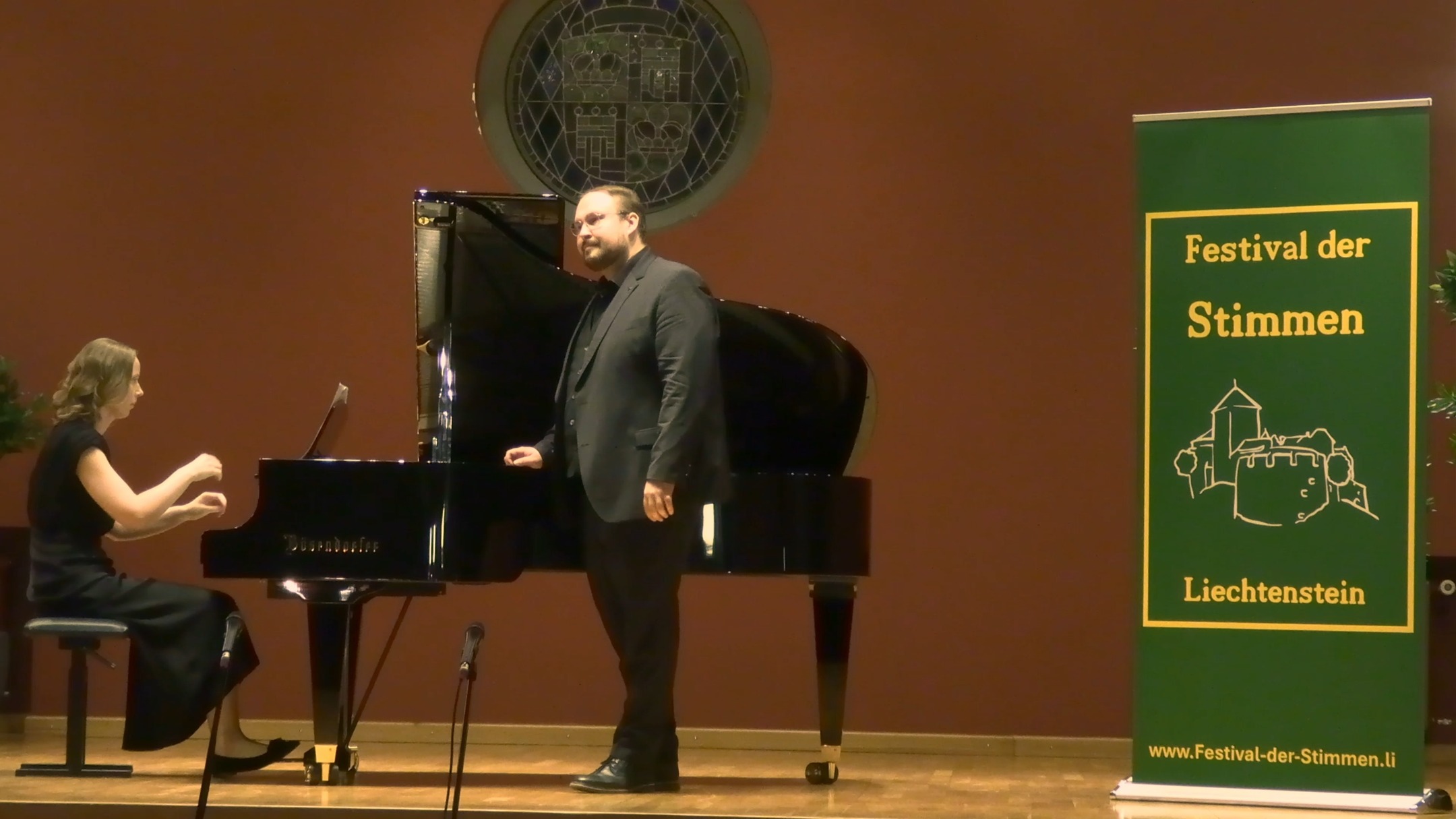
Pianist Evgenia Fölsche interprets “Am leuchtenden Sommermorgen” as a point of repose in the middle section of Dichterliebe – with a breathing line and finely graded dynamics.
Frequently Asked Questions about Schumann: “Am leuchtenden Sommermorgen” (Dichterliebe No. 12)
Click on a question to reveal the answer.
What is the song about?
A quiet garden scene: the flowers speak compassionately to the lyrical self and plead for leniency toward their “sister” – the beloved.
How does Schumann’s setting sound?
Calm, intimate cantabile with legato piano writing, narrow dynamic range, and a brief, fading closing gesture.
Is the song strophic?
Yes, two stanzas with subtle colouring in stanza 2; brief postlude.
Which voice types are common?
Editions/transpositions exist for different ranges; often soprano/mezzo-soprano as well as tenor/baritone.
Interpretive tip?
Imagine a cultivated piano tone, keep the text in focus, use rubato sparingly; the consolation lives through restraint, not through pathos.